
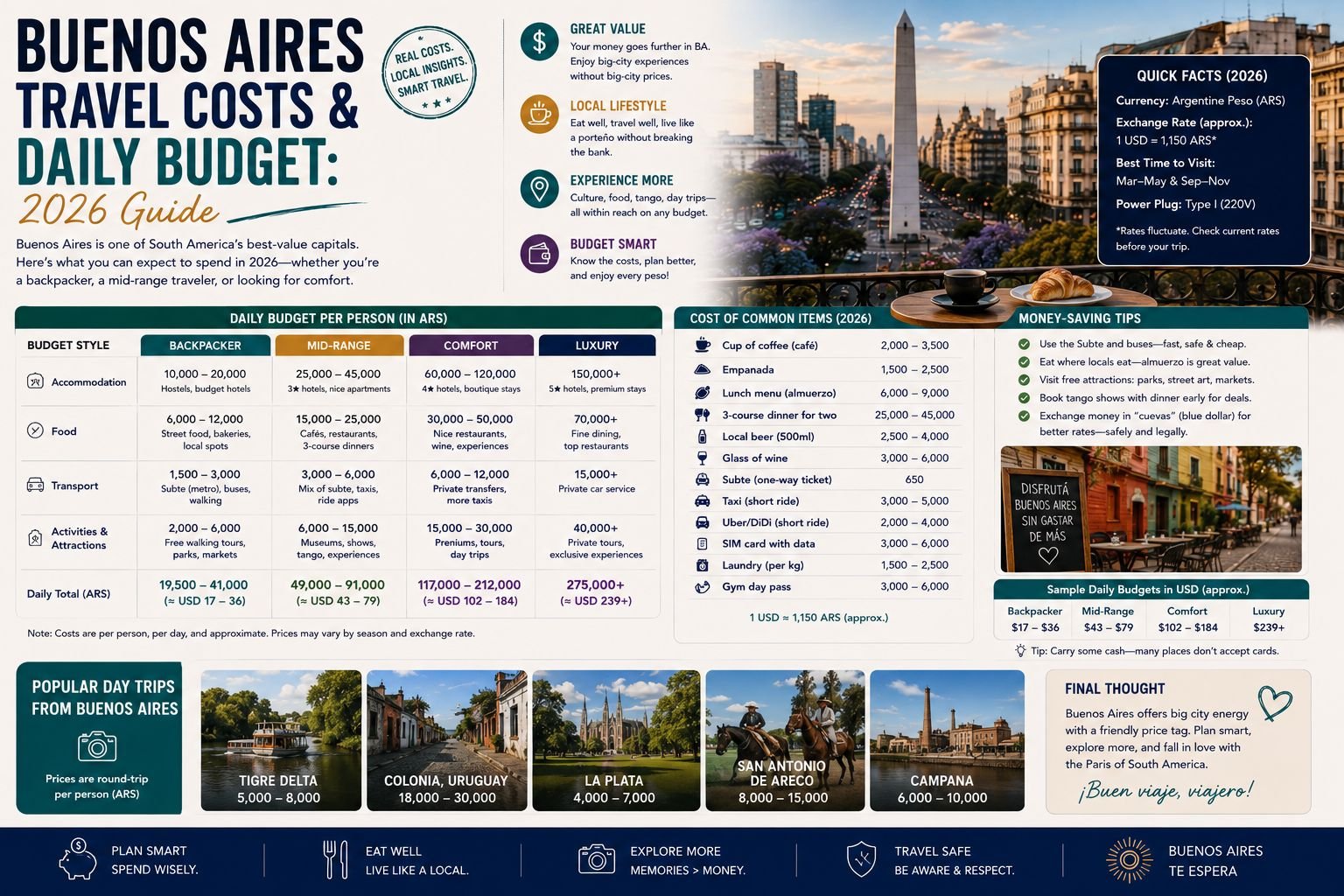
Buenos Aires is one of the most affordable major cities in the world for visitors from Western countries, but the cost savings are not distributed evenly and depend significantly on understanding the currency situation. A visitor who does not understand how the exchange rate works in practice will spend significantly more than one who does. This guide covers both the currency mechanics and the practical cost benchmarks for a Buenos Aires trip.
The Exchange Rate Situation: What You Need to Know
Argentina has experienced significant currency volatility and inflation over recent years, which has created a dual exchange rate system. Understanding this is the single most important financial preparation for a Buenos Aires visit.
The official rate: The rate you would receive if you exchanged money at a bank using a foreign bank card or a standard currency exchange. This rate is substantially lower than what is available through other legitimate channels.
The tourist card rate (tarjeta turista) / MEP dollar rate: Legal exchange mechanisms that provide a rate significantly better than the official rate, typically 50 to 100 percent better or more depending on the current economic conditions. These mechanisms are legitimate and legal; they reflect Argentina’s complex monetary policy rather than any black market activity.
The blue dollar (dólar blue): An informal parallel exchange rate that exists in the grey market. This guide does not recommend using it. The legal tourist rate alternatives have closed much of the gap that previously made the blue dollar financially significant, while the risks (counterfeit notes, scam operations, legal risk) remain real.
The practical implication: A visitor who pays for everything by credit card at the official rate will spend roughly 40 to 70 percent more (depending on current conditions) than a visitor who accesses the tourist rate. Given how affordable Buenos Aires already is, this can mean the difference between a budget trip and a very cheap one, or between a mid-range trip and a genuinely comfortable one.
How to access the tourist rate: The most reliable methods are using the “tarjeta turista” rate when paying by card at participating businesses (where the business receives payment in pesos at the better rate); using specific exchange services and apps (Saldo, etc.) that process the exchange at the better legal rate; or carrying foreign cash (USD or EUR in good condition) to exchange at a legitimate casa de cambio that offers the mejor rate.
Daily Budget Benchmarks
These benchmarks assume you are accessing the tourist/MEP rate for your spending rather than the official bank rate. All figures are approximate and will shift with the exchange rate conditions at the time of your visit.
Budget traveller (USD 40 to 70 per day)
Staying in a hostel dorm or budget guesthouse, eating at local restaurants and paradores, using public transport, and focusing on free attractions and the city’s free cultural life (parks, markets, street tango). This budget includes occasional drinks and one or two activities per week but not nightly restaurant dinners or tango shows.
Mid-range traveller (USD 80 to 150 per day)
A private room in a mid-range hotel or apartment rental, eating at good neighbourhood restaurants, occasional taxis or Uber, some paid attractions and a tango show during the trip. This covers a comfortable Buenos Aires experience without extravagance.
Comfortable travel (USD 150 to 250 per day)
A boutique hotel or well-located apartment, good restaurants every evening, activities and tours, taxis as primary transport, and no significant compromises on comfort or experience. This covers the Buenos Aires experience most Western visitors with reasonable travel budgets would expect.
Luxury (USD 250+ per day)
Five-star hotels (Alvear, Palacio Duhau, Four Seasons), the city’s best restaurants, private guides and premium experiences. Buenos Aires has genuine luxury infrastructure at prices that are still very competitive with European or North American equivalents.
Key Cost Items
Accommodation
Budget hostels: USD 15 to 30 per night for a dorm bed; USD 40 to 70 for a private room
Mid-range hotels: USD 60 to 120 per night
Boutique and design hotels: USD 100 to 200 per night
Luxury hotels: USD 200 to 500+ per night
Furnished apartments (monthly): USD 600 to 1,500 per month depending on neighbourhood and quality
Food
Medialunas (croissants) and coffee at a café: USD 2 to 5
Lunch menú at a local restaurant (2 to 3 courses): USD 8 to 15
Dinner at a neighbourhood restaurant per person: USD 15 to 35
Dinner at a good parrilla per person with wine: USD 25 to 50
Tasting menu at a top restaurant: USD 60 to 120 per person
Street food and market food: USD 2 to 8
Transport
Subte (metro) single journey: under USD 1
Colectivo (bus) single journey: under USD 1
Taxi (in-city): USD 3 to 10 depending on distance
Uber/Cabify (similar range to taxis)
Ferry to Colonia del Sacramento: USD 40 to 80 return depending on service
Ezeiza airport transfer by remis: USD 25 to 40
Activities and Attractions
Tango show (mid-range, with dinner): USD 80 to 150 per person
Tango show (budget, without dinner): USD 30 to 60 per person
Milonga entry: USD 5 to 20
Recoleta Cemetery: Free
Most city museums: Free or USD 2 to 10
MALBA (Museum of Latin American Art): USD 8 to 15
Day trip to Colonia del Sacramento: USD 80 to 150 (ferry return, full day)
Guided city tour: USD 20 to 50 per person
What Makes Buenos Aires Unusually Affordable
The affordability of Buenos Aires for Western visitors is real and significant. It is particularly pronounced in:
Restaurants: The price-to-quality ratio at Buenos Aires’ better restaurants is extraordinary by any European or North American benchmark. A dinner that would cost 80 euros in a Paris equivalent costs 20 to 35 dollars here.
Accommodation: The city has a very large stock of well-located boutique and mid-range accommodation that is cheap by any Western capital standard.
Culture: Many of the city’s museums are free or very cheap, the tango cultural life includes affordable milongas alongside expensive shows, and street and neighbourhood culture (markets, parks, street performance) is essentially free.
Related: Plan Your Trip | Practical Info | Money Guide | Neighborhoods
What Has Changed in the Buenos Aires Cost Picture
Buenos Aires costs for international visitors have changed significantly in recent years, and not in a uniform direction. Understanding the current landscape requires acknowledging that the situation is dynamic:
The exchange rate advantage that makes Buenos Aires cheap for those earning in foreign currencies is real and significant, but its magnitude fluctuates with Argentine monetary policy and economic conditions. At some points in the past five years, the gap between official and tourist rates has been very large; at others, it has been much smaller. The [money guide](/practical-info/money/) provides the current position; this is worth checking in the months before travel rather than relying on information from years ago.
What has remained stable: the underlying price level of Argentine goods and services is low relative to Western equivalents at any reasonable exchange rate. Even in scenarios where the tourist rate premium has been small, Buenos Aires has remained significantly cheaper than comparable European or North American cities for accommodation, food, and cultural activities.
Tips for Reducing Costs Without Reducing Quality
The Buenos Aires food culture is structured in ways that allow significant cost reduction without quality reduction:
Lunch over dinner: Many Buenos Aires restaurants, including very good ones, offer a fixed-price lunch menu (menú del mediodía) at significantly below their dinner prices. A three-course lunch at a well-regarded Palermo restaurant for USD 12 to 20 per person is the standard offer; the same restaurant for dinner costs USD 30 to 60 per person for comparable food. Structuring the bigger eating day around lunch and a lighter dinner (empanadas, wine, charcuterie at home) produces significant savings without compromising the restaurant experience.
Neighbourhood restaurants over tourist-area restaurants: The restaurants on the main tourist streets of San Telmo and the immediate Caminito vicinity charge tourist prices. Walking two or three blocks to a street without tourist foot traffic produces the same or better food at 20 to 40 percent lower prices.
The house wine: The vino de la casa at a Buenos Aires neighbourhood restaurant is almost always a drinkable and sometimes very good Malbec or blend, served in a jug, at very low cost. Ordering the house wine rather than a bottle from the list is the correct choice for casual restaurant meals.
Buenos Aires costs, at the tourist exchange rate, represent extraordinary value by global standards. This is not a marginal advantage; it is a fundamental difference that makes possible a quality of travel experience that would be significantly more expensive in any Western European or North American equivalent city. Understanding and accessing the best legitimate rate before arrival, and managing money accordingly throughout the stay, is the single financial decision with the most consistent positive impact on a Buenos Aires trip.