
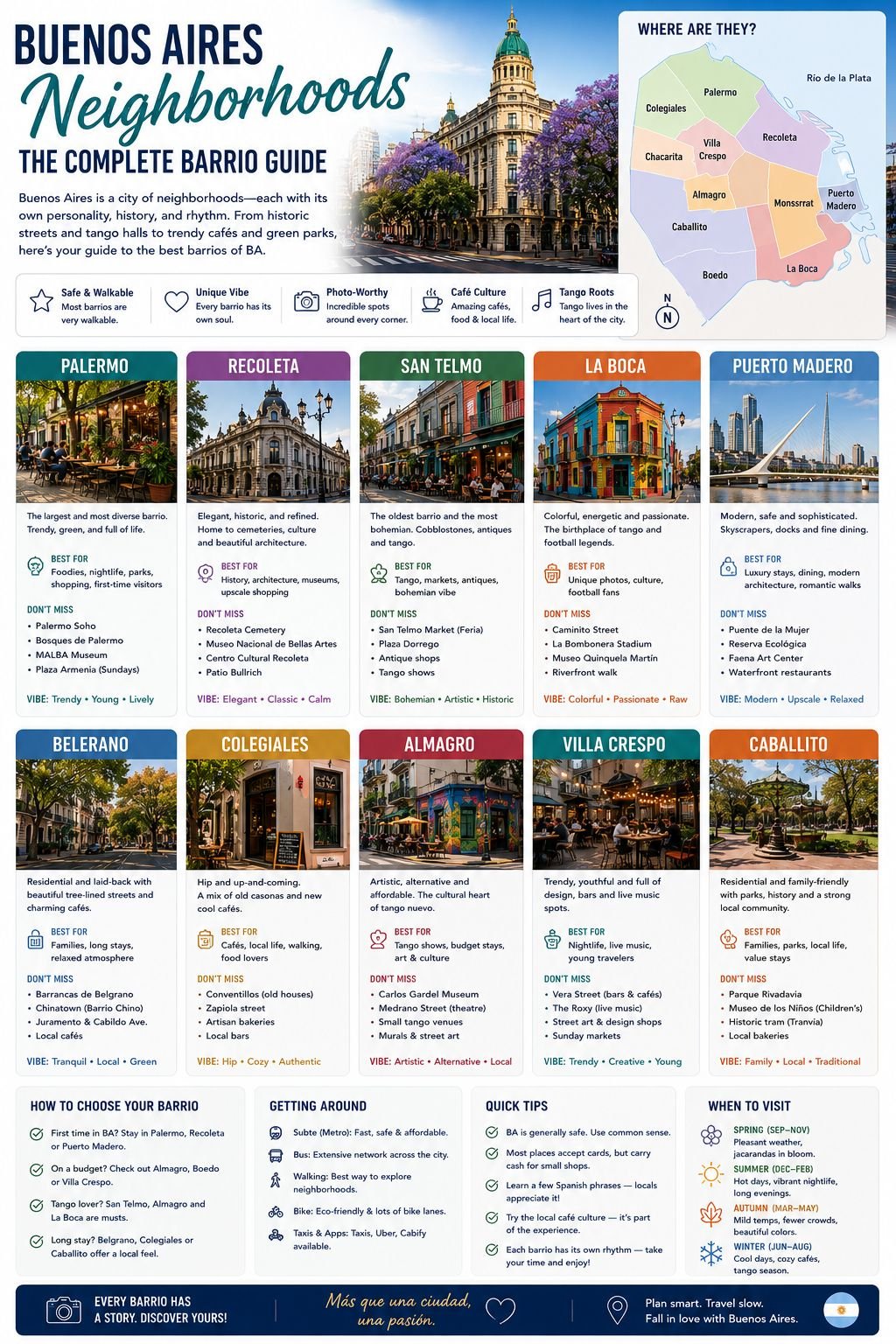
Buenos Aires is a city of barrios. The 48 officially recognised neighbourhoods, each with its own distinct character, history, and social composition, are the primary unit of local identity in a way that the city as a whole never quite is. Ask a Porteño where they live and they will tell you the barrio, not the city. The barrio is the village within the metropolis.
For visitors, understanding the barrios is the most important piece of local knowledge. Where you stay determines what you walk to, what you overhear, what kind of morning coffee you have. The famous sights are worth visiting from any base, but the character of your visit is shaped by your neighbourhood.
This hub covers the main barrios that visitors spend time in, with detail on what makes each distinctive and who it suits.
The Barrios at a Glance
Northern Barrios
Palermo is the city’s largest neighbourhood and its most popular base for visitors. It encompasses several sub-neighbourhoods: Palermo Soho (boutiques, restaurants, independent cafés), Palermo Hollywood (named for the TV production companies that moved here, now a restaurant and nightlife hub), and Las Cañitas (smaller, residential, good restaurants). Palermo has the widest range of good eating and drinking in the city, good transport connections, and large green spaces in the Palermo Parks.
Belgrano is a residential neighbourhood north of Palermo with a distinct character: solid, comfortable, slightly conservative by Buenos Aires standards, and home to the city’s Chinatown (Barrio Chino, along Calle Arribeños). It has good restaurants and cafés but is less visited by tourists than the more central barrios.
Central Barrios
Recoleta is the most elegant neighbourhood in Buenos Aires, with French-style mansions, wide tree-lined boulevards, and the city’s best luxury hotels and traditional restaurants. The famous cemetery is here, as is the Floralis Genérica sculpture and easy access to MALBA. It has a formal, slightly hushed character compared to the more exuberant energy of Palermo.
Retiro is the neighbourhood around the main train station and one of the city’s main transport hubs. Plaza San Martín, one of the finest public squares in the city, is in Retiro; the neighbourhood has a mix of grand historic buildings and the more chaotic transit infrastructure of a major hub. The Retiro bus terminal, the primary long-distance bus hub for all of Argentina, is here.
Microcentro (Centro) is the business and commercial heart of the city: dense, busy during the week, quieter on weekends. The historic centre, including Plaza de Mayo and the main commercial streets (Florida, Corrientes), is technically the Centro. It is central but lacks the residential character that makes other barrios pleasant to base in.
Puerto Madero is the city’s most modern neighbourhood: upscale waterfront restaurants and apartments in the converted old port warehouses, with the Puente de la Mujer as its signature landmark. It is the most expensive neighbourhood to eat and stay in and has a corporate character that differs from the rest of the city.
Southern Barrios
San Telmo is the oldest and most atmospheric neighbourhood in Buenos Aires: cobblestone streets, colonial and early-19th-century buildings, a strong tango culture, the famous Sunday market at Plaza Dorrego, and a mix of antique dealers, craft breweries, and traditional parrillas. It has a more authentic and slightly rougher character than the polished northern barrios.
La Boca is the most photographed neighbourhood in Buenos Aires for its brightly coloured Caminito street and its association with the Boca Juniors football club. It is a tourist area within a larger, genuinely working-class neighbourhood; visitors should stay within the small tourist precinct rather than wandering into the surrounding streets.
Choosing Where to Stay
The neighbourhoods best for first-time visitors are Palermo (for its range of options, food, and green spaces), San Telmo (for character and atmosphere), and Recoleta (for elegance and easy access to the northern attractions). Each suits a different travel style.
Palermo suits: visitors who want the widest range of restaurants and nightlife, families, those who want green space, and those who want a more residential feel.
San Telmo suits: visitors who want history and atmosphere, those interested in tango culture, and travellers who want a neighbourhood with genuine grit alongside its attractions.
Recoleta suits: visitors who want elegance, those staying at the luxury hotel end of the market, and travellers who want quick access to the northern cultural institutions.

Individual Barrio Guides
- Palermo — the city’s most popular visitor neighbourhood
- San Telmo — historic, atmospheric, tango-rich
- Recoleta — elegant, grand, home of the famous cemetery
- La Boca — colourful, football-famous, strictly tourist-zone
- Puerto Madero — modern waterfront, upscale dining
- Retiro — grand squares, transport hub, mixed character
- Belgrano — residential, Chinatown, good food
- Best neighborhoods to stay — the full accommodation guide
Related: Things to Do | Food and Drink | Accommodation | Practical Info
Neighbourhoods Beyond the Tourist Circuit
The six barrios described in detail above cover the areas that most visitors spend their time in. Buenos Aires has 48 officially recognised neighbourhoods, however, and several beyond the tourist circuit reward exploration:
Villa Crespo sits immediately north of the Palermo/Soho area and has become the neighbourhood that food writers have been paying attention to for the past five years. The streets around Corrientes and Aguirre have accumulated a cluster of excellent independent restaurants, wine bars, and coffee shops that serve the neighbourhood’s young, creative population rather than tourists. Lower rents than Palermo have attracted exactly the kind of operators who produce genuinely interesting food at reasonable prices.
Chacarita is north of Villa Crespo, home to the city’s largest cemetery (the Cementerio de Chacarita, where Carlos Gardel, the most celebrated tango singer in history, is buried alongside many other Argentine cultural figures) and an emerging food and wine scene along Avenida Corrientes and the streets around the cemetery.
Boedo is the neighbourhood that Buenos Aires literature made famous; the Boedo poets and the Boedo literary movement of the early 20th century gave the neighbourhood a cultural identity that it maintains through bookshops, cultural centres, and the slightly melancholy poetry of a working-class barrio that knows its own history. The weekend market on Calle San Juan has local character.
Colegiales occupies the triangle between Palermo, Belgrano, and Chacarita and has a neighbourhood character that is genuinely local: good cafés, an active street market on weekends, and residential streets that have not been significantly altered by the tourist economy.
The Internal Geography of Buenos Aires
One practical note for navigating the city: Buenos Aires is built on a near-perfect grid, with the major avenidas running at regular intervals and the street numbering system following a logical incremental pattern as you move away from the zero point (the obelisco on Avenida 9 de Julio). Understanding this logic makes orientation significantly easier: odd numbers are typically on one side of the street, even on the other; and the hundred blocks correspond to 100-metre increments from the grid origin. This is not the only city on a grid, but Buenos Aires’ grid is unusually consistent and unusually large.
Buenos Aires’ neighbourhood structure is one of the features that makes extended time here so rewarding. Each barrio has a character specific enough to provide a genuinely different experience of the city; the transition from Palermo to Villa Crespo to Chacarita, covering perhaps two kilometres, passes through three genuinely distinct urban personalities. This variety, maintained despite the city’s enormous scale, is what makes Buenos Aires so inexhaustible as a place to explore.
A Final Note
Buenos Aires rewards visitors who arrive prepared and remain open. The practical preparation covered in this guide removes the friction that prevents engagement; the openness is yours to bring. The city that reveals itself to a visitor who knows what they are looking for, who has sorted the practical foundations, and who has the curiosity to follow what the city offers is one of the genuinely great urban experiences available anywhere in the world.
For questions, corrections, or feedback on this guide, the contact page is the right place. This site is updated regularly; if you visit Buenos Aires and find that conditions have changed from what this guide describes, telling us makes the guide better for the next reader.
Buenos Aires’ barrio structure is part of what makes the city so rewarding for extended time. Each neighbourhood has enough character to provide a genuinely different experience of the city; the proximity of different neighbourhoods to each other (most of the main tourist barrios are within 5 kilometres of each other) means that variety is easy to access without long journeys. The city rewards neighbourhood-level exploration as much as it rewards visiting the famous sights.