
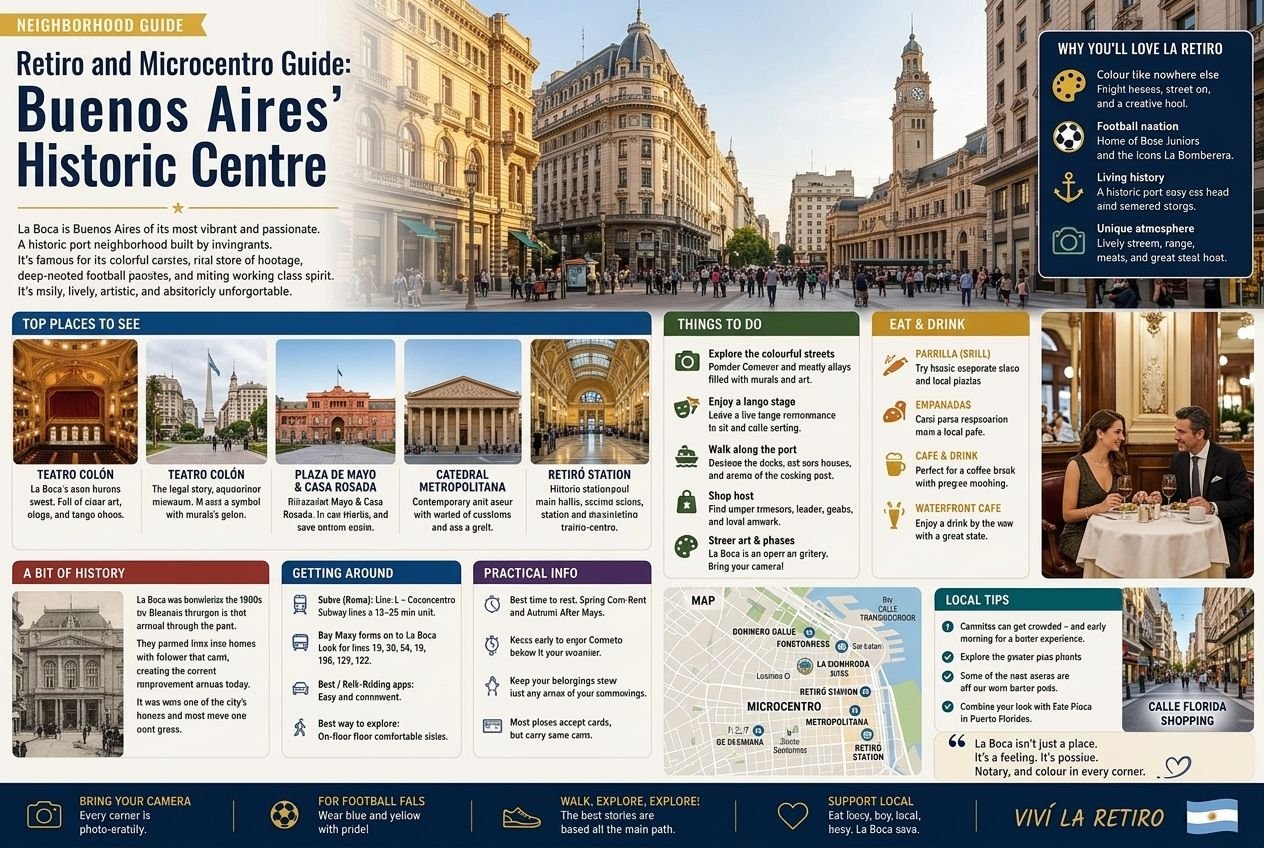
Retiro and the Microcentro form the historic and commercial heart of Buenos Aires, the area that has been the city’s centre since the colonial period. It is where you will find the most imposing public buildings, the widest avenues, the main transport hubs, and the highest density of grand 19th and early 20th-century architecture. It is not the most charming neighbourhood for a leisurely day, but understanding this area gives you the essential foundation for understanding Buenos Aires as a city rather than just as a series of pleasant neighbourhoods.
Plaza San Martín and Retiro
Plaza San Martín is one of the finest public squares in Buenos Aires: a sloping park with enormous trees, surrounded by a remarkable concentration of early 20th-century architecture. The Palacio Paz, an extraordinary beaux-arts mansion built in 1914 for the Paz family (one of the wealthiest in Argentina), now houses the Círculo Militar and can be visited on guided tours. The Torre Monumental (formerly Torre de los Ingleses, the tower of the English), a Victorian clock tower given by the British community to Buenos Aires in 1910, stands at one edge of the square.
The Retiro bus terminal is at the northern end of the square: a chaotic but functional hub handling all long-distance buses from Buenos Aires. Adjacent to it, the Estación Retiro is a series of three rail stations (Mitre, Belgrano, and San Martín lines) handling suburban rail services north and west of the city.
The Microcentro: Buenos Aires’ Commercial Heart
The Microcentro is the dense commercial and financial district that forms the physical centre of Buenos Aires. Its defining characteristics:
Avenida Florida: The main pedestrian shopping street, stretching from Avenida de Mayo to Plaza San Martín, is one of the busiest streets in South America on weekdays. It is loud, commercial, crowded, and quintessentially urban Buenos Aires. The Galería Güemes, accessed from Florida, is an extraordinary shopping arcade from 1915 with a glass dome and ornate decoration; the Paris Tango, in the basement, hosts milongas several evenings per week.
Avenida Corrientes: Known as Buenos Aires’ Broadway, Corrientes runs west from the Microcentro through the theatre district, passing bookshops, theatres, and the cultural institutions that make it one of the most intellectually alive streets in the city. Corrientes never closes; the bookshops, cinemas, and cafés on this street operate into the early hours.
Avenida de Mayo: The broad ceremonial avenue connecting Plaza de Mayo with the Congreso Nacional, lined with the most impressive selection of early 20th-century buildings in the city. The Hotel Castelar, the Café Tortoni (the most famous traditional café in Buenos Aires, operating since 1858), and the extraordinary Palacio Barolo (a building designed according to the architecture of Dante’s Divine Comedy, with the Inferno in the basement and Paradise accessible by lift) are all on Avenida de Mayo.
Plaza de Mayo and the Historic Centre
Plaza de Mayo is the political and historical centre of Argentina. The Casa Rosada (the pink Government House, where the president’s offices are) faces the square on the east. The Cabildo (the colonial town hall, one of the few surviving colonial buildings in the city, now a museum) is on the west. The Metropolitan Cathedral, where the Liberator General San Martín is interred, faces the north.
The Madres de Plaza de Mayo have marched around the central obelisk every Thursday since 1977, making this one of the most historically charged public spaces in the world. The circular white headscarves painted on the paving around the obelisk commemorate the disappeared. Understanding what this square represents to Argentina, and why the Madres have continued their march for nearly 50 years, is essential context for understanding contemporary Buenos Aires.
Getting Around Retiro and the Microcentro
The Microcentro is served by multiple Subte lines. Lines A, B, C, and D all pass through the area, making it the most connected point in the Buenos Aires metro system. The Subte stations at Plaza de Mayo (Lines A and D) and 9 de Julio (Lines C and D) are the most central.
The area is entirely walkable and should be explored on foot; the traffic and density make driving through the Microcentro impractical.
Eating in Retiro and the Microcentro
The Microcentro is primarily a business lunch destination rather than an evening dining destination. The best eating is at the traditional cafés along Avenida de Mayo and Corrientes, and at the worker’s restaurants in the streets off Florida that offer fixed-price midday menus.
Café Tortoni: The most historic café in Buenos Aires, on Avenida de Mayo. The food is secondary; the atmosphere and the Art Nouveau interiors are the point. Coffee and a pastry here is one of the essential Buenos Aires experiences.
Gran Café: Opposite the Obelisco, open 24 hours, the Gran Café is the kind of Buenos Aires institution that has been serving coffee to taxi drivers, journalists, and insomniacs since before the Obelisco was built.
Related: San Telmo | Puerto Madero | Neighborhoods Hub | Getting Around
The Retiro Villa and Its Context
A note that the Retiro area includes, immediately adjacent to the exclusive apartment towers of the Retiro neighbourhood, the Villa 31, one of Buenos Aires’ most significant informal settlements (villas miserias, the equivalent of favelas). The Villa 31, visible from the Retiro bus terminal and from the tracks approaching Retiro station, is home to over 40,000 people and represents the direct social geography of a city with extreme inequality.
This is relevant for visitors not as a tourist attraction (visiting the villa is not something to do casually or without local connection) but as context for understanding what Buenos Aires actually is. The visual proximity of the luxury apartment towers of Retiro and the zinc-roofed structures of Villa 31 is one of the most direct images of Argentine inequality and is visible from the train window before you have left the station.
Walking the Microcentro: A Detailed Circuit
For visitors who want to understand Buenos Aires’ urban history through its architecture, the Microcentro circuit is the most concentrated experience available. Start at Plaza de Mayo in the early morning; walk along Avenida de Mayo to the Congreso (20 minutes, extraordinary architecture the entire way); return along Rivadavia or Corrientes (the theatre and bookshop street); visit the Galería Güemes on Florida; and conclude at Plaza San Martín in Retiro. This route takes 2 to 3 hours with stops and covers the most significant examples of every architectural period in Buenos Aires’ history from the colonial to the modernist.
The fact that this walk is free, passes through active city life rather than museum environments, and requires no booking or planning makes it one of the best value urban experiences in South America.
Retiro and the Microcentro form the historical and logistical spine of Buenos Aires: the area where the city’s major transport connections, its most significant public buildings, and its historic commercial life are concentrated. Understanding this area is understanding Buenos Aires as a functioning city rather than as a collection of appealing neighbourhoods. The free architectural walking route through this area is one of the best single things you can do in the city.
A Final Note
Buenos Aires rewards visitors who arrive prepared and remain open. The practical preparation covered in this guide removes the friction that prevents engagement; the openness is yours to bring. The city that reveals itself to a visitor who knows what they are looking for, who has sorted the practical foundations, and who has the curiosity to follow what the city offers is one of the genuinely great urban experiences available anywhere in the world.
For questions, corrections, or feedback on this guide, the contact page is the right place. This site is updated regularly; if you visit Buenos Aires and find that conditions have changed from what this guide describes, telling us makes the guide better for the next reader.
Retiro and the Microcentro form the logistical and historical core of Buenos Aires that every visitor eventually passes through and that deserves more than transit time. The free architectural walking route through this area, the Café Tortoni on Avenida de Mayo, the Plaza San Martín and its surrounding buildings, and the historical context that these spaces provide for understanding contemporary Buenos Aires all reward the investment of a specific half-day of deliberate exploration.
Buenos Aires rewards the traveller who arrives prepared and remains curious. Every guide in this site is designed to remove the friction between arrival and genuine engagement with the city; the engagement itself is yours to pursue. The city is inexhaustible, genuinely warm, and consistently surprising even to those who have been here many times. Whatever brings you to Buenos Aires, whether a first visit, an extended stay, or the beginning of a longer Argentine chapter, the preparation this guide provides is the starting point. What comes next is the city’s contribution.