
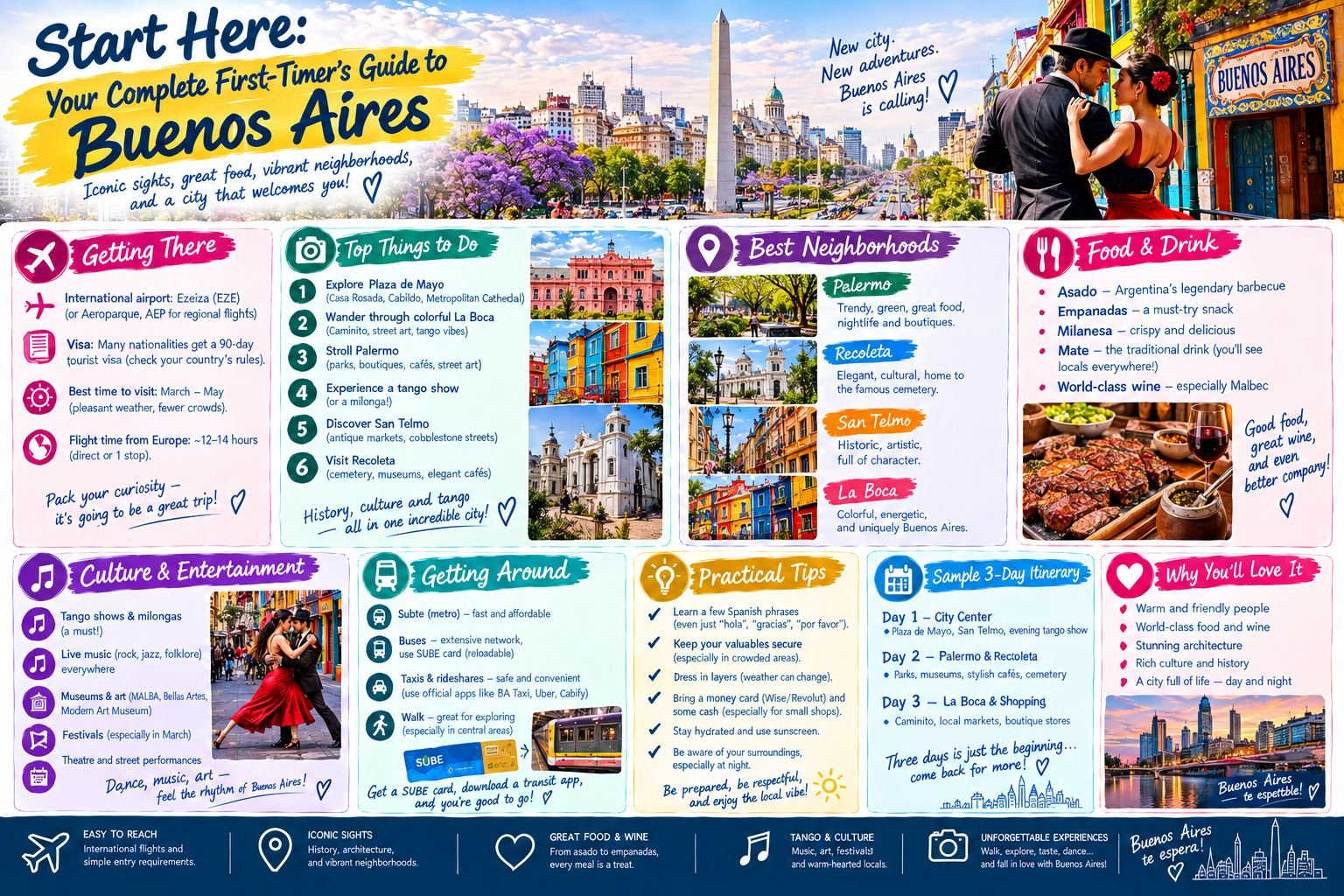
Buenos Aires is one of those cities that gets under your skin immediately. The wide boulevards, the smell of grilling meat drifting out of neighbourhood restaurants, the sound of tango from an open doorway at midnight, the Porteños who will talk to you for an hour about football or politics or the price of empanadas: everything about this city is turned up slightly louder than you expect. Planning a visit here well makes the difference between a good trip and one you will be recounting for years.
This page maps everything you need to know before and during your visit, organised in the order you will actually need it.
Before You Arrive
How long should you stay? Buenos Aires rewards time. A long weekend gives you a taste; a full week lets you actually settle into a neighbourhood, figure out your favourite café, and stop consulting a map every five minutes. Two weeks is ideal for a first visit. The how many days guide gives you specific itinerary frameworks for different stay lengths.
When should you go? The city has a genuine four-season climate. The best times are spring (September to November) and autumn (March to May), when temperatures are comfortable and the city is full of life without the January heat that drives many Porteños to the coast. The best time to visit guide covers each month in detail.
Do you need a visa? Most Western passport holders (EU, UK, US, Canada, Australia) can enter Argentina visa-free for 90 days as tourists. Some nationalities require advance visas. The visa and entry guide covers the requirements for all major nationalities and the process for those who need to apply.
What will it cost? Buenos Aires is dramatically more affordable than most Western capitals, but the currency situation is genuinely complicated. Argentina has a dual exchange rate system; understanding how this works before you arrive means you will spend significantly less money for the same experience. The travel costs guide covers daily budget benchmarks and the exchange rate situation in plain terms.
Getting There and Getting Around
Buenos Aires is served by two airports: Ezeiza (EZE), the international airport 35km from the city centre, and Aeroparque Jorge Newbery (AEP), the domestic airport just a few kilometres from Palermo. Most international visitors arrive at Ezeiza. The airport guide covers which airport to use and exactly what to do when you land.
Getting from Ezeiza to the city is straightforward but worth planning in advance. The safest and most reliable option is a remis (private car service) booked at the official transport desk in arrivals; the journey takes 40 to 70 minutes depending on traffic. Taxis, Uber, and the Tienda León bus service are also valid options. The Ezeiza to city guide covers all the options with current prices.
Within the city, Buenos Aires has an extensive subway (Subte), bus (colectivo), and taxi network. The Subte runs until around midnight on most lines and is the fastest way to cross the city during the day. Colectivos cover virtually every corner of the metropolitan area. Uber and Cabify operate and are reliable; street taxis are generally honest but the apps remove any ambiguity. The getting around guide covers everything.
Money: The Most Unusual Practical Issue
The Argentine peso has experienced significant volatility, and the currency situation in Buenos Aires is unlike anything in most of the countries your passport holders visit. There are multiple exchange rates operating simultaneously, and the rate available to tourists through informal legal channels (the MEP dollar or tourist card rate) can be significantly better than the official bank rate.
The practical upshot: paying for almost everything in cash, using the best available legal exchange rate, makes your trip significantly cheaper. The money and exchange guide covers this in full, including what the blue dollar is and why you should not use it (legal risk, scam risk, and the fact that other legal alternatives are now nearly as good).
Carry some cash at all times; card acceptance outside hotels and large restaurants is variable. Most ATMs dispense pesos but some machines have very low withdrawal limits; knowing which to use saves frustration.
Which Neighbourhood to Stay In
Buenos Aires is a city of barrios, each with its own distinct character. Where you stay affects everything, from your walk to restaurants to your sense of the city.
Palermo is the most popular choice for first-time visitors and for good reason: it is safe, full of excellent restaurants and bars, has green spaces and parks, and connects easily to the rest of the city. Palermo Soho and Palermo Hollywood are the sub-neighbourhoods with the densest concentration of good places to eat and drink.
Recoleta is the grandest neighbourhood in the city, home to the famous cemetery, the finest French-style architecture, and the city’s best-regarded traditional restaurants. It is more formal in character than Palermo and slightly more expensive.
San Telmo is the oldest and most atmospheric neighbourhood, famous for the Sunday antiques market at Plaza Dorrego, colonial architecture, and a strong tango and craft beer culture. It suits travellers who want a more historic, less polished Buenos Aires experience.
Microcentro/Centro is the business district and is central but relatively quiet at nights and weekends; it suits those who want to be in the middle of the city map rather than embedded in any particular barrio character.
The best neighbourhoods to stay guide covers all the options with specific recommendations at different price points.
The Things You Should Not Miss
Tango. Not the tourist show version (though those are genuinely spectacular; see the tango shows guide but also the milongas, the neighbourhood dance halls where Porteños actually dance. These are open to visitors, cheaper than shows, and more authentic. The milongas guide covers which ones welcome beginners.
A Sunday at San Telmo market. The Plaza Dorrego antiques and artisan market on Sunday is one of Buenos Aires’ great free pleasures, with street performers, tango dancers, and a city in its most relaxed weekend mode.
An asado. A proper Argentine barbecue, either at a parrilla restaurant or, if you are lucky, as a guest at someone’s house. The best parrillas guide covers where to eat if you are not getting a home invitation.
Mate. The national drink, a bitter herbal infusion shared from a gourd through a metal straw. It is everywhere and it is deeply embedded in the social culture. The mate guide explains the culture and how to participate when someone offers to share.
Recoleta Cemetery. Not as morbid as it sounds. A vast outdoor museum of extraordinary funerary architecture and sculpture, containing the graves of Evita Perón, multiple presidents, and a cast of Argentine historical figures rendered in elaborate marble and bronze.
Safety
Buenos Aires is broadly safe for tourists by South American city standards, but like any major city it requires basic awareness. The most significant risks are petty theft and specific scams targeting tourists, particularly around the central tourist areas and at transport hubs. The safety guide covers the practical picture honestly. The scams guide covers the specific tricks most commonly used on tourists so you will recognise them immediately.
Using This Site
The site is organised around how visitors actually use Buenos Aires:
Plan your trip for everything before you arrive: visa, budget, timing, itineraries, and packing.
Neighborhoods for understanding each barrio and choosing where to base yourself.
Things to do for tango, attractions, day trips, and experiences.
Food and drink for where to eat, drink, and understand the food culture.
Practical info for transport, money, safety, and the things that catch people out.
Expat and nomad for those thinking about staying longer, working remotely, or making Buenos Aires a base.
Buenos Aires is one of the most rewarding cities in South America to visit. The more you know before you arrive, the faster you settle in, and the less time you spend on logistics instead of living.
The Buenos Aires That Guidebooks Often Miss
Most Buenos Aires travel content focuses on the iconic: the cemetery, the tango show, the parrilla dinner. These are all genuinely worth doing and this site covers them in detail. But the Buenos Aires that visitors who love the city describe when asked what made them love it tends to be something else: the quality of a long dinner conversation with Porteños who became unexpectedly close, the afternoon that turned into an evening that turned into a morning without anyone planning it, the discovery that a city that initially seemed like a louder version of a European city is actually something entirely its own.
This site is designed to get you through the solvable practical challenges (the visa, the money, the neighbourhood, the transport) efficiently, so that you arrive with enough practical foundation to let the better things happen. Buenos Aires rewards visitors who are prepared for it and open to it in roughly equal measure.
What Changes and What Doesn’t
Buenos Aires is a city where practical information goes out of date faster than in most places. The exchange rate situation changes; restaurants open and close; specific transport arrangements shift. The guides on this site are updated regularly, and the last-updated date is shown at the top of each guide.
What does not change: the fundamental character of the city, the warmth of the Porteño social temperament, the quality of the beef and the wine, the vitality of the cultural life, and the specific pleasure of being in a major South American city that takes itself seriously without taking itself solemnly. These have been consistent for as long as Buenos Aires has been welcoming visitors, and there is no reason to expect them to change.
Welcome to Buenos Aires.