
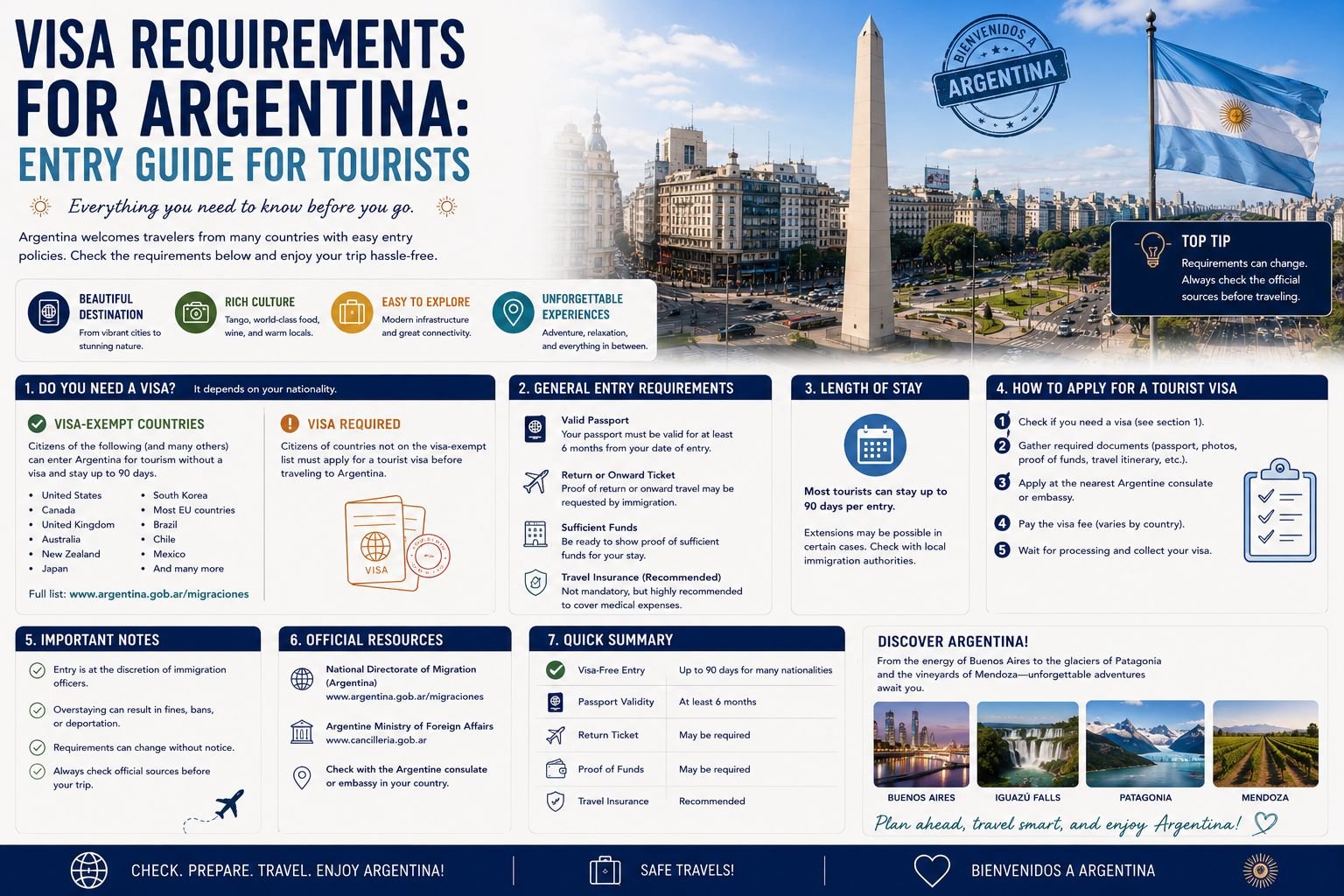
Argentina is one of the more welcoming countries in South America for international visitors in terms of entry requirements. Most Western passport holders can enter visa-free for 90 days as tourists, with no advance application required. That said, the rules are specific and the definition of which countries qualify for visa-free entry, and for what duration, has been subject to changes, so checking the current position for your specific passport before travel is always advisable.
Visa-Free Entry: Who Qualifies
The following nationalities can enter Argentina without a visa for tourist purposes, typically for 90 days:
European Union citizens: All 27 EU member state nationals can enter visa-free. The permitted stay is 90 days and can generally be renewed once for an additional 90 days by crossing a border and returning (a “border run”).
United Kingdom: British nationals have visa-free access for 90 days as tourists.
United States: US citizens can enter Argentina visa-free for 90 days. Note that Argentina previously charged a “reciprocity fee” to US visitors to match fees charged by the US to Argentine nationals; this fee was abolished and has not been reinstated as of the most recent update to this guide, but it is worth verifying the current position before travel.
Canada: Canadian nationals have visa-free access for 90 days.
Australia and New Zealand: Australian and New Zealand passport holders can enter visa-free for 90 days.
Most Latin American countries: Citizens of most other South American and Central American countries have visa-free access, often on longer terms due to Mercosur and other bilateral agreements.
Entry Requirements for Visa-Free Visitors
Even if you do not need a visa, you must meet these entry requirements at the border:
Valid passport: Your passport must be valid for the duration of your stay. Argentina does not have a mandatory six-month validity rule beyond your departure date, but having at least three months of validity remaining is strongly advisable to avoid any potential issues.
Proof of onward travel: Immigration officers can ask for evidence that you intend to leave Argentina. In practice this is not always checked for visitors from visa-free countries, but having a return or onward flight booking available to show if asked is sensible.
Proof of sufficient funds: Immigration can technically ask for evidence of sufficient funds for your stay. This is rarely requested in practice for visitors from Western countries, but having access to a bank card and being able to explain your accommodation plans covers this requirement.
Completed immigration card: You will complete a brief immigration form either on the plane or at the border. Keep the tourist card portion you are given; you may need to present it when you leave.
Extending Your Stay
Tourist entry gives you 90 days in the country. There are several options if you want to stay longer:
Border crossing renewal: Crossing into a neighbouring country (Uruguay is the easiest option from Buenos Aires, a 1 to 3 hour ferry ride away) and returning resets your 90-day tourist entry. Argentine immigration is generally understanding about this being done once. Doing it repeatedly (multiple “border runs”) is technically at the discretion of the immigration officer and some travellers have been questioned about their intentions; it is not a guaranteed strategy for indefinite stays.
Tourist visa extension (prórroga): You can apply for a 90-day extension without leaving the country through the Dirección Nacional de Migraciones (DNM) in Buenos Aires. This costs a small fee and requires supporting documentation. It can typically only be done once; you cannot stack extensions indefinitely on a tourist visa.
Long-stay visas: If you are planning to stay more than 180 days in a year or want a more stable legal basis for an extended stay, Argentina offers several visa categories for longer-term residents: the Rentista visa (for those with passive income), the Pensionado visa (for retirees), and various work-based visa categories. These are covered in the [expat visa and residency guide](/expat/visa-residency/).
Countries That Do Require a Visa
Citizens of China, India, and several other nationalities require advance visas to visit Argentina as tourists. The application is made at the Argentine embassy or consulate in the applicant’s home country. Processing times vary; the consulate website of the Argentine embassy in your country is the authoritative source for current requirements and processing times.
For nationals of countries requiring visas, the documentation typically required includes: a completed application form, a valid passport, passport-sized photographs, proof of accommodation bookings, proof of a return flight, proof of financial means, and a consular fee payment. Requirements can change; always verify directly with the relevant Argentine consulate.
Entry at Buenos Aires Airports
Most international arrivals to Buenos Aires land at Ezeiza International Airport (EZE). The immigration process follows a standard international airport format:
Queue for passport control (lines can be long, particularly on flights from Europe and the US arriving in the morning); present your passport, completed immigration card, and any supporting documents if requested; receive your entry stamp. Luggage collection follows passport control. There is no customs interview for most travellers; you proceed through the green (nothing to declare) or red (goods to declare) channel.
Argentine customs has regulations on bringing in food products, large amounts of cash (over USD 10,000 must be declared), and commercial quantities of goods. For most tourists carrying personal luggage, none of these are relevant.
Entering by Land or Ferry from Uruguay
Many visitors arrive in Buenos Aires by ferry from Colonia del Sacramento or Montevideo in Uruguay. The border crossing process is managed on both sides; ensure your passport is stamped both out of Uruguay and into Argentina. Ferry services from Colonia (Buquebus, Seacat, Colonia Express) are the most popular route for those arriving from or transiting through Uruguay.
Land border crossings from Chile, Bolivia, Paraguay, and Brazil are used by travellers doing wider South American itineraries. All land borders have full passport control; ensure you have the entry requirements for Argentina and, if applicable, the country you are entering from, as the requirements can differ from what you might expect.
Important Note on Current Requirements
Immigration rules change. The information in this guide reflects the current position at the time of writing, but visa requirements, reciprocity fees, and permitted stay durations are subject to revision. Before travel, verify the current requirements at the official Argentine immigration authority website (migraciones.gov.ar) or at the Argentine embassy or consulate website in your country.
Related: Plan Your Trip | Travel Costs | How Many Days | Practical Info
Practical Application: Checking Your Specific Situation
The information in this guide covers the most common situations, but visa rules are specific and subject to change. The correct process for confirming your entry requirements is:
Step 1: Identify the correct Argentine consulate or embassy website for your specific country of residence or passport nationality. The Argentine Ministry of Foreign Affairs (cancilleria.gob.ar) maintains a directory of Argentine diplomatic representations abroad.
Step 2: Check the current visa requirements for your specific passport nationality on this official source, not on a travel blog or third-party aggregator. Requirements can change based on diplomatic developments, reciprocity arrangements, or policy changes that are not immediately reflected in secondary sources.
Step 3: If a visa is required, begin the application process at least two to three months before your planned travel date. Processing times are not guaranteed and can be significantly longer than official estimates during busy periods.
Step 4: For any uncertainty about whether your specific situation qualifies for visa-free entry, contact the consulate directly before booking non-refundable travel. A short email inquiry saves the cost of a cancelled trip.
The Argentine E-Visa System
Argentina has progressively introduced electronic visa systems for nationalities that previously required physical visas. The current availability of e-visas varies by passport nationality; the official Argentine immigration website (migraciones.gov.ar) lists which nationalities can apply for an e-visa rather than a physical consulate visa, and the application process if available electronically is generally simpler and faster.
For those from countries where an e-visa is available, applying at least two weeks before travel (rather than the stated minimum processing time) provides a buffer against unexpected delays in the system.
The visa and entry process for Argentina, once researched and understood, is rarely an obstacle for most Western travellers. The 90-day visa-free entry covers most standard visits; the extension and border-run options cover most extended stays; the longer-term visa categories cover those intending to stay permanently. The research investment required is modest; the consequences of not making it can be significant. Always verify from the official source before booking non-refundable travel.
A Final Note
Buenos Aires rewards visitors who arrive prepared and remain open. The practical preparation covered in this guide removes the friction that prevents engagement; the openness is yours to bring. The city that reveals itself to a visitor who knows what they are looking for, who has sorted the practical foundations, and who has the curiosity to follow what the city offers is one of the genuinely great urban experiences available anywhere in the world.
For questions, corrections, or feedback on this guide, the contact page is the right place. This site is updated regularly; if you visit Buenos Aires and find that conditions have changed from what this guide describes, telling us makes the guide better for the next reader.