
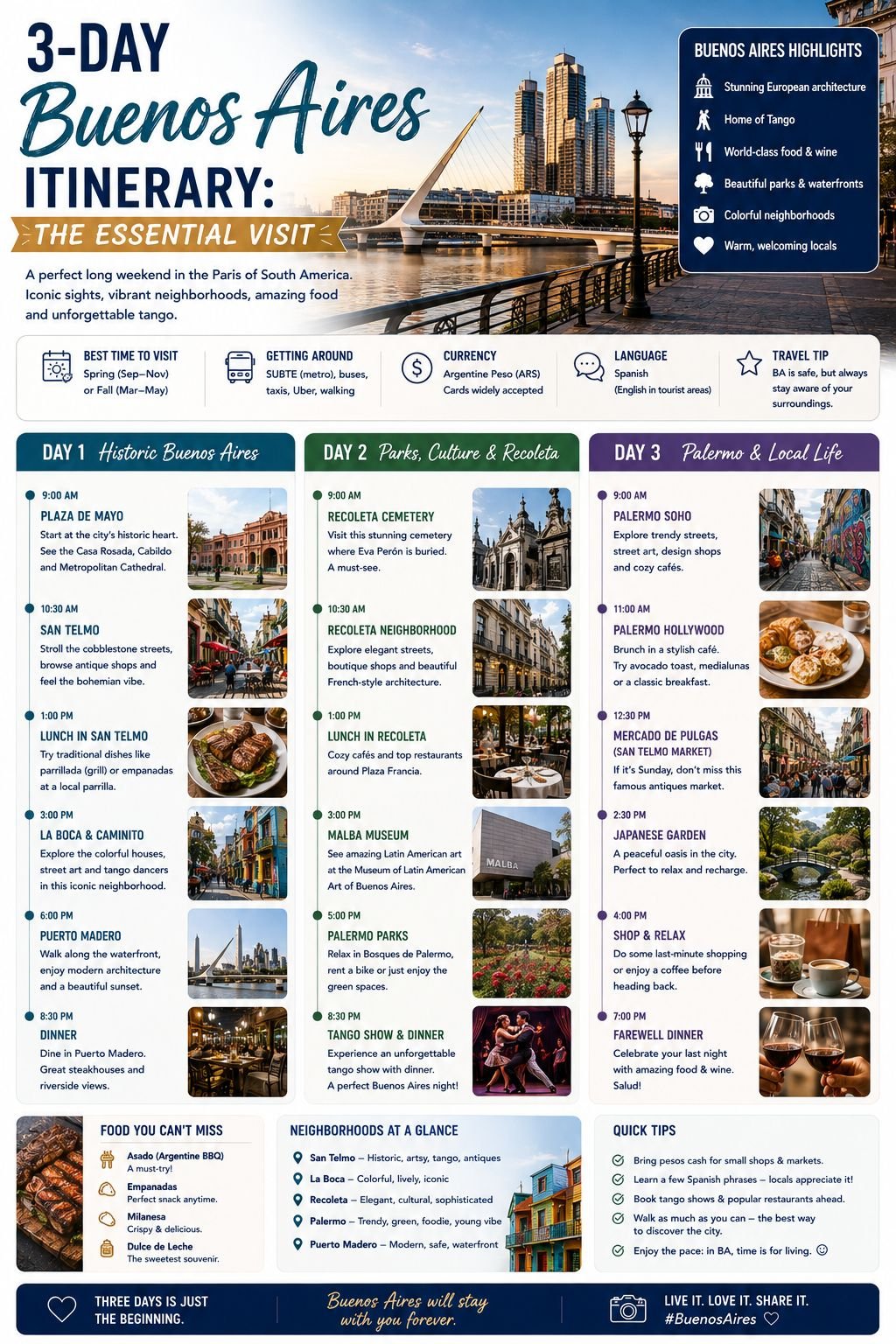
Three days is a tight window for Buenos Aires, but it is enough to experience the city’s essential character if the days are structured well. This itinerary prioritises depth over coverage: you will know three neighbourhoods properly rather than passing through seven briefly.
Day 1: San Telmo, Recoleta, and the Historic Centre
Morning: the historic centre and Plaza de Mayo
Start at Plaza de Mayo, the political heart of Argentina and one of the most historically charged squares in South America. The Casa Rosada (the presidential palace, pink facade, balcony where Evita spoke) faces the square; the Metropolitan Cathedral is on one side; the Cabildo (colonial town hall) on another. This is where Argentina’s key historical events, from the May Revolution of 1810 to the protests of 2001, have played out. Spend 30 to 45 minutes walking the square and its immediate surroundings before the tourist crowds build.
Walk south along Defensa into San Telmo, stopping at the San Telmo Market (Mercado de San Telmo) which has been operating in the same covered building since 1897. The market interior combines traditional butcher and produce stalls with a growing number of artisan food and craft vendors; it is one of the most atmospheric covered markets in South America. Have breakfast or a coffee inside before the market fills up.
Midday: San Telmo
San Telmo is the oldest neighbourhood in Buenos Aires, with colonial and early 19th-century architecture, cobblestone streets, and a concentration of antique shops, independent bookshops, tango bars, and restaurants. Walk the length of Calle Defensa from the market south to Plaza Dorrego, the small square that becomes the city’s best flea market on Sundays (if your three days include a Sunday, prioritise this).
Lunch in San Telmo at one of the neighbourhood’s no-frills parrillas or traditional restaurants. La Brigada, El Desnivel, and Patagonia Sur are all within a few blocks of the main square.
Afternoon: Recoleta
Take a taxi or Uber north to Recoleta. The Recoleta Cemetery is the first stop: an extraordinary place of elaborate mausoleums and funerary sculpture, set out on a street grid of its own. Eva Perón (Evita) is buried here in the Duarte family mausoleum; so are multiple Argentine presidents, military generals, and cultural figures. Allow 60 to 90 minutes; the cemetery is best explored without a set route, following what catches your eye.
After the cemetery, walk the Recoleta neighbourhood itself: the wide Avenida Alvear (the most Parisian of Buenos Aires’ boulevards), the Palais de Glace (exhibition space), and the Floralis Genérica (the giant metal flower sculpture in the park that opens and closes with daylight). The MALBA museum, the city’s best collection of Latin American art, is a 15-minute walk away and worth 60 to 90 minutes if time allows.
Evening: Tango show
Buenos Aires is the birthplace of tango and experiencing it in some form is essential, even on a short visit. For a first-time visitor on a three-day trip, a tango show is the most efficient way to see the dance at its most spectacular. The shows combine dinner with a theatrical performance featuring the city’s best professional dancers. The [tango shows guide](/things-to-do/tango-shows/) covers the range of options from intimate to spectacular; book in advance as the best shows fill up.
Day 2: Palermo, La Boca, and Puerto Madero
Morning: La Boca
La Boca is one of Buenos Aires’ most photographed neighbourhoods, famous for the brightly coloured corrugated metal houses of the Caminito street-museum. It is also one of the most tourist-concentrated areas in the city; the key is to arrive early (before 10am) before the tour buses arrive, and to be aware that the colourful area is a small, performance-oriented section of a larger, less polished neighbourhood. The street performers and tango dancers in La Boca are professional and photo-friendly; the neighbourhood around it is genuinely rough and should not be walked beyond the immediate tourist area.
The Fundación PROA, a contemporary art foundation at the edge of La Boca, has one of the best contemporary art programmes in the city. The Museo de la Pasión Boquense, the museum of the Boca Juniors football club, is worth 45 minutes if football is any part of your interest; the club’s stadium (La Bombonera) is directly adjacent.
Midday: Puerto Madero and the ecological reserve
Puerto Madero, directly east of the city centre, is the city’s most modern neighbourhood: the old port warehouses converted into restaurants, hotels, and commercial spaces facing the Río de la Plata. It is the most expensive neighbourhood to eat and stay in, but the walk along the Puerto Madero waterfront past the Puente de la Mujer (the rotating pedestrian bridge designed by Santiago Calatrava) is worth doing.
The Reserva Ecológica Costanera Sur, adjacent to Puerto Madero, is a nature reserve occupying land reclaimed from the river. It has over 350 bird species, walking and cycling paths, and an entirely different character from the urban Buenos Aires around it. An hour here is worthwhile for the contrast alone.
Lunch in Puerto Madero at one of the restaurants in the reclaimed warehouses, or walk back to the city centre for something cheaper.
Afternoon and evening: Palermo
Palermo is the largest and most varied neighbourhood in Buenos Aires. The Palermo Parks (Bosques de Palermo) are a large network of parks, rose gardens, lakes, and cycling paths that provide the city’s best green space. The Japanese Garden and the Botanical Garden are both within the Palermo parks complex.
Palermo Soho and Palermo Hollywood (the sub-neighbourhoods immediately south of the parks) have the densest concentration of independent boutiques, design shops, galleries, good coffee, and restaurants in the city. Spend the afternoon exploring; there is no shortage of things to notice.
Dinner in Palermo, which has the widest range of good restaurants in the city, from neighbourhood parrillas to creative contemporary Argentine cuisine.
Day 3: Deep Palermo, a Milonga, and the Departure
Morning: MALBA and Palermo Soho
If you did not visit MALBA on Day 1, this morning is the time. The Museo de Arte Latinoamericano de Buenos Aires is the best art museum in the city for Latin American modernist and contemporary work, with a strong collection including Frida Kahlo, Diego Rivera, and major Argentine artists. Allow 90 minutes to two hours.
Browse Palermo Soho’s boutiques and design shops; this is the best area in the city for Argentine design, independent fashion, and locally made goods if you want to take anything home.
Lunch in Palermo at one of the neighbourhood’s casual lunch spots, many of which run special midday menus at significantly lower prices than the evening menu.
Afternoon: A neighbourhood of your choice
By day three you will have a sense of which part of the city you want to revisit. San Telmo on a Sunday morning is the best possible Buenos Aires afternoon if the timing aligns. Recoleta for a quieter revisit. Palermo for more of the neighbourhood you have been enjoying.
Evening: A milonga
For a last evening in Buenos Aires, a milonga is more authentic and more memorable than a tango show. A milonga is a social tango dance event; in Buenos Aires they run multiple evenings per week in various locations, from traditional ballrooms (most serious, established codes of etiquette) to more relaxed spaces welcoming of visitors and beginners. The [milongas guide](/things-to-do/milongas/) covers which venues welcome first-timers and what to expect. You do not need to dance; watching is entirely acceptable and extraordinary.
Three-Day Logistics
Transport: Taxis and Uber are the most practical option for a short visit. The distances between neighbourhoods are short enough that most journeys cost USD 3 to 8. The Subte (metro) is useful for longer crossings (north-south along Line D, for example).
Eating timing: If you want to eat where and when Porteños eat, adjust your timing: lunch from 1pm to 3pm, dinner from 9pm onwards. Restaurants before these times will be full of tourists; after them, full of everyone.
Booking: Tango shows should be booked in advance, ideally before arrival. The best shows fill up, particularly in peak season.
Related: 5-Day Itinerary | One-Week Itinerary | Plan Your Trip | Things to Do
Making the Most of a Three-Day Schedule
Three days in Buenos Aires is a genuine constraint, and the itinerary above is deliberately dense. A few specific notes for making it work:
Prioritise evenings: The best Buenos Aires experiences happen at night. If something has to give, let it be a daytime attraction rather than an evening at a milonga or a tango show. The daytime sights are worthwhile; the evening experiences are irreplaceable.
Stay in one neighbourhood: For a three-day visit, basing in Palermo or San Telmo and accepting that you will know one neighbourhood well rather than passing through several briefly produces a better experience. Travelling between distant parts of the city takes time that a short visit cannot afford.
The one restaurant decision: With only three dinner opportunities, making at least one of them a genuinely special parrilla experience is worth the planning. Don Julio requires advance reservation; La Brigada and El Desnivel in San Telmo are excellent without reservation. The parrilla dinner is the culinary experience most specific to Buenos Aires and most difficult to replicate elsewhere.
Accept that you will want to return: Three days is not enough. Accepting this before you arrive, rather than trying to compensate by overloading the schedule, makes the three days you have significantly more enjoyable. Buenos Aires rewards a second visit; the first one is the invitation.

Hi, I’m Natalia, an Argentine writer born and raised in Buenos Aires, and I’ve been writing about this city for 9 years.
I cover Buenos Aires the way only a local can: the neighbourhoods that don’t make the highlight reels, the ferias worth getting up early for, the parrillas where the menu isn’t in English, and the safety picture by barrio — honest, not sanitized. I’ve taken 40+ solo trips across Argentina, Uruguay, Chile, Bolivia and Peru, and I write in both Spanish and English, which means the local forums, neighbourhood Facebook groups and municipal notices that never get translated are all fair game for me.
My writing covers two things I know from the inside: Buenos Aires as a destination — what to do, where to stay, how to navigate the city as a visitor — and Buenos Aires as a place to live. The expat life content comes from real experience: the paperwork that defeats everyone, the healthcare system that surprises you, the cost of living that changes faster than any guidebook can track, and the parts of porteño life that make it worth all of it.
If you’re visiting for a week or moving here for a year, I aim to be the honest friend who actually lives here — not the one who visited once and wrote a listicle.