
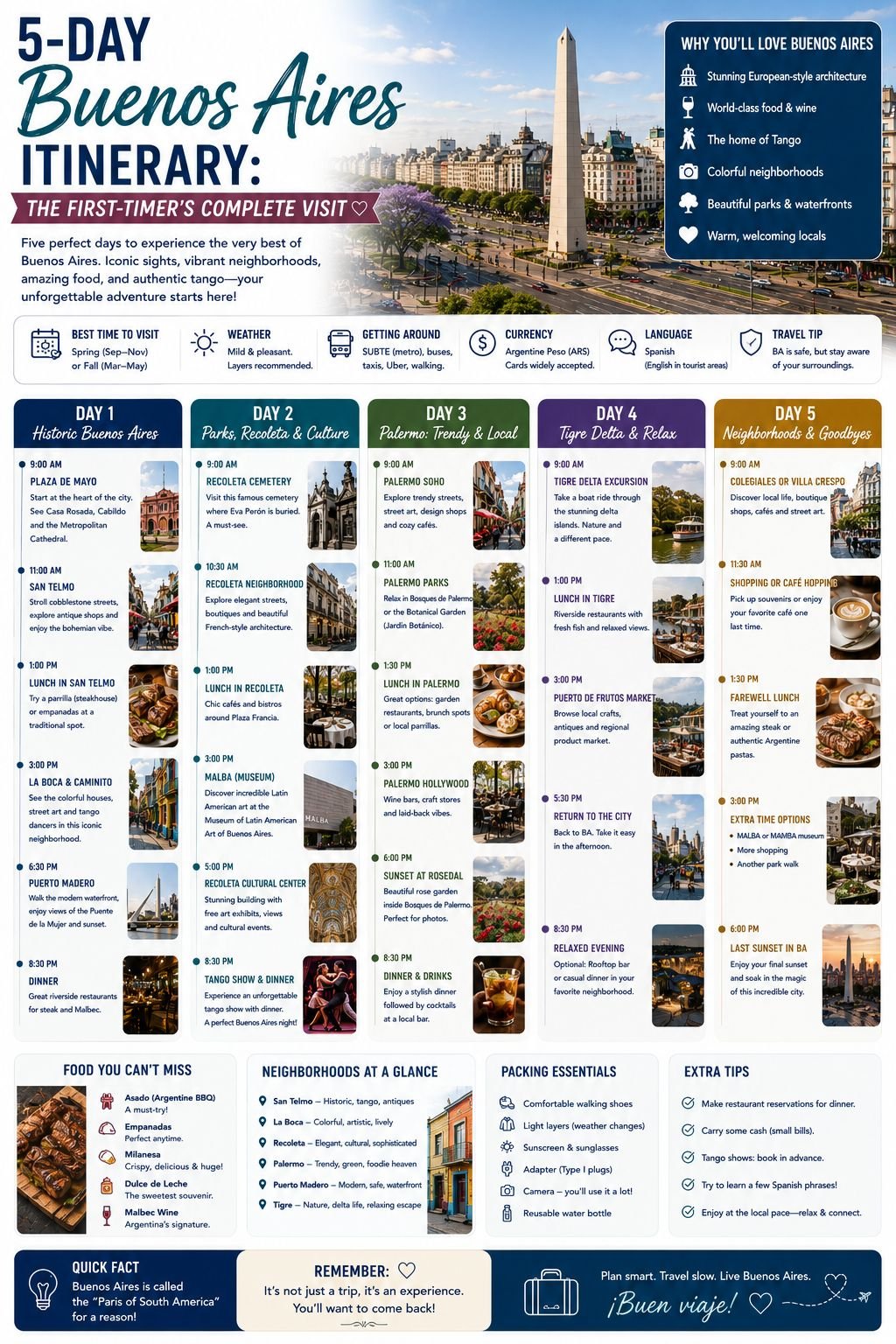
Five days in Buenos Aires is enough to experience the city properly: you have time for all the essential neighbourhoods, a day trip, a genuine tango evening at a milonga, and enough unscheduled time to let the city work on you rather than just passing through it.
Day 1: Arrival, Orientation, and San Telmo
Arrive, settle in, and resist the instinct to try to cover ground. Buenos Aires takes an hour or two to calibrate to: the scale, the traffic, the noise, the pace.
Afternoon orientation walk: From your accommodation, find your bearings in the neighbourhood. Walk to a nearby café. Order a cortado and observe the pace of things. Notice that lunch is happening at 2pm, that people are taking their time, that the street life is dense and unhurried.
Evening: San Telmo for dinner
San Telmo is the most atmospheric evening neighbourhood for a first-time visitor. The cobblestone streets, the lit doorways of tango bars, the old parillas with their grills visible from the street: this is the Buenos Aires of imagination. Eat at a traditional parrilla; El Desnivel on Calle Defensa is reliably excellent and local in character.
Day 2: The Historic Centre and Recoleta
Morning: Plaza de Mayo and the historic centre
An early start at Plaza de Mayo before the crowds: Casa Rosada, the Cathedral, the Cabildo, and the streets of the Microcentro including the extraordinary glass-roofed Galería Güemes shopping arcade. Walk along Avenida Florida, the pedestrian shopping street that crosses the heart of the city.
Afternoon: Recoleta Cemetery and neighbourhood
The Recoleta Cemetery is one of the genuinely unmissable experiences in Buenos Aires: a city within the city, where the funerary architecture is some of the finest in the country and where Evita’s grave draws a steady stream of visitors. After the cemetery, walk the Recoleta neighbourhood: Avenida Alvear, the Palais de Glace, the parks. The MALBA museum, 10 minutes’ walk away, is open until 8pm.
Evening: Tango show
Reserve an evening on Day 2 for a tango show. By the second evening you are calibrated enough to appreciate the spectacle. Book in advance; the best shows (Rojo Tango, Señor Tango, El Viejo Almacén) fill up. See the [tango shows guide](/things-to-do/tango-shows/) for the full range of options.
Day 3: La Boca, Puerto Madero, and Palermo
Morning: La Boca
Early to La Boca (before 10am) to beat the tour groups. The Caminito, the PROA foundation, the Boca Juniors museum. The nearby Vuelta de Rocha, the old port area where the neighbourhood’s early immigrants lived, has a quieter and more authentic character than the main tourist street.
Midday: Puerto Madero
Walk the Puerto Madero waterfront and visit the Reserva Ecológica Costanera Sur for an hour; the contrast between the urban city and this bird-filled nature reserve just a few hundred metres away is one of Buenos Aires’ genuine surprises.
Afternoon and evening: Palermo
Palermo is the neighbourhood for the rest of the day. The Palermo Parks for a late-afternoon walk, then Palermo Soho or Hollywood for dinner and the evening. Palermo has the widest range of restaurants in the city; choose based on mood.
Day 4: Day Trip to Colonia del Sacramento
The day trip to Colonia del Sacramento in Uruguay is the best one-day trip from Buenos Aires: a 1 to 3 hour fast or slow ferry across the Río de la Plata brings you to one of South America’s best-preserved colonial towns, a UNESCO World Heritage Site with cobblestone streets, 17th-century Portuguese fortifications, and a deeply pleasant pace of life entirely unlike Buenos Aires.
Getting there: Ferries depart from the Dársena Norte port terminal in Puerto Madero. Buquebus runs the fastest service (1 hour, more expensive); Colonia Express runs slower ferries (3 hours, cheaper). Book in advance, particularly on weekends.
In Colonia: The old town is compact and entirely walkable. The Barrio Histórico (the UNESCO-listed old quarter) has the original fortifications, the Lighthouse, the Faro del Barrio Histórico, the old cobblestone streets, and a series of small museums. The town also has good restaurants and cafés on the main square.
Return: An afternoon or early evening ferry back to Buenos Aires, arriving in time for a late dinner.
Day 5: Palermo Deeper, Sunday Market (if applicable), Milonga
Morning: Palermo parks or Sunday market
If Day 5 falls on a Sunday, go to the San Telmo Sunday market at Plaza Dorrego first thing: street performers, antiques vendors, tango dancers in the square, and a Buenos Aires in its most relaxed weekly mode. If it is not a Sunday, the Palermo Japanese Garden (Jardín Japonés) and the Buenos Aires Ecological Reserve are both excellent morning destinations.
Afternoon: Final neighbourhood of choice
By day five you will have a clear sense of which parts of the city you want more of. Recoleta for a quieter afternoon. San Telmo for a final wander. Palermo for the boutiques and cafés.
Evening: A milonga
Reserve the last evening for a milonga rather than another show. A milonga is where Buenos Aires tango actually lives: a social dance event in a ballroom or club, with an orchestra or DJ, where people of all ages and backgrounds dance together. Visitors are welcome at most milongas; you do not need to dance (watching is fine), but many milongas offer introductory group lessons in the hour before the main session begins.
The atmosphere at a good milonga late on a weeknight, when the room fills up around midnight, is one of the most memorable things in Buenos Aires. Start the evening at 11pm; plan to stay until at least 1am.
Five-Day Practical Notes
Day trips: The Colonia day trip needs advance ferry booking, particularly on weekends. Book both ways when you make the reservation.
Tango show: Book before you arrive, not when you get there.
Milonga timing: Milongas do not reach their peak until midnight. If your last night involves an early departure the next morning, either choose a different activity or accept that you will be tired the next day; it is worth it.
The blank afternoon: Leave at least one afternoon in the itinerary with no plan. Discovering a neighbourhood café, following an interesting street, accepting an invitation: these require space that tightly planned itineraries do not provide.
Related: 3-Day Itinerary | One-Week Itinerary | Plan Your Trip | Day Trips
Building Flexibility Into the Five-Day Framework
The five-day itinerary above is a framework, not a prescription. Buenos Aires works best when the plan has room for the city to contribute its own suggestions. Specific points where flexibility pays off:
The Colonia day trip: The schedule places Colonia on Day 4, but if the weather forecast shows a particularly beautiful day earlier in the trip, moving the ferry trip forward and taking advantage of the light over the river is a better decision than following the itinerary mechanically.
Restaurant discoveries: By day three of a Buenos Aires visit, you will have opinions about which restaurants you liked and which you want to return to. An itinerary that includes a planned return to the parrilla where you had the best meal produces a better experience than one that requires trying a new restaurant every evening.
The milonga timing: The milonga on the last evening is deliberately placed where you have had enough Buenos Aires experience to appreciate it. If you encounter a milonga opportunity earlier in the trip (a local recommendation, a chance encounter with a flyer), take it; the experience of a milonga on your third night rather than your fifth is better than not experiencing one.
Day trip alternatives: If Colonia doesn’t appeal (ferry crossing, international border, more colonial history), the Tigre Delta is an equally valid half-day or full-day alternative that requires no ferry booking and produces a completely different experience of what is immediately accessible from Buenos Aires.
Five days in Buenos Aires, well spent, gives you enough of the city to understand why people come back. You will leave knowing which neighbourhood you preferred, which meal you will describe for years, which evening was the one that changed the character of the visit. These are the things that cannot be planned; they can only be enabled by having enough time and enough flexibility that the city can contribute its own suggestions to the itinerary you brought.
A Final Note
Buenos Aires rewards visitors who arrive prepared and remain open. The practical preparation covered in this guide removes the friction that prevents engagement; the openness is yours to bring. The city that reveals itself to a visitor who knows what they are looking for, who has sorted the practical foundations, and who has the curiosity to follow what the city offers is one of the genuinely great urban experiences available anywhere in the world.
For questions, corrections, or feedback on this guide, the contact page is the right place. This site is updated regularly; if you visit Buenos Aires and find that conditions have changed from what this guide describes, telling us makes the guide better for the next reader.

Hi, I’m Natalia, an Argentine writer born and raised in Buenos Aires, and I’ve been writing about this city for 9 years.
I cover Buenos Aires the way only a local can: the neighbourhoods that don’t make the highlight reels, the ferias worth getting up early for, the parrillas where the menu isn’t in English, and the safety picture by barrio — honest, not sanitized. I’ve taken 40+ solo trips across Argentina, Uruguay, Chile, Bolivia and Peru, and I write in both Spanish and English, which means the local forums, neighbourhood Facebook groups and municipal notices that never get translated are all fair game for me.
My writing covers two things I know from the inside: Buenos Aires as a destination — what to do, where to stay, how to navigate the city as a visitor — and Buenos Aires as a place to live. The expat life content comes from real experience: the paperwork that defeats everyone, the healthcare system that surprises you, the cost of living that changes faster than any guidebook can track, and the parts of porteño life that make it worth all of it.
If you’re visiting for a week or moving here for a year, I aim to be the honest friend who actually lives here — not the one who visited once and wrote a listicle.