
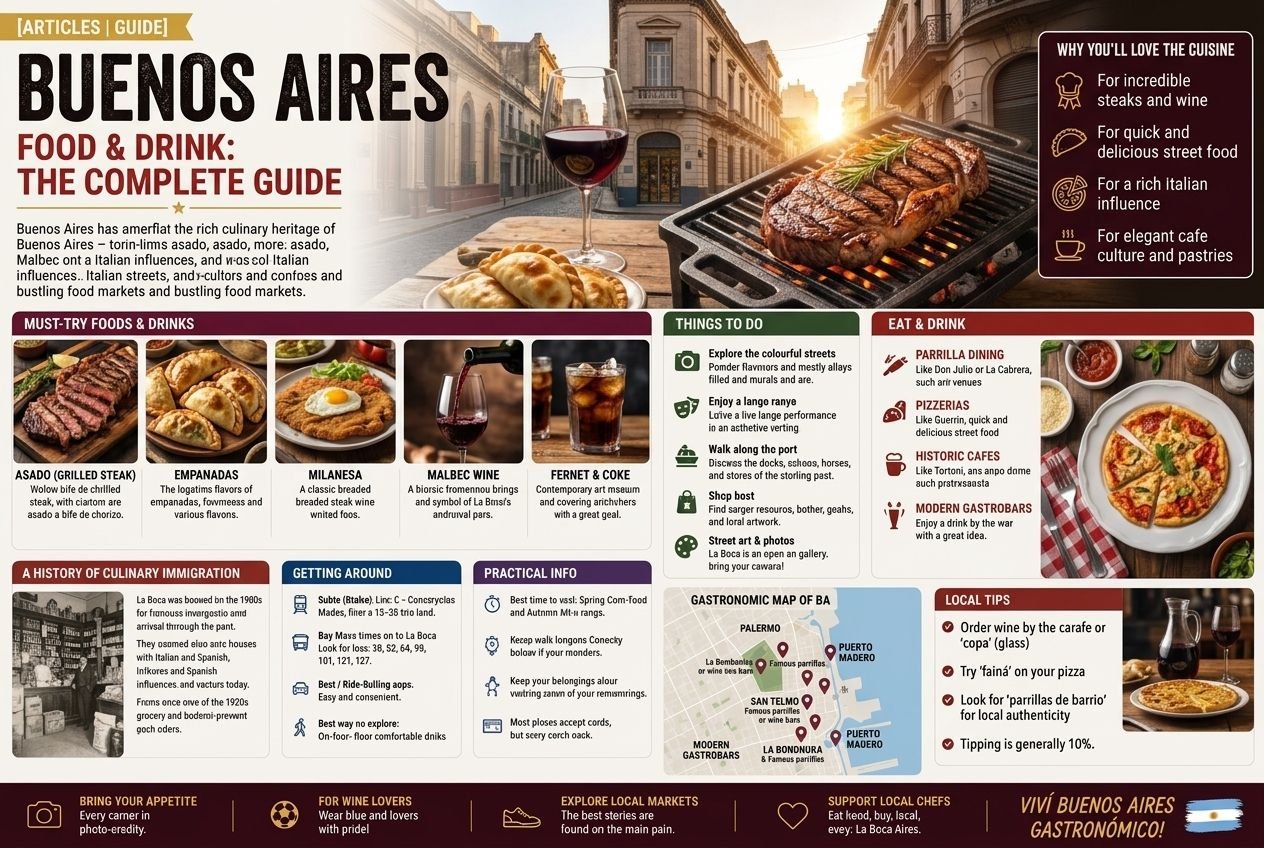
Buenos Aires has one of the great food cultures of South America. The city’s cuisine developed at the intersection of the food traditions that the European immigrants brought with them, principally from Italy, Spain, and France, and the native abundance of the Argentine Pampas, specifically the extraordinary quality of the beef and the wine that the country produces. The result is a food culture that is simultaneously European in its formal restaurant tradition and distinctly Argentine in its priorities: beef, simplicity, generosity, and the social rituals that surround eating and drinking.
Understanding Argentine food culture makes every meal in Buenos Aires better. This hub covers the full picture.
The Central Ritual: The Asado
The asado, the Argentine barbecue, is not primarily about food. It is a social institution: an occasion, a ritual, a way of organising time around the fire and around the people you are with. An asado typically starts in the early afternoon and continues until late evening; the cooking is done slowly, over embers rather than flames, by a designated asador whose authority over the grill is absolute; the eating is divided into multiple waves of different cuts; and the social function is the point as much as the food.
Visitors experience the asado primarily through Buenos Aires’ parrilla restaurants, which are dedicated grillhouses specialising in the asado experience.
The Beef
Argentine beef is genuinely exceptional and its quality in Buenos Aires is particularly high. The characteristic of the best Argentine beef, raised on Pampas grass rather than grain, is a cleaner flavour and a tenderness that comes from the animal’s natural movement. The cuts used in the asado tradition are different from European or North American steak culture: the vacío (flank), the tira de asado (short ribs cut across the bone), and the ojo de bife (bone-in ribeye equivalent) are the essential Argentine cuts.
Ordering steak at a parrilla in Buenos Aires requires a small vocabulary. Jugoso means rare to medium-rare (the correct default for most cuts). A punto means medium. Bien cocido means well-done and is considered by most Porteños to be the wrong way to cook good beef.
The Wine
Argentina is one of the world’s great wine countries, and Buenos Aires is the best place outside the wine regions themselves to explore this. The country’s signature variety is Malbec, a grape that was struggling in its original French home of Cahors and has found in the high-altitude vineyards of Mendoza and Salta a terroir that produces wines of extraordinary depth and character. Argentine Malbec at a mid-range Buenos Aires restaurant costs a fraction of comparable quality European wine.
Beyond Malbec, Argentina produces excellent Torrontés (a white variety specific to Argentina, aromatic and dry), Bonarda, and increasingly interesting small-producer wines from regions beyond Mendoza. The Argentine wine guide covers the main varieties, regions, and where to explore Argentine wine in Buenos Aires.
The Italian Legacy
The Italian immigration that shaped Buenos Aires in the late 19th and early 20th century left an indelible mark on the food culture. Pizza is taken seriously in Buenos Aires in a way that surprises many visitors: the Argentine pizza, thick-crusted and generously topped with fainá (a chickpea flatbread traditionally eaten alongside or on top of the pizza), is a distinct and genuinely excellent thing. The fugazetta, a focaccia-style pizza topped with caramelised onions and mozzarella, is an Argentine invention that has no equivalent elsewhere.
Pasta is equally embedded: most parrillas also serve pasta, and the fresh pasta tradition in Argentine Italian-neighbourhood restaurants is excellent and cheap.
Cafés and Coffee Culture
Buenos Aires has a serious café culture rooted in the old European café tradition: the grand downtown cafés (Café Tortoni on Avenida de Mayo, most famously) where intellectuals, politicians, and writers have gathered for over a century, and the neighbourhood cafés where locals take their morning coffee and read the newspaper. The traditional Buenos Aires café order is a cortado (espresso with a small amount of warm milk), often accompanied by medialunas (the local croissant variant, sweeter and smaller than French croissants).
The independent specialty coffee scene that emerged in the 2010s has added a more contemporary coffee culture to the traditional café landscape; Palermo and Villa Crespo have the highest concentration of specialty coffee shops.
What Is in This Section
- Best parrillas (steakhouses) — where to eat Argentine beef at its best
- Argentine wine guide — Malbec and beyond, where to drink, what to order
- Mate tea guide — the social ritual of the national drink
- Buenos Aires nightlife guide — the city after midnight
- Markets and street food — where to eat standing up
- Tipping guide — when, how much, and the restaurant cubierto charge
- Empanadas guide — the national snack, where to eat the best
- Vegetarian and vegan options — Buenos Aires is improving
Related: Neighborhoods | Things to Do | Practical Info | Plan Your Trip
Understanding the Restaurant Culture
Buenos Aires restaurant culture has specific features that visitors benefit from understanding before their first dinner:
The cubierto: Most Buenos Aires restaurants charge a cubierto, a small cover charge per person (typically USD 1 to 5) that covers the bread, water, and place setting. This appears on every bill and is not optional; it is a structural feature of the Buenos Aires restaurant economy, not a tourist surcharge.
The timing of dinner service: Buenos Aires restaurants have their own internal logic about service timing. Arriving at 7pm typically means a restaurant that is set up but empty; arriving at 10pm means one that is alive and fully operational. Service at the busier hours is not slower; it is what the staff are optimised for. The experience of eating at a Buenos Aires restaurant at the local dinner time is genuinely different from eating at the tourist hour.
Portions and the sharing culture: Argentine restaurant portions, particularly at parrillas, are substantial. The culture of ordering several items to share is common and welcomed; a table of four ordering three main dishes plus starters is a standard approach. Parrillas in particular often serve portions that can be split without embarrassment.
Wine and the table: Ordering wine at a Buenos Aires restaurant is the norm rather than the exception. The house wine (vino de la casa), typically a young Malbec or blend served in a jug, is a good starting point at casual restaurants; the bottle list allows more deliberate choices. Drinking water alongside wine is common; sparkling water (agua con gas) is ordered separately.
The Emerging Food Scene
Buenos Aires has an established fine dining tradition (several restaurants have appeared on the Latin America’s 50 Best lists in recent years) and a growing creative restaurant scene that is working with Argentine produce in ways that would have been unrecognisable twenty years ago. The Palermo and Villa Crespo neighbourhoods have the highest concentration of these newer restaurants; food media in Buenos Aires tracks them closely, and local food publications including La Nación Cocina and the food section of Infobae are worth checking for the current moment in the Buenos Aires food scene.
Buenos Aires food culture is one of the most compelling reasons to visit and, for many visitors, the most enduring reason to return. The combination of European culinary tradition, extraordinary Argentine produce, genuine social ritual around eating, and a food scene that has matured significantly in the past decade without losing the fundamental pleasures of a great parrilla dinner produces an experience that is both specific to Argentina and genuinely world-class. Eat well here; it is one of the things this city does best.
A Final Note
Buenos Aires rewards visitors who arrive prepared and remain open. The practical preparation covered in this guide removes the friction that prevents engagement; the openness is yours to bring. The city that reveals itself to a visitor who knows what they are looking for, who has sorted the practical foundations, and who has the curiosity to follow what the city offers is one of the genuinely great urban experiences available anywhere in the world.
For questions, corrections, or feedback on this guide, the contact page is the right place. This site is updated regularly; if you visit Buenos Aires and find that conditions have changed from what this guide describes, telling us makes the guide better for the next reader.
Buenos Aires food is one of the most compelling reasons to visit and, for many visitors, the reason they return. The extraordinary quality of the beef, the wine, the food culture’s social function as the centre of Argentine social life, and the recent evolution of the restaurant scene into something that goes beyond the traditional parrilla tradition: these together produce a food landscape that rewards genuine attention and that reveals more depth the more time you spend with it.