
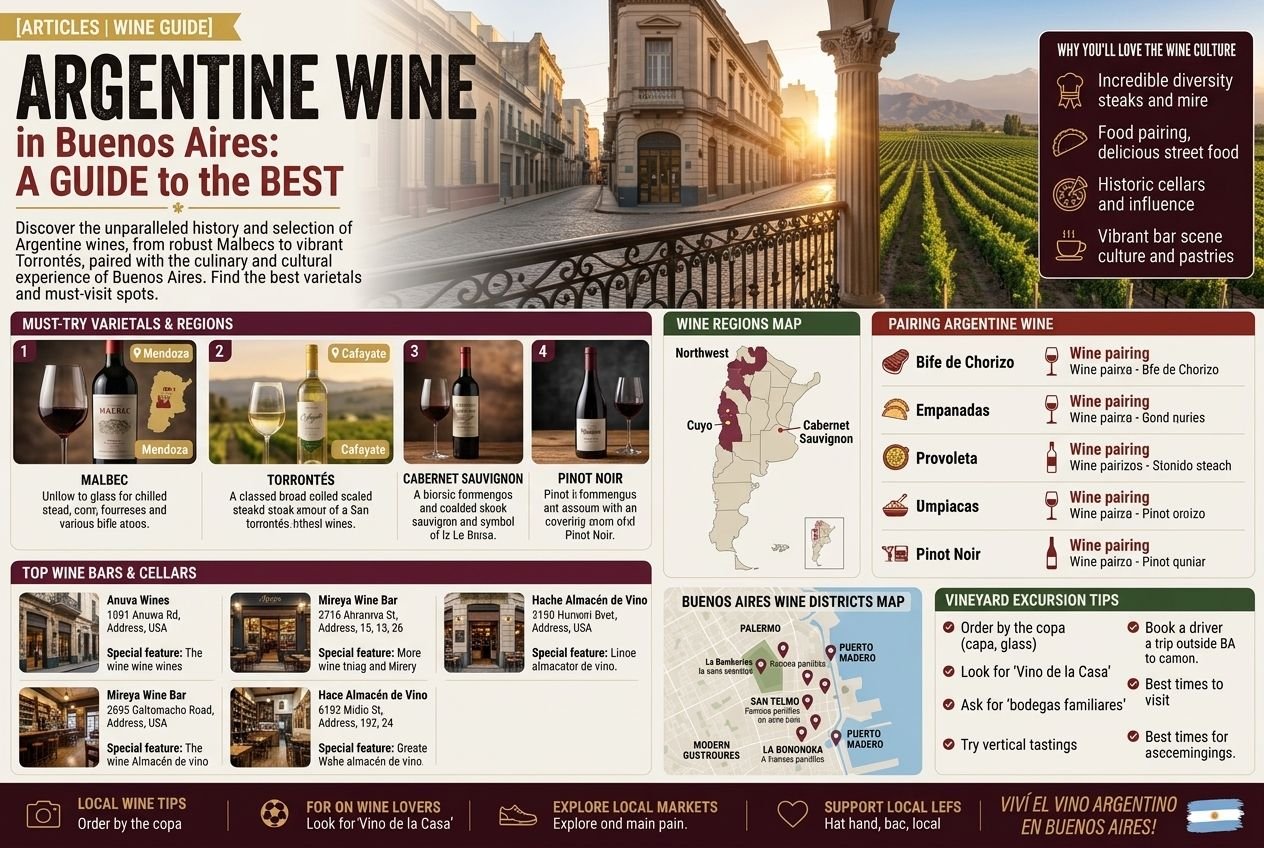
Argentina is one of the great wine countries of the world, and Buenos Aires is the best place to explore this outside the wine regions themselves. The wines available in Buenos Aires restaurants, wine bars, and vinotecas span the full range of Argentine production, from the internationally celebrated Malbec of Mendoza to the distinctive high-altitude whites of Salta to the emerging small producers from Patagonia and San Juan. For wine-interested visitors, the city represents one of the best value wine drinking opportunities in the world: bottles that would cost 30 to 60 euros in a European equivalent restaurant cost 8 to 20 dollars here.
The Wine Regions
Mendoza is Argentina’s most important wine region, producing approximately 70 percent of the country’s wine and containing most of the established premium producers. The region is high-altitude (most vineyards sit between 600 and 1,100 metres) and arid, with irrigation from Andean snowmelt and a climate of hot days and cool nights that concentrates flavour in the grapes. Mendoza produces excellent Malbec, Cabernet Sauvignon, Bonarda, and the full range of international varieties.
Salta and the North produces the most distinctive Argentine whites. Torrontés, the country’s signature white grape, reaches its best expression in the high-altitude vineyards of Cafayate in Salta, where it produces a wine that is emphatically aromatic (floral, peach, lychee) but dry and structured rather than sweet. The Salta reds, particularly the Tannat and high-altitude Malbec, are increasingly celebrated.
San Juan is Argentina’s second-largest wine region, traditionally focused on bulk production but increasingly producing quality wines. Syrah and Bonarda are the most interesting varieties here.
Patagonia (Rio Negro and Neuquén provinces) is the most recent region to develop quality viticulture. The cool climate favours Pinot Noir, Chardonnay, and Riesling-style wines; the best producers are making wines that compete with quality European equivalents.
The Key Varieties
Malbec: The grape that made Argentina famous on the international wine market. Malbec originated in France (where it is the variety of Cahors wine), but struggled in its original home and was nearly abandoned before finding its ideal terroir in the high-altitude vineyards of Mendoza. Argentine Malbec is typically deep-coloured, with concentrated dark fruit (blackberry, plum), violet notes, and in the best examples a silky texture and length that has no equivalent in the French original. Every price point has good options; the basic single-vineyard Malbec at 8 to 15 dollars in a Buenos Aires restaurant is remarkable value.
Torrontés: Argentina’s signature white, and unlike any other white grape variety. Aromatic (intensely so, with floral, peach, and lychee notes that can seem sweet but in good examples resolve into a dry, mineral finish), it is best from Cafayate in Salta. Pair with the lighter dishes of Argentine cooking; spiced empanadas, lighter fish, and the goat cheese found in northern Argentine cuisine.
Bonarda: Argentina’s most planted red variety, relatively unknown internationally, but capable of producing excellent value wines with generous dark fruit and lower tannin than Malbec. Often used for everyday drinking at very accessible prices.
Cabernet Sauvignon: Produces excellent results in Mendoza, with more structure and ageworthiness than Malbec and a style that will be familiar to Bordeaux and California wine drinkers.
Where to Drink Argentine Wine in Buenos Aires
Wine bars and vinotecas: The Buenos Aires wine bar scene has grown significantly over the past decade and is one of the city’s most distinctive food and drink offerings. The best wine bars offer a comprehensive Argentine wine list, often with extensive by-the-glass selection, alongside food designed to pair with the wines.
Gran Bar Danzón on Libertad in Recoleta is the original Buenos Aires wine bar and remains one of the best: a comprehensive list emphasising quality Argentine producers, good food, and an atmosphere that suits serious wine drinking.
Wine Bar on Honduras in Palermo is a good-value option with a strong Argentine list and a casual atmosphere.
Uniclub and El Preferido de Palermo are both excellent for mixing Argentine wine with the neighbourhood eating and drinking scene.
Wine shops (vinotecas): For buying rather than drinking on the premises, Buenos Aires has excellent specialist wine shops. El Ateneo on Viamonte in the Microcentro, Winery (a chain with branches throughout the city), and the specialist retailers in Palermo and San Telmo all have comprehensive Argentine selections with staff who can advise on producers and regions.
Restaurants: Argentine restaurants almost uniformly have strong Argentine wine lists. Asking the sommelier or waiter for a recommendation from an Argentine producer rather than an international variety typically yields a better price-to-quality outcome than choosing an international wine at a Buenos Aires restaurant.
Tasting the Wine Regions Without Leaving Buenos Aires
Wine tours and tastings: Several Buenos Aires operators offer structured Argentine wine tastings that function as an introduction to the main regions and varieties. These are worth doing if wine is a significant part of your reason for visiting Argentina.
Argentine Experience: A well-regarded dining and cultural experience in Palermo that includes a structured wine tasting alongside a traditional Argentine dinner; popular with visitors who want a structured introduction to both the food and wine culture.
Bodega visits in Buenos Aires: A few Buenos Aires-based wine producers (Cavas de Crianza, and several others in the wine producing belt of greater Buenos Aires) offer cellar visits and tastings.
Ordering Wine at a Buenos Aires Restaurant
Argentine restaurant wine lists are typically organised by variety and then by region. The sommelier or waiter recommendations are generally reliable. A few practical notes:
House wine (vino de la casa) in Buenos Aires restaurants is typically a young Malbec or blend, served in jugs and decent value for casual meals. For a better experience, move to the bottle list.
The wine is typically served at the correct temperature; if your Malbec arrives warm, asking for a brief chill in an ice bucket is reasonable.
Ordering by the glass is possible in wine bars but less common in traditional restaurants, where a half-bottle (media botella) is the usual minimum.
Related: Food and Drink Hub | Best Parrillas | Restaurants | Nightlife
Bringing Argentine Wine Home
For visitors who develop specific wine preferences during their Buenos Aires stay, bringing bottles home is worth planning. Argentine wines in Buenos Aires are very cheap relative to import prices in Europe or North America; a bottle that costs USD 10 to 15 in a Buenos Aires wine shop may retail for 25 to 40 euros as an imported wine in Europe.
The logistics: Argentine customs allows export of wine without specific quantity limits for personal use, though you must check your home country’s import rules. Most countries allow 2 to 3 litres per person duty-free; above that, you pay import duty. Wine-specific packaging (the inflatable wine bottle bags or sturdy cardboard wine carriers) is available at Buenos Aires wine shops and the larger supermarkets, and significantly reduces breakage risk in checked luggage.
The best wines to bring home are those from producers with limited or no international distribution: the small Mendoza boutique wineries, the Salta high-altitude producers, and the emerging Patagonian labels that have strong reputations locally but limited export presence. Staff at quality Buenos Aires wine shops (Winery, El Ateneo’s wine section, the specialist shops in Palermo) can identify these producers with specific knowledge.
Natural and Organic Wine in Buenos Aires
The natural wine movement has arrived in Buenos Aires. A cluster of wine bars and specialist importers, concentrated in Palermo and Villa Crespo, now focus specifically on natural, organic, and biodynamic Argentine and international wines. These represent a different segment from the conventional Argentine wine market; the styles are more variable (some are exceptional; some are challenging) but the best examples are genuinely interesting. El Banco Rojo in San Telmo and Vico Wine Bar in Palermo are two venues that have built serious reputations in this niche.
Argentine wine is one of the great undersung pleasures of Buenos Aires. The combination of extraordinary quality, remarkable value, and the social context of wine in Argentine culture produces a wine experience that is genuinely different from tasting wine in a European wine region. You are drinking at the source of a wine culture that has spent decades developing its identity; the Malbec in your glass is not merely a wine but an expression of a specific landscape, a specific agricultural tradition, and a specific moment in Argentine cultural confidence.
A Final Note
Buenos Aires rewards visitors who arrive prepared and remain open. The practical preparation covered in this guide removes the friction that prevents engagement; the openness is yours to bring. The city that reveals itself to a visitor who knows what they are looking for, who has sorted the practical foundations, and who has the curiosity to follow what the city offers is one of the genuinely great urban experiences available anywhere in the world.
For questions, corrections, or feedback on this guide, the contact page is the right place. This site is updated regularly; if you visit Buenos Aires and find that conditions have changed from what this guide describes, telling us makes the guide better for the next reader.