
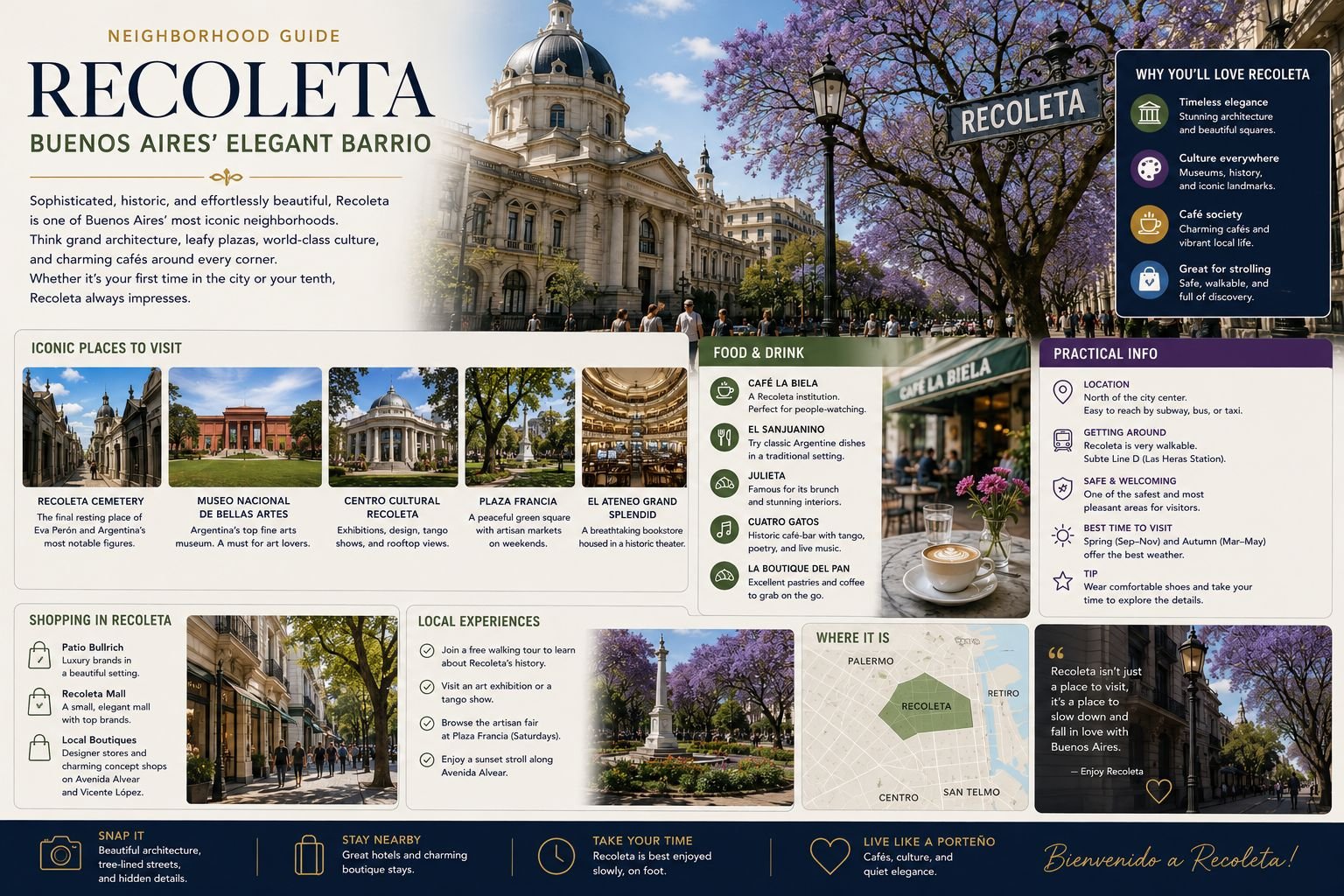
Recoleta is Buenos Aires at its most European and most formal. The neighbourhood was developed in the late 19th century by the wealthy families who fled San Telmo during the yellow fever epidemic, and they built on a scale and in a style that reflected their ambitions: French-influenced mansions, wide tree-lined boulevards, ornate apartment buildings with wrought-iron balconies, and public spaces designed to communicate civic confidence. Walking through Recoleta today, past the Álvear Palace Hotel or along Avenida Libertador, is to walk through the Buenos Aires that was determined to rival Paris.
The Famous Cemetery
The Cementerio de Recoleta is the most visited attraction in Buenos Aires and one of the most extraordinary spaces in South America. It is a city within the city: 6,400 above-ground vaults and mausoleums on a street grid, ranging from simple chamber tombs to elaborate neo-Gothic fantasies with stained glass and bronze statuary. Many of Argentina’s most significant historical figures are interred here: presidents, military leaders, writers, artists, and above all, Eva Perón.
Evita’s grave, in the Duarte family mausoleum near the cemetery entrance, draws a steady stream of visitors. Flowers are placed there daily; the mausoleum is often the only one with a queue. Beyond the Evita pilgrimage, the cemetery is best explored without a specific destination, following the streets of elaborate funerary architecture and reading the stones, which tell the compressed history of Argentine immigration and ambition.
The cemetery is free to enter, open 7am to 5:30pm. A free map is available at the entrance; guided tours (in English and Spanish) depart from the entrance at set times. Allow 60 to 90 minutes for a proper visit.
Things to Do in Recoleta
MALBA (Museo de Arte Latinoamericano): While technically just across the border into Palermo, MALBA is the primary art museum destination for the Recoleta area and worth extended time. The permanent collection spans Latin American modernism and contemporary work; the temporary exhibitions programme is consistently strong. Open Thursday to Monday.
Museo Nacional de Bellas Artes: Free, extensive, and excellent. The national fine arts collection includes strong Argentine and European work from the 19th and 20th centuries, alongside a collection of Argentine colonial art that rarely gets the attention it deserves. The building, in a former pumping station, has beautiful rooms.
Floralis Genérica: The enormous steel flower sculpture in Parque del Plata, adjacent to the museum, is one of Buenos Aires’ signature photographic subjects. The flower theoretically opens and closes with daylight via a mechanical system; it is often stuck partially open, but remains an impressive object.
Palais de Glace: A former ice skating rink turned exhibition space, now used for rotating exhibitions of Argentine and international art and photography. Worth checking the current programme.
Avenida Álvear: The most expensive and architecturally impressive street in Buenos Aires. Walking its length from Callao to Austria takes you past the finest examples of French-influenced Porteño architecture and several of the city’s best luxury hotels, including the Álvear Palace, the Palacio Duhau, and the Buenos Aires Park Hyatt.
Where to Eat in Recoleta
Recoleta has the city’s highest concentration of traditional formal-dining restaurants, the kind that have been operating in the same rooms for 30 or 40 years.
El Mirasol and Clark’s: Traditional parrillas on the Recoleta dining circuit, with high-quality beef and the kind of service that has been refined over decades.
La Biela: The most famous café in Recoleta, directly opposite the cemetery entrance, with tables beneath a massive rubber tree. The food is average; the location and the character are exceptional. Order coffee and watch the neighbourhood.
El Sanjuanino: A long-running restaurant on Posadas known for the best empanadas in the neighbourhood, unpretentious and reliably good.
Where to Stay in Recoleta
Recoleta has the city’s finest hotel stock. The Álvear Palace, the Palacio Duhau, and the Dazzler Tower are among the best luxury properties in the country. Mid-range boutique hotels in the neighbourhood reflect the area’s premium character; budget accommodation is limited.
Recoleta is the most convenient base for the northern cultural institutions (MALBA, Bellas Artes, Palais de Glace) and for access to Palermo (which begins immediately north). It is more formal and less food-diverse than Palermo but has easy access to Palermo’s dining scene.
Related: Palermo | Best Neighborhoods to Stay | Things to Do | Accommodation
The Hidden Recoleta: Beyond the Cemetery
Recoleta’s identity is so completely defined by the cemetery in the international imagination that it is easy to miss the neighbourhood’s other dimensions. The real Recoleta, the one that Porteños from other barrios reference with a slightly ironic respect, is a neighbourhood of beautiful apartment buildings, old-money social clubs, and the specific atmosphere of a place that has always taken itself seriously.
The Alvear Palace Hotel on Avenida Alvear, the most prestigious address in Buenos Aires, has been the social centre of the Argentine establishment since it opened in 1932. The weekend afternoon tea in the hotel’s French tearoom is one of the most genuinely Buenos Aires experiences available: beautiful rooms, extraordinary pastries and savourities, and the particular social performance of Recoleta at its most self-consciously elegant.
The Biblioteca Nacional (National Library), in a large brutalist building in the Recoleta parks area, holds the national book collection and runs an excellent programme of exhibitions, talks, and cultural events. The building itself is controversial architecturally (Jorge Luis Borges was director when it was commissioned; he reportedly disliked the result); the library’s collection and cultural programme are beyond reproach.
Recoleta’s Relationship with Palermo
Recoleta and Palermo are adjacent and, for visitors, often treated as interchangeable bases for the northern Buenos Aires experience. The practical difference: Recoleta has better access to the formal cultural institutions (MALBA, Bellas Artes, the Palais de Glace, the National Library) and the luxury hotel infrastructure; Palermo has the broader restaurant range, the street culture, and the neighbourhood character that most extended-stay visitors prefer. A first visit of 3 to 5 days benefits from being in Palermo; a cultural immersion with the institutions as the primary focus benefits from Recoleta.
Recoleta is Buenos Aires at its most formally beautiful and most self-consciously European. The neighbourhood’s combination of extraordinary funerary architecture, grand boulevards, excellent museums, and the particular social character of the city’s traditional establishment makes it a genuinely distinctive urban environment. It is not the most alive or the most warm of Buenos Aires’ neighbourhoods; it is the most aesthetically impressive, and for a city that cares deeply about its European heritage, it is the most direct expression of that care.
A Final Note
Buenos Aires rewards visitors who arrive prepared and remain open. The practical preparation covered in this guide removes the friction that prevents engagement; the openness is yours to bring. The city that reveals itself to a visitor who knows what they are looking for, who has sorted the practical foundations, and who has the curiosity to follow what the city offers is one of the genuinely great urban experiences available anywhere in the world.
For questions, corrections, or feedback on this guide, the contact page is the right place. This site is updated regularly; if you visit Buenos Aires and find that conditions have changed from what this guide describes, telling us makes the guide better for the next reader.
Recoleta is worth extended time regardless of where you base yourself. The cemetery, the museums, the grand boulevards, and the specific atmosphere of the city’s most formally beautiful neighbourhood all reward unhurried exploration. For visitors based in Palermo, Recoleta is 20 minutes away by Subte and a genuinely different experience of Buenos Aires. Making it a dedicated half-day rather than a passing visit produces the more rewarding outcome.
Buenos Aires rewards the traveller who arrives prepared and remains curious. Every guide in this site is designed to remove the friction between arrival and genuine engagement with the city; the engagement itself is yours to pursue. The city is inexhaustible, genuinely warm, and consistently surprising even to those who have been here many times. Whatever brings you to Buenos Aires, whether a first visit, an extended stay, or the beginning of a longer Argentine chapter, the preparation this guide provides is the starting point. What comes next is the city’s contribution.
Buenos Aires is one of the great cities of South America and one of the most rewarding for visitors who approach it with good preparation and genuine curiosity. The specific combination of European-influenced culture, Argentine character, extraordinary food and wine, and a social warmth that is entirely its own makes it unlike any other city in the world. Whatever aspect of the city this guide covers, it is one part of a whole that is considerably greater than its components.