
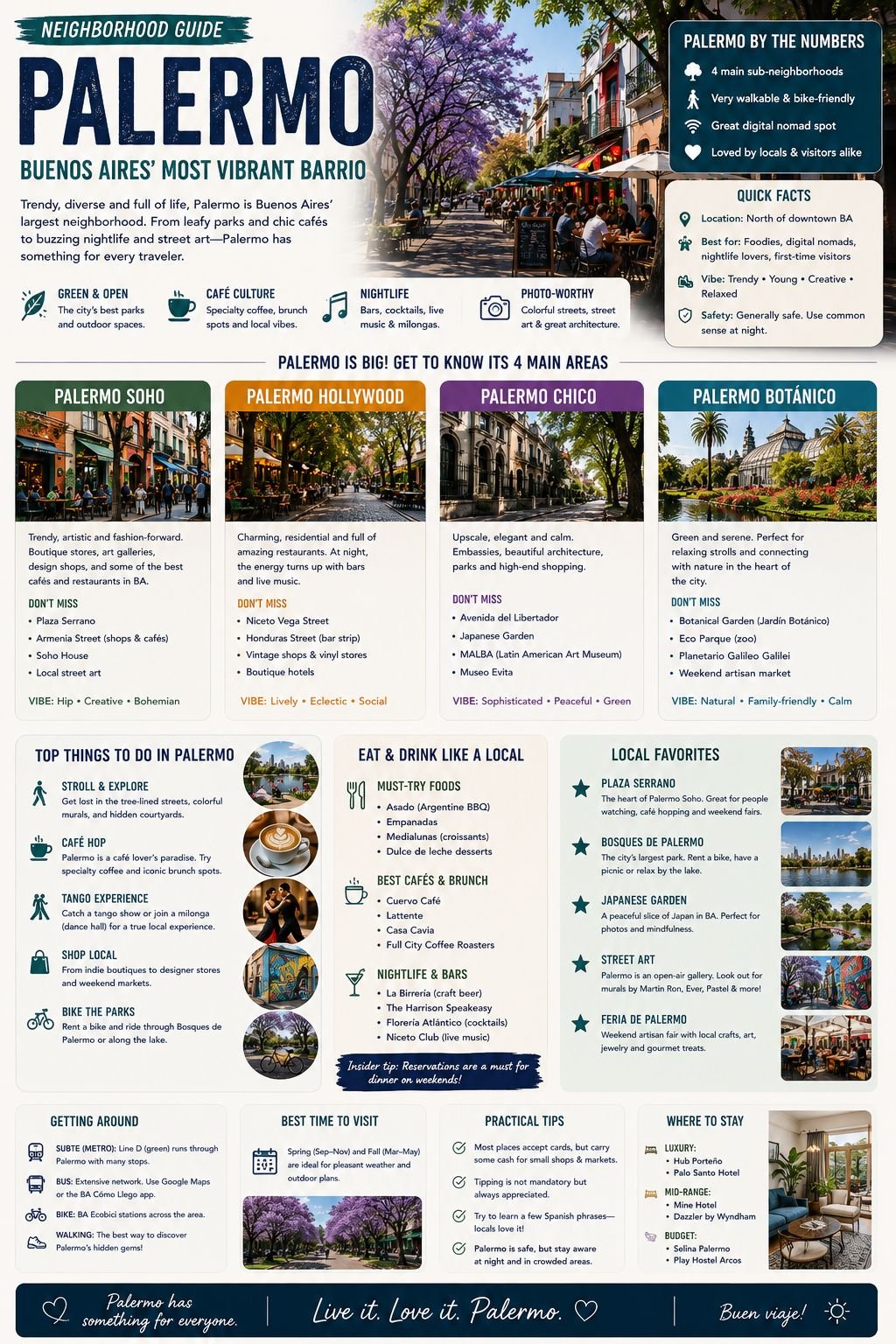
Palermo is where most visitors to Buenos Aires spend the majority of their time, and with good reason. It is the largest neighbourhood in the city, encompassing a range of distinct sub-areas from the design boutiques of Palermo Soho to the restaurant strip of Las Cañitas to the parks and gardens of the northern section. It has the widest range of good restaurants, cafés, and bars in the city, good green space, and an energy that is distinctively Buenos Aires: relaxed in the mornings, building through the afternoon, reaching its social peak somewhere between 11pm and 2am.
The Palermo Sub-Neighbourhoods
Palermo Soho is the commercial heart of the visitor’s Palermo: a grid of tree-lined streets dense with independent fashion boutiques, design shops, leather goods, art galleries, and an extraordinary concentration of good cafés and restaurants. The streets of Gorriti, Honduras, and Thames are the main axes. It is called Soho by a naming logic that is pure Buenos Aires: the neighbourhood was rebranded in the early 2000s by the creative class who moved in and decided it needed a New York analogue.
Palermo Hollywood is immediately north of Soho. It was named for the television production companies that relocated here in the 1990s; the name stuck even as the companies mostly moved on. Today it is primarily a restaurant and bar neighbourhood with a slightly more grown-up, less boutique-focused character than Soho. Some of the city’s best contemporary restaurants are here.
Las Cañitas is a small, tight sub-neighbourhood northwest of Palermo Hollywood, primarily a restaurant strip along Báez and nearby streets. It has a slightly more local, less tourist-heavy character than central Palermo.
The Palermo Parks make up the northern section of the neighbourhood: a large network of parks, lakes, gardens, and recreational spaces that constitute the city’s main green lung. The Rosedal (rose garden) is spectacular in spring. The Japanese Garden (Jardín Japonés) and the Botanical Garden (Jardín Botánico) are both within the park complex.
Things to Do in Palermo
MALBA (Museo de Arte Latinoamericano de Buenos Aires): The finest collection of Latin American modernist and contemporary art in the country, housed in a purpose-built building on Avenida Figueroa Alcorta. The permanent collection includes Frida Kahlo, Tarsila do Amaral, Diego Rivera, Xul Solar, and major Argentine artists. The temporary exhibitions programme is consistently strong.
Museo Evita: In the building that Eva Perón used as a shelter for women in need, this museum on Lafinur tells her life story with considerable sophistication, going beyond the cartoon version to examine her actual political impact and her complex relationship with Argentine society. One of the better museum experiences in the city.
Palermo Parks circuit: The parks are best explored by bicycle, which can be rented at various points; the circuit takes 60 to 90 minutes. The Planetarium, the Rosedal, the Jardín Japonés, and the lakes are all within cycling distance.
El Ateneo Grand Splendid: Technically in the adjacent neighbourhood of Villa Crespo but close enough to include: the most beautiful bookshop in South America, housed in a former theatre. The stage is now a café; the stalls and balconies are bookshelves. It must be seen.
Where to Eat in Palermo
Palermo’s restaurant scene is the most diverse and highest quality in the city. A few specific recommendations:
For an asado experience: Don Julio, on Guatemala, is consistently cited as one of the best parrillas in Buenos Aires and was on the list of Latin America’s 50 Best Restaurants. Reservation essential; book weeks in advance for weekends.
For contemporary Argentine cuisine: Mishiguene, Tegui, and Chila (in Puerto Madero but accessible) represent the creative end of Argentine cooking.
For casual neighbourhood eating: The streets of Palermo Hollywood and Las Cañitas have dozens of excellent mid-range restaurants where a three-course dinner with wine costs USD 20 to 40 per person.
For lunch: Most Palermo restaurants offer a lunch menu (almuerzo) that is significantly cheaper than the same restaurant at dinner.
Where to Stay in Palermo
Palermo has accommodation at every price point:
Boutique hotels: Palermo has the city’s highest concentration of boutique hotels in converted casas chorizo (traditional long, narrow Argentine houses) and belle-époque buildings. Many offer pool, roof terrace, and breakfast included at prices that are very competitive by international standards.
Airbnb and apartment rentals: Palermo is the best neighbourhood for apartment rentals. The residential streets are safe and pleasant; the proximity to good food and cafés makes self-catering genuinely practical.
Budget: Hostels in Palermo are abundant, particularly in Palermo Soho and its edges.
Getting To and Around Palermo
Subte: Line D runs through Palermo, with stations at Scalabrini Ortiz, Ministro Carranza, and Palermo. This line connects south to the city centre (taking approximately 20 minutes to the Plaza de Mayo area) and north to Belgrano. It is the most useful metro line for Palermo residents.
Bus: Multiple colectivo lines cross Palermo in all directions; the city’s Ecobici public bike-sharing system has stations throughout the neighbourhood.
Taxis and apps: Uber and Cabify are widely available in Palermo and take 10 to 20 minutes to the main southern neighbourhoods.
Practical Notes for Palermo Visitors
Street safety: Palermo is among the safer areas of Buenos Aires. The usual awareness around not displaying expensive items and being conscious in crowded areas applies, but the neighbourhood has a low level of serious crime compared to much of the city.
Parking: Buenos Aires traffic and parking are challenging; if arriving from the airport, arriving by taxi or Uber is strongly recommended over rental car.
The Palermo Sunday: Sunday in Palermo has its own character: the parks are busy with joggers, cyclists, and families; the cafés are full from mid-morning; and the restaurants fill up for the Sunday lunch that is a Buenos Aires social institution.
Related: San Telmo | Recoleta | Best Neighborhoods to Stay | Things to Do | Food and Drink
Palermo’s Sub-Neighbourhood Distinctions: A More Detailed Map
The distinctions within Palermo matter for choosing accommodation and daily orientation.
Around Plaza Armenia and Plaza Serrano (sometimes called the heart of Palermo Soho): The densest concentration of restaurants, bars, boutiques, and the social life that defines Palermo for most visitors. This is the area that’s most active on weekend nights and on Sunday afternoons when the feria runs around Plaza Serrano.
The streets north of Córdoba toward Palermo Hollywood: A transition zone between Soho and Hollywood with some of the neighbourhood’s best independent restaurants and a slightly quieter, more residential character. The streets around Fitz Roy and Bonpland are particularly good.
The Las Cañitas strip (around Báez): A tight restaurant and bar corridor that functions as Palermo’s most explicitly social dinner zone, where tables on the pavement extend the restaurant into the street and the energy is explicitly social rather than intimate.
The parks-adjacent area (around Libertador and the Palermo Parks): More family-oriented, with joggers and cyclists in the mornings, and a connection to the city’s leisure infrastructure that is different from the commercial energy of Soho and Hollywood.
The Palermo Food Evolution
Palermo’s food scene is not static; it is one of the most actively evolving restaurant ecosystems in South America. New restaurants open monthly; some close within a year; others become institutions. The challenge and pleasure of eating in Palermo is that the landscape genuinely changes faster than any guide can track.
The most reliable navigation strategy: at any good neighbourhood café or wine bar, asking the staff where they eat when they are not working consistently produces recommendations that are more current and more genuinely good than any printed or online list. Buenos Aires food culture is word-of-mouth; the good places are known to people who work in the industry even when they have not yet reached the food press.
Palermo is the neighbourhood that makes Buenos Aires work for most first-time visitors, and it deserves the reputation. The scale, the variety, the quality of the food scene, the safety, and the sense of being in a neighbourhood that is genuinely alive throughout the day and into the early morning: these are real advantages that are not replicated in the same combination anywhere else in the city. Making Palermo your base for a first visit is the right call; discovering the city’s other barrios from that foundation is the recommended path.
A Final Note
Buenos Aires rewards visitors who arrive prepared and remain open. The practical preparation covered in this guide removes the friction that prevents engagement; the openness is yours to bring. The city that reveals itself to a visitor who knows what they are looking for, who has sorted the practical foundations, and who has the curiosity to follow what the city offers is one of the genuinely great urban experiences available anywhere in the world.
For questions, corrections, or feedback on this guide, the contact page is the right place. This site is updated regularly; if you visit Buenos Aires and find that conditions have changed from what this guide describes, telling us makes the guide better for the next reader.