
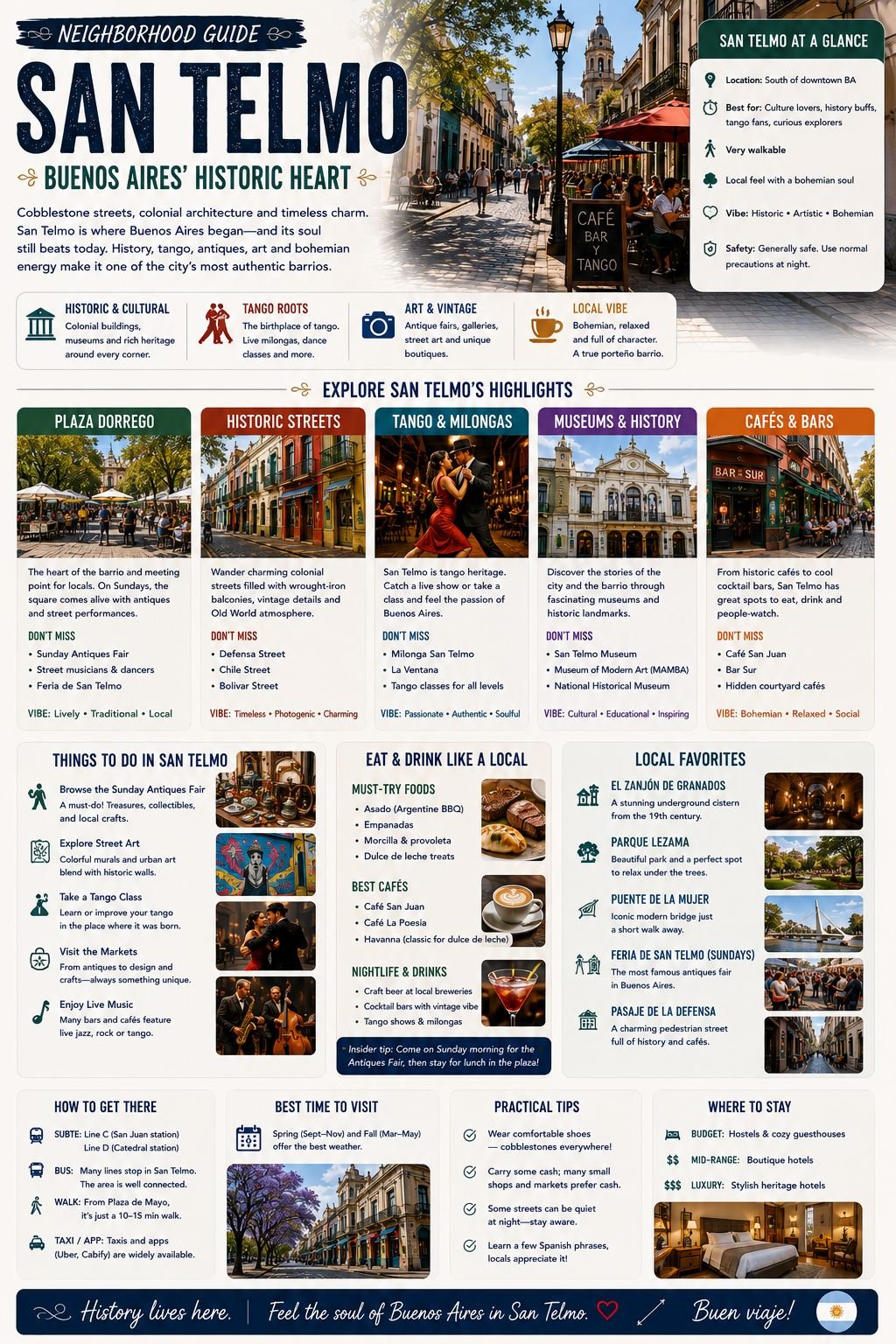
San Telmo is the oldest neighbourhood in Buenos Aires and the one that most clearly embodies the city’s layered, complicated character. The cobblestone streets, the colonial architecture, the Sunday market that has been running in Plaza Dorrego for decades, the tango bars that open at midnight and close at dawn: San Telmo is the Buenos Aires that visitors imagine before they arrive, and it largely delivers on the fantasy while also being more genuinely rough, more lived-in, and more interesting than a tourist district that simply performs at history.
History and Character
San Telmo was the first area of Buenos Aires to be built up south of the historic centre. It was the neighbourhood of the city’s British and Italian communities in the 19th century, a character visible in the architecture: large townhouses and casonas in various states of maintenance, from lovingly restored to gently decaying. The yellow fever epidemic of 1871 killed a significant portion of the neighbourhood’s population and triggered the migration of the wealthy to the north (where Recoleta was subsequently developed); the abandoned houses were subdivided into conventillos (tenements) and became home to the waves of immigrants, particularly from Italy and Spain, who populated the neighbourhood through the early 20th century.
The tango developed in the conventillos of San Telmo and nearby La Boca. The neighbourhood’s association with the dance is historical rather than merely promotional.
Things to Do in San Telmo
Plaza Dorrego and the Sunday Market: The most famous thing in San Telmo and the best free activity in Buenos Aires. Every Sunday from around 10am to 5pm, the plaza and surrounding streets fill with antiques dealers, artisan vendors, street performers, and tango dancers who perform in the square for tips and photographs. It is genuinely excellent: unpredictable, colourful, and completely authentic as an expression of the city’s market culture. Arrive by 11am to avoid the worst of the crowds; come hungry and eat your way through the food stalls around the edges.
Mercado de San Telmo: The covered market on Calle Defensa has been operating since 1897. The original market had meat and produce stalls around the perimeter; the interior has evolved to include artisan food vendors, coffee bars, and craft shops alongside the traditional stalls. The architecture, with its soaring roof supported by cast iron columns, is beautiful. Worth visiting on a non-Sunday morning to see it without the tourist density.
El Zanjón de Granados: One of the most unusual attractions in Buenos Aires, and genuinely extraordinary: an excavated network of tunnels and cisterns running under a colonial-era house, revealing layers of the city’s history back to the 1600s. Guided tours (in English, advance booking required) are the only way to visit. An hour here covers 400 years of Buenos Aires history in a way that no museum can match.
Calle Defensa: The main street of San Telmo, running north-south through the neighbourhood. Walking its entire length (from the city centre south to the park at the southern edge) takes you past the market, numerous antique and craft shops, old parrillas, and the neighbourhood’s best examples of 19th-century architecture.
Tango bars and milongas: San Telmo has the highest concentration of tango venues in the city. El Viejo Almacén on the corner of Independencia and Balcarce, in a converted warehouse, is one of the most atmospheric tango shows in Buenos Aires. La Catedral, a milonga in a rambling building on Sarmiento, is one of the city’s most beloved casual tango venues.
Where to Eat in San Telmo
San Telmo has a strong food scene anchored in traditional Argentine cooking and increasingly diverse with craft beer and artisan food culture.
For parrilla: El Desnivel and La Brigada are the neighbourhood stalwarts; both have been operating for decades and both maintain quality. El Desnivel is smaller and more casual; La Brigada is slightly more formal and slightly more expensive.
For craft beer: San Telmo has a cluster of craft breweries and beer bars, particularly around Calle Estados Unidos. BierKraft is the most serious beer shop in the city.
For coffee: Puerto Fuy and Raw Café are among the best independent coffee shops in the neighbourhood.
Where to Stay in San Telmo
San Telmo has a smaller accommodation offer than Palermo but a more atmospheric one. Boutique hotels in restored colonial houses, small hostels with good common areas, and a growing number of apartment rentals in the neighbourhood’s characteristic tall-ceilinged rooms.
The neighbourhood is safe in its main areas during the day and on Sundays; be more aware at night, particularly on the streets south of Independencia.
Getting To and Around San Telmo
San Telmo has no Subte station of its own (the closest are Peru on Line A and Independencia on Line E) but is walkable from both the historic centre and Puerto Madero. Multiple bus lines run through the neighbourhood. Taxis and Uber are available.
Related: Palermo | La Boca | Best Neighborhoods to Stay | Tango Shows | Milongas
The San Telmo Craft Beer Revolution
One of the most pleasant recent developments in San Telmo is the emergence of a serious craft beer culture in a neighbourhood that previously meant tango bars and traditional wine. A cluster of craft breweries and specialist beer bars has opened in and around the barrio, producing Argentine craft beer at quality levels that would surprise anyone whose experience of Argentine beer is confined to Quilmes.
BierKraft on Peru is the most serious: a specialist beer shop and bar with an extraordinary selection of Argentine craft beers and thoughtful international imports. Jerome on Humberto Primo and the various small taprooms that have opened in the southern end of the neighbourhood are worth exploring for visitors with craft beer interest.
The neighbourhood’s craft beer and traditional wine cultures coexist without friction; you can drink craft IPA at a BierKraft stool and traditional Malbec at an old parrilla on the same evening without any sense of contradiction.
San Telmo’s Literary Life
San Telmo has a quietly strong literary culture centred on a cluster of secondhand bookshops and the neighbourhood’s association with several of Buenos Aires’ most celebrated writers and intellectuals. The bookshops along Defensa and the surrounding streets sell everything from Argentine pulp fiction from the 1940s to 20th-century European literature in Spanish translation. Browsing these shops is one of the quieter and more genuinely local pleasures of a San Telmo afternoon.
The Buenos Aires international book fair (one of the largest in the world) is held in La Rural exhibition centre, accessible from the neighbourhood by taxi, in late April and early May; the book culture that surrounds it is felt throughout the city’s intellectual barrios, of which San Telmo is one.
Getting Out of the Tourist Zone
The tourist experience of San Telmo is concentrated on a few blocks of Defensa and the Plaza Dorrego. Immediately adjacent to this concentration, the barrio opens up into streets that are tourist-free and entirely normal Buenos Aires: fruit shops, mechanics, small restaurants without English menus, and the everyday life of a working Buenos Aires neighbourhood. Walking two blocks west of Defensa and exploring the streets toward Bolívar and Chacabuco gives a completely different version of San Telmo that rewards curiosity.
San Telmo is the Buenos Aires that most visitors imagine before arriving and that, at its best, delivers on the imagination. The combination of genuine history, atmospheric streets, excellent tango culture, and a neighbourhood character that includes both tourist-facing pleasures and entirely real local life makes it the most layered and in some ways the most interesting of the city’s main visitor neighbourhoods. Spending unhurried time here, particularly outside the peak Sunday market hours, produces an experience of Buenos Aires that is genuinely authentic.
A Final Note
Buenos Aires rewards visitors who arrive prepared and remain open. The practical preparation covered in this guide removes the friction that prevents engagement; the openness is yours to bring. The city that reveals itself to a visitor who knows what they are looking for, who has sorted the practical foundations, and who has the curiosity to follow what the city offers is one of the genuinely great urban experiences available anywhere in the world.
For questions, corrections, or feedback on this guide, the contact page is the right place. This site is updated regularly; if you visit Buenos Aires and find that conditions have changed from what this guide describes, telling us makes the guide better for the next reader.
San Telmo is the neighbourhood that most clearly embodies the complexity of Buenos Aires: the tourist experience and the genuine neighbourhood, the historical preservation and the contemporary life, the tango culture designed for audiences and the tango culture that exists for its own participants. Engaging with both layers, the famous and the behind-the-scenes, produces a San Telmo experience that is richer than the one available to visitors who stay on Calle Defensa.