
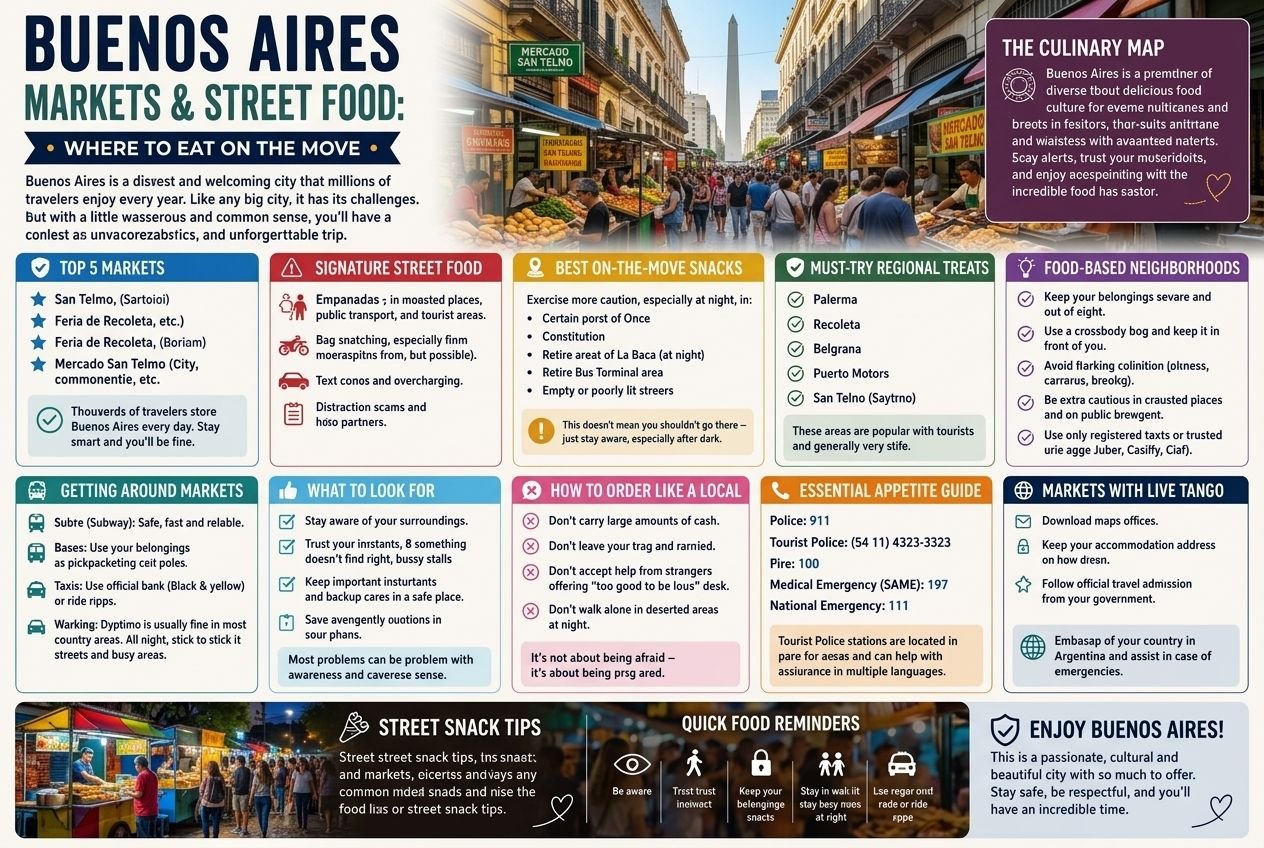
Buenos Aires has a market culture that reflects both its European heritage and its distinctly Argentine character. The covered market (mercado) tradition brought by Italian and Spanish immigrants persists in several beautiful 19th-century buildings; the Sunday flea market and artisan market tradition is one of the city’s most vibrant social institutions; and the street food culture, while less elaborate than Southeast Asian equivalents, has its own specific and excellent character.
The Great Markets
Mercado de San Telmo: On Calle Defensa in San Telmo, this covered market has been operating in the same 1897 building since it opened. The original function was as a neighbourhood food market; the interior now mixes traditional butcher and produce stalls around the perimeter with artisan food vendors, coffee bars, and craft shops in the centre. The building itself, with its cast iron columns supporting a high roof, is one of the finest 19th-century market buildings in South America. Visit on a weekday morning to see it at its most local; avoid Sunday when it becomes crowded with tourists.
Mercado de Belgrano: On Juramento in Belgrano, this covered market has a less touristic character than the San Telmo equivalent and a better variety of fresh produce, fish, cheese, and everyday food shopping. It is the best working market in the city for visitors who want to see how Porteños actually shop rather than a curated tourist version of market life.
Puerto de Frutos, Tigre: Technically outside the city (in the Tigre Delta, accessible by suburban train), the Puerto de Frutos is a riverside market specialising in wicker goods, wood furniture, and delta crafts. It has some food vendors and is best combined with the Tigre day trip rather than as a standalone destination.
The Sunday Markets
San Telmo Antiques Market (Feria de San Telmo): The most famous and best-attended market in Buenos Aires, running every Sunday from approximately 10am to 5pm in and around Plaza Dorrego and along Calle Defensa. Street performers (including tango dancers who perform in the square), antiques dealers, artisan craft vendors, and food stalls combine into one of the great Buenos Aires free experiences. The antiques sold range from genuine period pieces to tourist-oriented reproductions; the prices reflect this, with negotiation expected on everything.
Feria de Mataderos: A Sunday market in the western neighbourhood of Mataderos, significantly further from the tourist centre but offering a more authentic version of the Argentine rural and gaucho craft tradition. The market (held in the area around the Lisandro de la Torre cattle market) features folk music, horsemanship demonstrations, traditional food, and craft vendors selling the leather goods, silverwork, and woven textiles of the Pampas tradition. Worth the journey (colectivo or taxi from the centre) for visitors interested in a less tourist-filtered version of Argentine craft culture.
Street Food: The Essential Items
Buenos Aires street food is anchored in a few specific items that are eaten standing up, from street stalls, or from market vendors.
Empanadas: The most important Argentine street food: small, hand-crimped pastry pockets filled with various savoury fillings (beef, cheese, ham and cheese, chicken, spinach and cheese, and regional variations). Argentine empanadas are baked rather than fried as a default, with a more delicate and flaky pastry than the fried versions found elsewhere in South America. The correct eating technique involves holding the empanada in the hand and biting from the curved end; the juice of the filling would drip if eaten from the crimped side. The [empanadas guide](/food-drink/empanadas/) covers the best places to eat them throughout the city.
Medialunas: The Argentine croissant, smaller and sweeter than the French version, typically eaten for breakfast with coffee. The best medialunas have a light, airy interior and a glossy, slightly sweet exterior glaze. They are available at virtually every café and bakery in the city and are one of the defining food experiences of Buenos Aires.
Choripán: A grilled chorizo sausage in a crusty bread roll, the essential Argentine street meat. Available at markets, street stalls near sporting events, and parrillas that run casual lunch service. The condiment is chimichurri, the herbed oil and vinegar sauce that is Argentina’s contribution to condiment culture.
Pizza and fainá: The Buenos Aires pizza is a specific thing: thick-crusted, generously topped, and typically eaten standing at a marble bar with a glass of moscato (the local sweet sparkling white wine) or red wine. The fainá (a thin chickpea flatbread, similar to Ligurian farinata) is placed on top of the slice or eaten alongside. The historic pizzerias of the Corrientes street and the Microcentro are the traditional venues for this experience.
Food Tours
Several Buenos Aires operators run guided food tours that are worth considering for visitors who want a structured introduction to the food culture. The Buenos Aires Food Tour (run by Eat Buenos Aires), Parrilla Tour (a parrilla circuit with a local guide), and the San Telmo Food Tour are among the most established. These typically run 3 to 4 hours, cover 5 to 8 food stops, and cost USD 60 to 100 per person.
The Wine and Food Culture Intersection
Buenos Aires markets are also excellent wine shopping venues. The Mercado del Abasto and Mercado de San Telmo both have vinotecas (wine shops) where Argentine wines can be purchased at retail prices. The specialist wine shops along Corrientes and in Palermo’s shopping streets are the best venues for more curated selections.
Related: Food and Drink Hub | Best Parrillas | Empanadas | San Telmo
Supermarkets and Everyday Food Shopping
For visitors staying in apartments or those who want to eat breakfast at home, Buenos Aires’ supermarket landscape is worth knowing:
The main chains: Coto, Disco, and Jumbo are the three main supermarket chains, present throughout the city. Coto is the most Argentine in character; Disco (owned by Walmart) is more international in its product range; Jumbo (the largest format) has the widest selection including imported goods. All three stock good Argentine products: excellent beef at the meat counter, good Argentine cheese, wine at very affordable prices, and the range of pantry staples that make a week of home cooking practical.
Feria de frutas y verduras: The neighbourhood produce markets (ferias) that operate in most Buenos Aires barrios on specific days of the week sell fresh fruit and vegetables at lower prices than supermarkets, with direct-from-producer quality for many items. The Palermo feria on Thursday and Sunday mornings is one of the best; each neighbourhood has its equivalent.
Delicatessen and specialty shops: The better delicatessen and specialty food shops in Palermo and Belgrano carry premium Argentine products: aged cheeses, cured meats, artisanal preserves, high-quality olive oil, and specialty wine selections. La Alacena in Villa Crespo and La Boutique del Libro y la Gastronomía are among the most respected.
The Argentine Dessert and Sweet Culture
Argentine sweet culture is an entire topic of its own. The national dessert is dulce de leche, a milk caramel paste of extraordinary richness that Argentines consume with the frequency and commitment that other countries reserve for less addictive substances. It appears in alfajores (the sandwich biscuit that is essentially the national snack food), on medialunas, on pancakes, and eaten directly from the jar with a spoon in the privacy of one’s own kitchen. The Havanna brand alfajores are the most famous; the independent bakeries produce better ones.
Facturas, the term for the full range of Argentine sweet pastries, are a morning culture unto themselves: medialunas, cañoncitos, vigilantes, and various others, bought by the dozen at the neighbourhood bakery and consumed with coffee.
Markets in Buenos Aires are not just food shopping; they are social spaces where the city’s neighbourhood character is most legible. The Sunday feria in San Telmo, the covered market on a weekday morning, the neighbourhood fruit and vegetable stall: each produces a different register of Buenos Aires daily life and each rewards unhurried time. The best Buenos Aires market experiences are the ones where you have nowhere to be and no agenda, free to follow whatever catches your attention.
A Final Note
Buenos Aires rewards visitors who arrive prepared and remain open. The practical preparation covered in this guide removes the friction that prevents engagement; the openness is yours to bring. The city that reveals itself to a visitor who knows what they are looking for, who has sorted the practical foundations, and who has the curiosity to follow what the city offers is one of the genuinely great urban experiences available anywhere in the world.
For questions, corrections, or feedback on this guide, the contact page is the right place. This site is updated regularly; if you visit Buenos Aires and find that conditions have changed from what this guide describes, telling us makes the guide better for the next reader.