
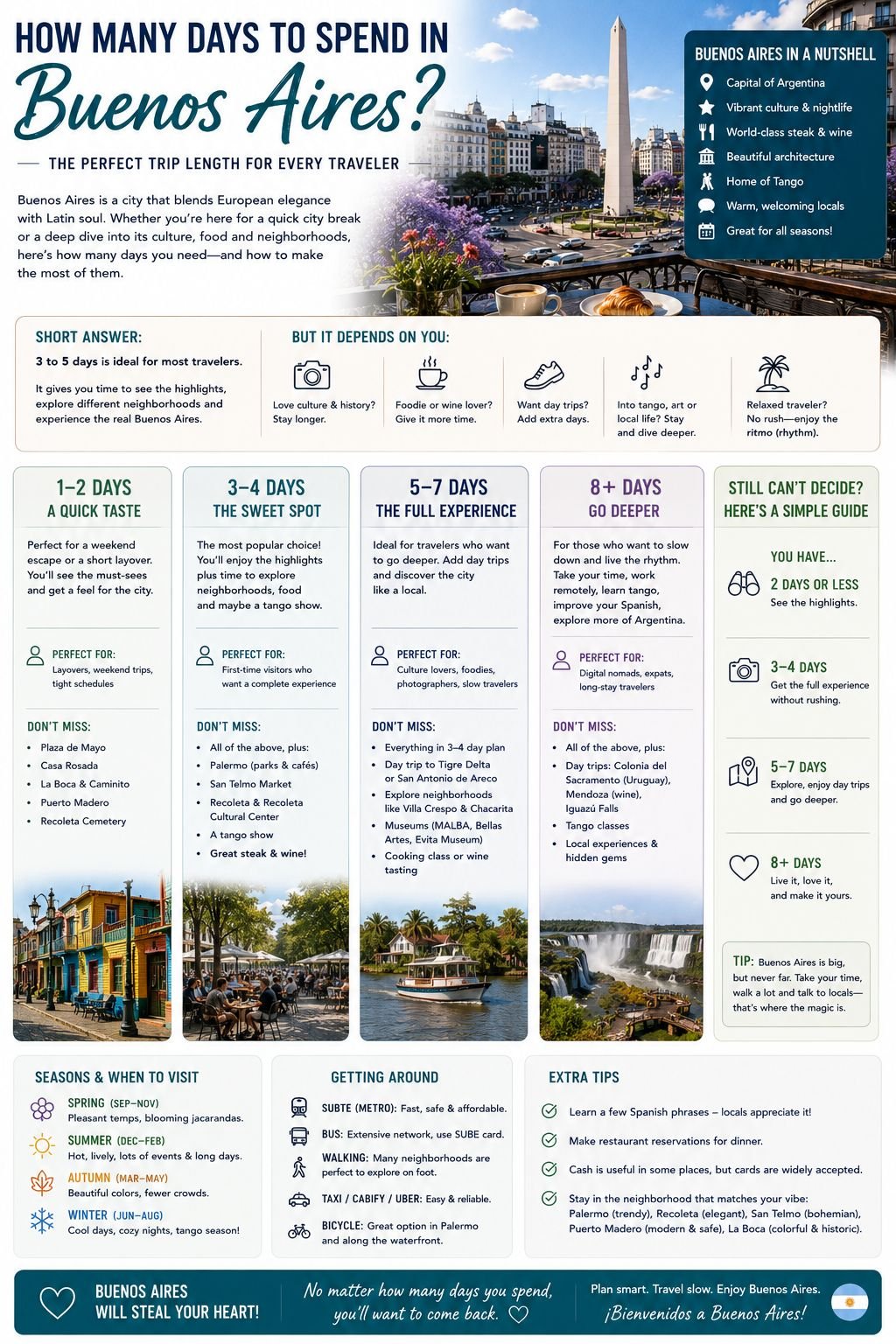
Buenos Aires is one of those cities where the official “highlights” can be covered in two or three days, but where two weeks still feels insufficient if you want to understand the place properly. How long you should stay depends on whether you are here for the highlights, here to genuinely experience the city, or considering whether Buenos Aires might suit a longer stay as a base.
The Honest Assessment by Stay Length
3 days: The highlights, efficiently
Three days is enough to experience Buenos Aires at the most important points. You will see the key sights, eat well, watch tango in some form, and come away with a genuine impression of the city. You will not have time to settle, to figure out your favourite neighbourhood, or to experience the city at its own pace. Three days in Buenos Aires is better than not visiting; it is not enough to really understand it.
What is possible in 3 days:
- The main barrios: San Telmo, Recoleta, La Boca, and part of Palermo
- Recoleta Cemetery
- At least one tango experience (show or milonga)
- At least one proper asado at a good parrilla
- Plaza de Mayo and the historic centre
- A walk through Palermo’s parks and boutiques
What requires time you do not have:
- Day trips (Tigre or Colonia require a full day each)
- Genuine neighbourhood immersion
- Experiencing the restaurant scene at any depth
- The Sunday San Telmo market (plan around a Sunday if possible)
See the 3-day itinerary for a specific framework.
5 days: Good first visit
Five days is the sweet spot for a genuinely satisfying first visit. You have time to see the main attractions, eat well enough to start understanding the food culture, spend a proper evening in a milonga, include a day trip, and begin to feel like you know where you are.
What 5 days adds:
- A full day trip to Colonia del Sacramento or Tigre
- More time in Palermo: parks, boutiques, and the Museo MALBA
- A second proper evening out, with time to experience the nightlife
- Beginning to have a relationship with a specific neighbourhood
- Time for the unexpected: the gallery that catches your eye, the conversation that turns into a dinner invitation
See the 5-day itinerary.
1 week: The right amount for a first visit
A full week is what a Buenos Aires first visit ideally looks like. You have time to do everything on the list and still have two or three days for slowing down, re-visiting places you liked, and discovering things that were not on any list. By day five or six, the city starts to become familiar; you stop consulting the map for every journey and start having a sense of where things are in relation to each other.
A week also allows for two day trips: Tigre one day, Colonia del Sacramento another. These are genuinely worth doing and require a full day each; a shorter visit forces you to choose.
See the one-week itinerary.
2 weeks: Where Buenos Aires really opens up
Two weeks in Buenos Aires moves you from tourist to something approaching temporary resident. You develop routines. You find the café where the staff start recognising you. You begin to navigate by feel rather than by GPS. You have time to explore neighbourhoods that are not on the tourist circuit: Villa Crespo, Coghlan, Chacarita, the enormous La Plata just outside the city.
Two weeks also makes it practical to take a longer trip out of the city: a weekend in Mendoza wine country, a few days in Iguazu Falls, or a crossing into Uruguay for a night.
One month or more: The base camp approach
For travellers who use cities as bases for exploring a region, or who want to genuinely live in Buenos Aires rather than visit it, a month or more is when the city makes the most sense. You settle into a furnished apartment (significantly cheaper per month than hotels), develop a social network, find your routines, and experience the city through its rhythms rather than its attractions.
Buenos Aires is excellent for this kind of extended stay. Costs are low, quality of life is high, the food and cultural scene is extraordinary, and the city has the infrastructure (coworking spaces, reliable internet, international community) to support remote work and an active social life.
The Days Not to Waste
Sundays are special. The San Telmo antiques and artisan market at Plaza Dorrego is one of Buenos Aires’ great free pleasures: street performers, tango dancers in the square, vendors selling anything from 1920s magazines to handmade leather goods. If your trip includes a Sunday, build the San Telmo market into the morning.
Reserve a full evening for a tango milonga. A tango show is two hours; a milonga can be an all-night experience. The authentic tango culture of Buenos Aires is in the milongas, not the shows, and experiencing it properly requires not having to leave by midnight for an early morning the next day.
One meal should be an unhurried asado. Argentine parrilla culture is not about fast eating. A proper lunch or dinner at a good parrilla takes two to three hours without trying to rush it. Reserve a slot in the itinerary where this can happen at its natural pace.
Building an Itinerary: The Key Principles
Stay in one neighbourhood at a time. Rather than trying to see every barrio every day, spending one or two days per area produces a more genuine sense of each place. Palermo for two days, San Telmo for one day, Recoleta for one day: this is more immersive than a half-hour in each on the same day.
Plan evenings separately from days. Buenos Aires daytime and nighttime are genuinely different cities. Build evening plans (restaurant, show, milonga) separately from daytime plans, and accept that evenings will run later than you expect.
Leave blank time. The best Buenos Aires experiences are often unplanned. An afternoon with no agenda, a willingness to follow an interesting side street, the freedom to stay at a café when the conversation is good: these require slack in the schedule that tightly programmed itineraries do not allow.
Specific Itinerary Recommendations by Interest
Not every Buenos Aires visitor is optimising for the same things. A few specific frameworks:
For tango enthusiasts: Minimum 5 days, ideally 7 to 10. You need at least three to four evenings at milongas to develop a sense of the scene, time for tango lessons if you want them, a show or two for context, and the freedom to follow the evening wherever it leads. Planning around August for the festival is worth doing if dates are at all flexible.
For food and wine focused visitors: 5 to 7 days. The restaurant scene requires time; eating one great meal per day while doing other things produces a better food experience than two meals per day rushed between sights. Include a Mendoza wine country weekend trip if a week or more allows it.
For architecture and history visitors: 4 to 5 days cover the main architectural periods and significant sites. The Microcentro circuit, Recoleta, San Telmo, La Boca, and Puerto Madero represent distinctly different architectural and historical moments. The MALBA, the Bellas Artes, and the Evita museum together provide the art and history context for what you are seeing.
For families with children: 5 to 7 days at a slower pace. The Palermo Parks, the Japanese Garden, the zoo, the MALBA’s family programming, the Tigre Delta, and the generally welcoming attitude of Buenos Aires restaurants toward children all make the city work better for families than most travel guides suggest.
For those combining Buenos Aires with the wider Argentina trip: 3 to 4 days in Buenos Aires as a gateway, with the rest of the time in Mendoza, Patagonia, Iguazú, or the northwest. Buenos Aires is a genuine destination in its own right but also a natural starting point; its infrastructure (international connections, Spanish immersion, orientation to Argentine culture) makes it the right opening or closing chapter for a wider Argentine journey.
However many days you have in Buenos Aires, they will not feel like enough by the time you leave. This is the consistent experience of visitors across all stay lengths; it is not a failure of planning but a consequence of the city’s depth. Accepting this before arrival and focusing on experiencing what your stay allows rather than compensating for what it doesn’t, produces a better trip than trying to resolve the tension by over-scheduling.
A Final Note
Buenos Aires rewards visitors who arrive prepared and remain open. The practical preparation covered in this guide removes the friction that prevents engagement; the openness is yours to bring. The city that reveals itself to a visitor who knows what they are looking for, who has sorted the practical foundations, and who has the curiosity to follow what the city offers is one of the genuinely great urban experiences available anywhere in the world.
For questions, corrections, or feedback on this guide, the contact page is the right place. This site is updated regularly; if you visit Buenos Aires and find that conditions have changed from what this guide describes, telling us makes the guide better for the next reader.