
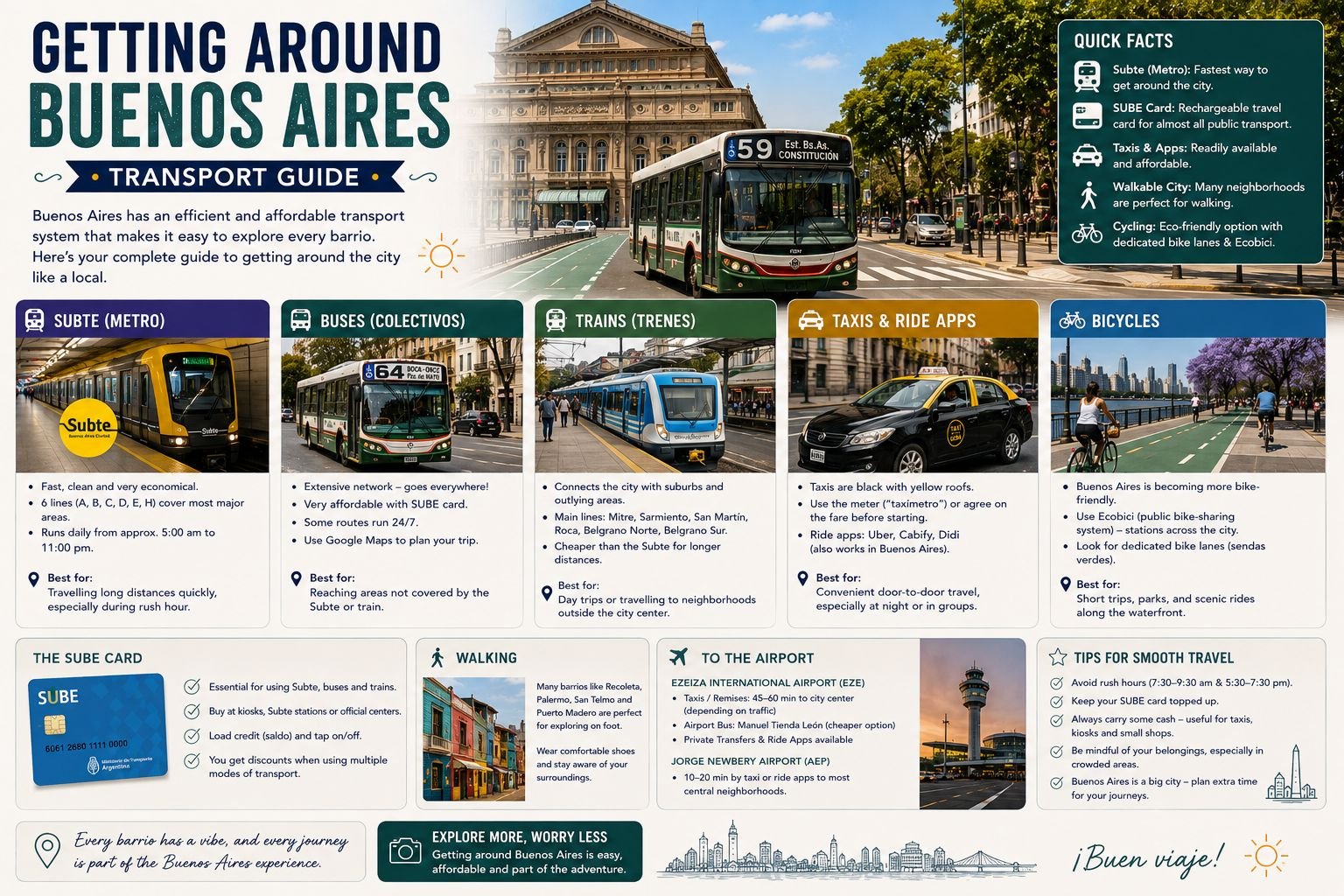
Buenos Aires is a large city, but the neighbourhoods that most visitors spend time in, from Palermo in the north to San Telmo and La Boca in the south, span a distance of approximately 10 kilometres. This is walkable in parts, well-served by the Subte (metro) along key axes, and easily covered by taxi or app-based ride services for any journey that requires more direct routing.
The SUBE Card: Your Transport Foundation
The SUBE card (Sistema Único de Boleto Electrónico) is the rechargeable transit card used for all public transport in Buenos Aires: the Subte, the colectivos (buses), and the suburban rail lines. Having a SUBE card is the foundation of navigating the city by public transport.
Getting a SUBE card: Available at kiosks (quioscos), lottery agencies (locales de lotería), and some supermarkets throughout the city. Ezeiza and Aeroparque airports have SUBE card vending machines in or near the arrivals areas. The card costs a small fee; top up credit at the same locations where you buy it.
Using it: Tap the card on the reader when boarding a bus or entering a Subte station; the fare is automatically deducted. The integrated fare discount (descuento por transferencia) applies if you transfer between the same or different modes within a set time window, reducing the total cost of combined journeys.
The Subte (Metro)
Buenos Aires’ Subte (short for subterráneo, underground) has six lines:
Line A (Azul, light blue): Runs east-west through the Microcentro and western neighbourhoods to San Pedrito. Passes through Plaza de Mayo, Lima, and the Microcentro commercial streets.
Line B (Rojo, red): Runs east-west from Leandro N. Alem (near Puerto Madero) through Once and west to Juan Manuel de Rosas.
Line C (Verde, green): Runs north-south connecting Retiro (north) with Constitution (south), passing through Lima and diagonal stations that connect multiple lines. The most useful north-south line.
Line D (Verde oscuro, dark green): Runs north-south from Congreso de Tucumán (Belgrano area) through Palermo, Recoleta, and into the Microcentro. The most useful line for visitors staying in the northern barrios.
Line E (Lila, purple): Runs east-west from Bolívar to General Urquiza.
Line H (Amarillo, yellow): Runs north-south on the western side of the city.
Hours: Lines generally operate from approximately 5am to between 10pm and midnight (extended on Friday and Saturday nights). Service frequency is every 3 to 6 minutes during peak hours.
Fares: Very cheap by international standards; under USD 1 per journey using a SUBE card.
Colectivos (Buses)
Buenos Aires has one of the most extensive urban bus networks in South America, with over 140 lines covering the entire metropolitan area and operating 24 hours. For destinations not on the Subte network or for journeys requiring more specific routing, the colectivos are the practical solution.
Navigating: Use Google Maps or the Moovit app for Buenos Aires bus routes; both apps are reliable and provide real-time arrival information. Enter your origin and destination; the app shows the relevant bus lines, where to catch them, and where to get off.
Payment: Only by SUBE card; colectivos do not accept cash. Having sufficient credit on your SUBE card is essential.
Identifying the right bus: Each bus line has a number; the route is shown on signs at the front of the bus. The driver does not announce stops; use your phone map to track your position and know when to ring the stop bell.
Taxis
The standard Buenos Aires taxi is black with a yellow roof. They are metered and, in normal tourist areas, generally honest. The fare structure starts with a base charge when you enter and increments with both distance and time.
Flagging a taxi: Easy throughout the city; taxi availability is generally good during the day and evening. Late-night taxis are less abundant.
Using the meter: Ensure the driver starts the meter at the beginning of the journey (meter should be visible and running). Most legitimate taxi drivers start the meter automatically; if not, you can ask.
Radiotaxis and taxi apps: Several radio taxi companies can be called by phone (which requires Spanish); the cab arrives at your location. This is more reliable than flagging on the street for late-night journeys or when a specific destination is involved.
Uber and Cabify
Both Uber and Cabify operate in Buenos Aires and are widely used. After an initially legally uncertain period, these services are now normalised. Both offer in-app payment by card (international cards are accepted) or cash, and typically match or slightly undercut standard taxi prices for most journeys.
Practical advantage: The app shows price estimates before booking, the route is tracked, and the driver rating system provides accountability. For visitors unfamiliar with the city, the certainty of the app-based service is valuable.
Cycling
Buenos Aires has a growing cycling infrastructure including the EcoBici public bike-sharing system (requires registration, free or very cheap for short journeys) and dedicated ciclovías (cycling lanes) in many main streets. Cycling is a practical option for daytime travel in Palermo and Recoleta; it is less practical in the dense Microcentro or south of the city.
Related: Airports | Ezeiza to City | Practical Info Hub | Neighborhoods
The Buenos Aires Traffic Reality
Buenos Aires traffic is a specific phenomenon worth preparing for. The city has one of the highest rates of car ownership in Latin America, a road network that predates cars, and a driving culture that operates on principles somewhat different from Northern European traffic norms. The result is dense, chaotic traffic that produces journey times that are variable in ways that are difficult to predict.
For visitors, the practical implication is: build more time into journeys by road than the apparent distance suggests. A Palermo to San Telmo journey that takes 12 minutes at 10am can take 35 minutes at 6pm. The Subte, which runs on tracks below the street, is immune to this variability; for time-sensitive journeys, the Subte is always the more reliable option than surface transport.
Crossing the street: Buenos Aires pedestrian crossings are advisory rather than regulatory in practice. Traffic frequently does not stop for pedestrians at green lights; crossing at any Buenos Aires intersection requires verifying that vehicles are actually stopping before stepping off the kerb, regardless of the light signal.
Night Transport: How to Get Around After Midnight
Buenos Aires nightlife runs until 4am and beyond; knowing how to get home at unconventional hours is practical preparation.
Uber and Cabify operate 24 hours and are the most reliable late-night option. During peak early-morning hours (2am to 4am on weekends, when clubs are releasing simultaneous crowds), there can be surge pricing and some wait times; booking the return journey before you need it reduces this.
Night buses (colectivos): Buenos Aires buses run 24 hours. At 3am, frequency is lower than during the day but the buses do run; navigation requires the Moovit app and comfort with the system. For those who know the city well, buses are a very cheap late-night option.
Radio taxis: Phone-ordered radio taxis operate at night; the Buenos Aires radio taxi dispatcher (Remisseria) can be called by phone (Spanish required) for a reliable, metered car.
Buenos Aires transport rewards learning the SUBE card system and the colectivo network, even if you mostly use Uber and Cabify for convenience. The colectivos are genuinely excellent, cover the entire city, run all night, and cost almost nothing; the Subte is fast and reliable for the routes it covers. A visitor who learns to use public transport alongside the app-based services develops a more independent and more cost-effective relationship with the city than one who relies entirely on ride-hailing.
A Final Note
Buenos Aires rewards visitors who arrive prepared and remain open. The practical preparation covered in this guide removes the friction that prevents engagement; the openness is yours to bring. The city that reveals itself to a visitor who knows what they are looking for, who has sorted the practical foundations, and who has the curiosity to follow what the city offers is one of the genuinely great urban experiences available anywhere in the world.
For questions, corrections, or feedback on this guide, the contact page is the right place. This site is updated regularly; if you visit Buenos Aires and find that conditions have changed from what this guide describes, telling us makes the guide better for the next reader.
Buenos Aires transport, taken as a whole, is genuinely good. The combination of an extensive Subte network for fast cross-city movement, a comprehensive 24-hour colectivo system for neighbourhood-level coverage, and the reliable app-based ride services as a flexible complement to public transport, means that getting anywhere in the city is achievable by multiple means. The SUBE card and a working smartphone cover the vast majority of transport needs.