
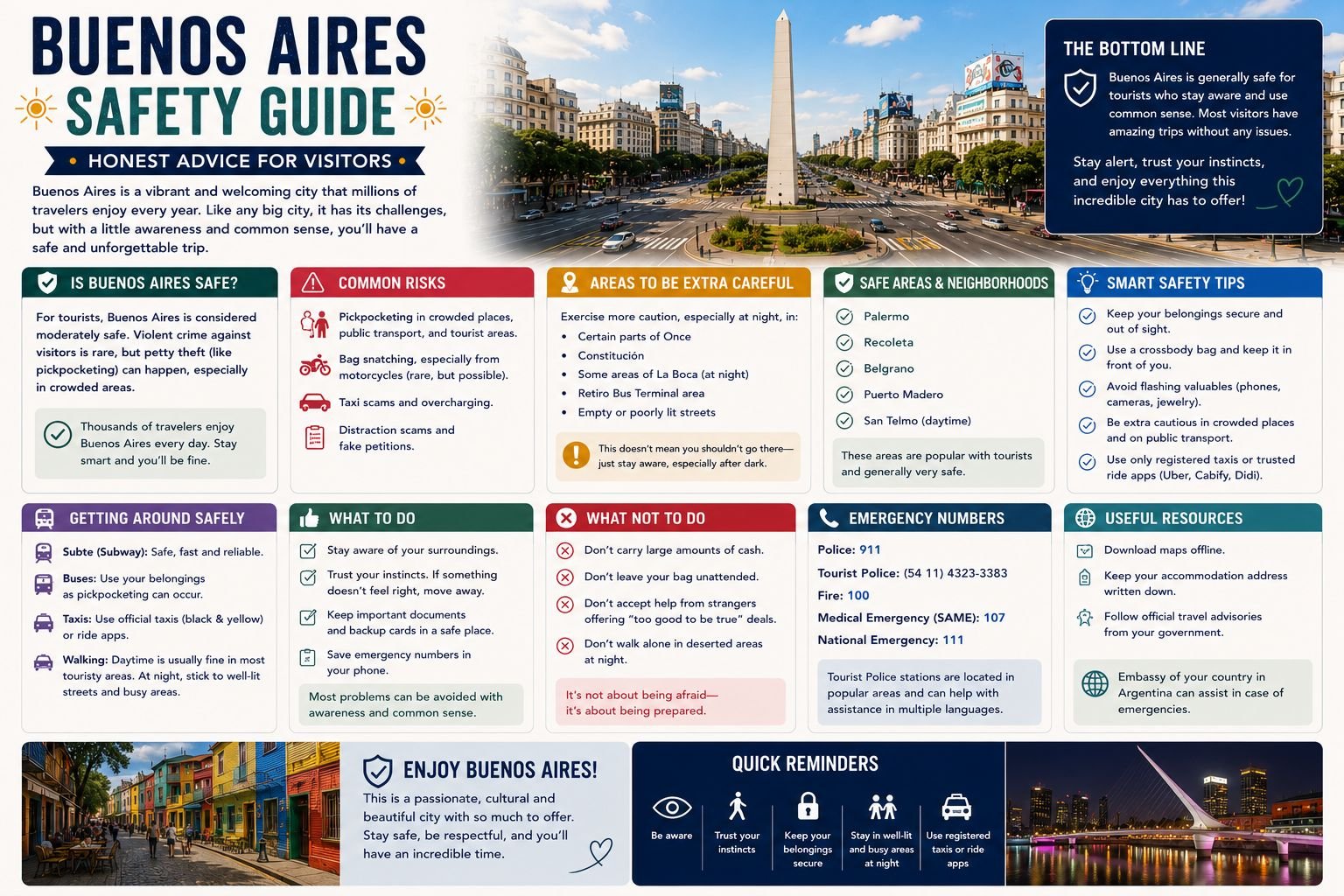
Buenos Aires is broadly safe for tourists by South American city standards. The city does not have the elevated homicide rates of some other major Latin American cities; the tourist areas are generally well-policed; and the specific risks affecting visitors are predominantly in the petty crime and scam categories rather than serious violent crime. That said, Buenos Aires is a major city of 15 million people with genuine urban safety challenges, and visiting without any awareness would be naive.
This guide gives you the honest picture: what the actual risks are, where they are concentrated, and the specific practices that reduce your exposure.
The Actual Risk Picture
What the risks mostly are: Petty theft (pickpocketing, bag snatching), telephone theft (phone snatched from hand while being used), and tourist-targeting scams. These are the primary safety challenges for visitors to Buenos Aires. They are real but manageable with basic urban awareness.
What the risks mostly are not: Violent crime targeting tourists in the main visitor areas is statistically uncommon. Street robberies at knifepoint or gunpoint do occur in Buenos Aires overall, but are much more concentrated in specific areas (shanty towns, certain peripheral neighbourhoods) rather than in the tourist areas most visitors inhabit.
The neighbourhood variable: Safety is not uniform across the city. The northern tourist barrios (Palermo, Recoleta, Las Cañitas) have relatively low crime rates; San Telmo and La Boca require more active awareness; and some peripheral areas should simply not be visited by tourists without local accompaniment.
The Highest-Risk Situations
Tourist areas during crowded hours: The Caminito in La Boca, the San Telmo Sunday market on Calle Defensa, and the Florida walking street in the Microcentro during busy periods are the highest-frequency pickpocketing environments in the city. Being in these areas requires specific attention: phone in pocket rather than in hand, bag worn at the front, and awareness of people who get unusually close.
Transport hubs: The Retiro bus terminal area, Ezeiza airport arrivals (where unofficial taxi operators operate), and the busy Subte stations during rush hour have higher rates of theft and scam attempts than other areas.
ATM use: Using ATMs in isolated or poorly lit locations is a risk that is completely avoidable. Use ATMs inside banks or established commercial premises, preferably during daylight hours.
Phone use on the street: Phone theft by snatching is the most common theft type in Buenos Aires. Phones held in the hand while walking are the primary target; keeping your phone in a pocket and using it with your back to a wall or inside a café reduces this risk dramatically.
Specific Safe Practices
Bag management: A bag worn across the body with the clasp at the front is much harder to snatch than one carried on a shoulder or in a hand. Leave obviously expensive bags at your accommodation; a simple, unobtrusive day bag attracts less attention.
Displaying wealth: Argentina has significant economic inequality; displaying expensive jewellery, watches, or multiple high-end devices creates an unnecessary target profile. Reasonable awareness about what you display in public reduces your attractiveness as a target.
Navigation: Looking obviously lost, stopping to study a map on a busy pavement, or standing with your luggage in an unfamiliar area attracts the wrong kind of attention. Use navigation apps before reaching street-level to orient yourself; if you need to stop and look at your phone, do it inside a shop or café.
Trust your instincts: If a situation or location feels wrong, leave it. The instinct that something is off in a specific situation is worth acting on.
The La Boca Specific Warning
La Boca is the neighbourhood that requires the most specific safety awareness in Buenos Aires. The Caminito tourist area is well-patrolled and relatively safe; walking more than a few blocks outside the immediate tourist precinct is genuinely inadvisable. The surrounding neighbourhood has a different safety profile from the tourist strip, and visitors who wander are often targeted.
Stay within the designated tourist area (the Caminito, the Fundación PROA building, the Bombonera stadium and museum), arrive by taxi or Uber rather than walking from the Subte, and return to the centre rather than continuing south.
If Something Goes Wrong
Theft: Report to the nearest Comisaría (police station) for a police report, which you will need for insurance purposes. The tourist police (Comisaría del Turista) at Avenida Corrientes 436 handles tourist-related crime reports in English.
Medical emergency: The public hospital emergency system is functional and free for foreigners for emergency treatment. Dial 107 for an ambulance. Travel insurance with medical cover and evacuation is strongly recommended; the insurance sections of the travel planning guide cover this.
Lost passport: Contact your country’s embassy or consulate immediately. Embassy contact details are available through your government’s travel advisory website.
Related: Scams Guide | Practical Info Hub | Safety for Solo Travellers | Plan Your Trip
Safe vs Unsafe: A More Nuanced Map
The binary of “Buenos Aires is safe/unsafe” is less useful than a more granular understanding of where specific risks are concentrated.
Very low tourist risk: Palermo Soho and Hollywood during the day; Recoleta throughout; the Palermo Parks; the Puerto Madero waterfront; Belgrano.
Standard urban awareness required: The Microcentro during business hours; San Telmo (main streets); the main tourist areas of La Boca (Caminito and immediate surroundings); Saturday evenings in the main bar areas.
Heightened awareness required: San Telmo’s southern and eastern edges after dark; the Florida Street pedestrian zone (pickpocket concentration); the Retiro bus station area; anywhere around major sporting events.
Not recommended for independent tourist exploration: The streets of La Boca beyond the tourist precinct; certain peripheral barrios in the south and west of the city that are outside the tourist circuit; the areas immediately around some of the villas (informal settlements).
This is not a complete safety map; it is a starting framework. Advice from your accommodation about the specific situation around where you are staying is always more current and specific than any general guide.
After an Incident: The Practical Steps
If you are the victim of theft or another incident in Buenos Aires:
Contact the Comisaría del Turista (at Corrientes 436, or call 4346-5748 during business hours) for tourist-related crime reports. Staff there speak multiple languages and can assist with the police report required for insurance claims.
Your insurance emergency line: Most travel insurance policies have 24-hour emergency numbers; calling this immediately after a medical or significant theft incident initiates the claims process and ensures any required authorisations are in place.
Your embassy: For lost or stolen passports, contact your country’s embassy or consulate. Most embassies have emergency numbers for after-hours passport issues; having this number saved before travel is worthwhile.
Keep digital copies of all documents: Photographs of your passport, travel insurance documents, and accommodation confirmations stored in a cloud service (accessible from any device) provide the information you need to navigate an incident even if physical documents are gone.
Buenos Aires safety, properly understood, is not an obstacle to having a rich and open experience of the city. The specific risks are manageable with specific practices; the genuine warmth and openness of Buenos Aires social life is not diminished by maintaining appropriate urban awareness. The visitor who approaches the city with calibrated rather than excessive caution, who understands where the actual risks are rather than applying general anxiety to every situation, will have both a safe and a rewarding Buenos Aires experience.
A Final Note
Buenos Aires rewards visitors who arrive prepared and remain open. The practical preparation covered in this guide removes the friction that prevents engagement; the openness is yours to bring. The city that reveals itself to a visitor who knows what they are looking for, who has sorted the practical foundations, and who has the curiosity to follow what the city offers is one of the genuinely great urban experiences available anywhere in the world.
For questions, corrections, or feedback on this guide, the contact page is the right place. This site is updated regularly; if you visit Buenos Aires and find that conditions have changed from what this guide describes, telling us makes the guide better for the next reader.
Buenos Aires safety, approached with accurate information rather than generalised anxiety, is not an obstacle to having a fully open and rich experience of the city. The city has genuine safety challenges; they are specific, concentrated, and largely manageable. Millions of visitors experience Buenos Aires as the warm, hospitable, and exciting city it is, without encountering the safety issues that general caution might suggest are ubiquitous. Calibrated awareness and specific preparation produce both safety and the freedom to engage with the city without excessive caution.
Buenos Aires rewards the traveller who arrives prepared and remains curious. Every guide in this site is designed to remove the friction between arrival and genuine engagement with the city; the engagement itself is yours to pursue. The city is inexhaustible, genuinely warm, and consistently surprising even to those who have been here many times. Whatever brings you to Buenos Aires, whether a first visit, an extended stay, or the beginning of a longer Argentine chapter, the preparation this guide provides is the starting point. What comes next is the city’s contribution.