
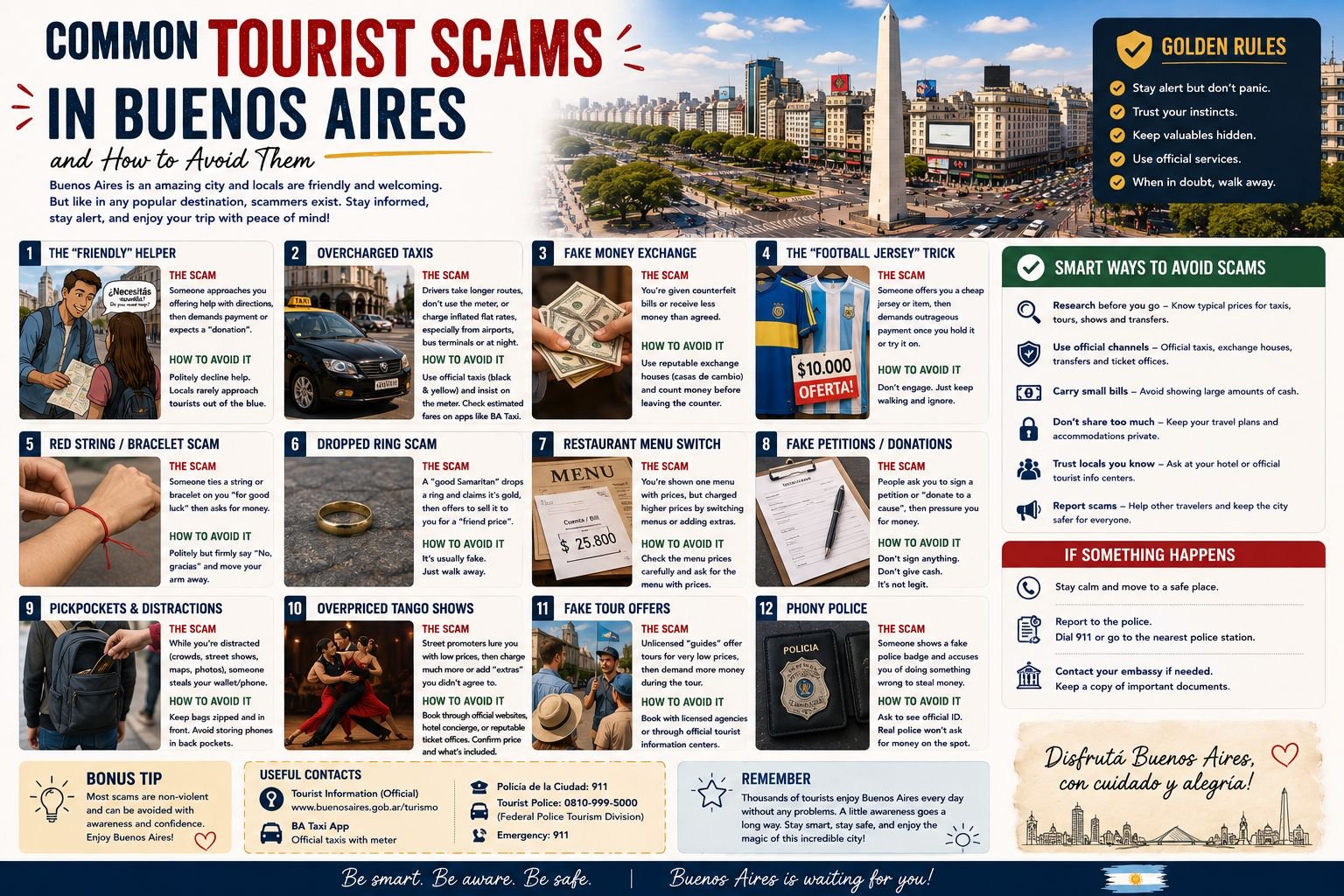
Buenos Aires has a well-documented set of tourist-targeting scams that have been operating in recognisable forms for many years. The good news: knowing what these scams look like means you will recognise them immediately when they appear, and recognition is 90 percent of the defence. The following are the most common and most important to know before you arrive.
The “Something on Your Clothing” Scam (Mustard Scam)
How it works: Someone approaches you on the street and points out, or you feel, something that has appeared on your clothes or bag: mustard, bird droppings, ice cream, ketchup. A helpful stranger immediately offers to help clean it off. While your attention is on your clothing and the helpful stranger, an accomplice rifles through your bag or pockets.
Where it happens: Tourist areas throughout Buenos Aires, particularly around Florida Street, San Telmo, La Boca, and bus station areas. Most frequently near the Florida/Lavalle intersection and around the main tourist attractions.
How to defend: If anything appears on your clothing in a public area, keep both hands on your belongings immediately and decline any offers of help. Move into a shop or café and check your belongings before attending to your clothing. The substance was deliberately placed there; you did not simply walk under a pigeon.
Taxi Overcharging and Meter Manipulation
How it works: A taxi driver takes a longer route than necessary, manipulates the meter to run faster than standard, or quotes a fixed price significantly above the metered rate for the journey. The less formal version is simply charging for a different currency unit than expected.
How to defend: Use the Uber or Cabify app whenever possible; the pre-calculated price eliminates meter disputes entirely. For street taxis, ensure the meter starts when you enter the vehicle. Know approximately how much a journey should cost: a 10-minute city journey should be USD 3 to 6; Ezeiza to the city centre should be USD 25 to 45. Significant deviations from these ranges are a signal.
The most important rule at Ezeiza airport: do not accept unofficial taxi offers from people who approach you in the arrivals hall. Use only the official transport desk inside the terminal.
The “Currency Help” Scam on Florida Street
How it works: Someone on Florida Street whispers “cambio, cambio” (exchange, exchange) offering to exchange your USD for pesos at a rate that sounds attractive. If you follow them to a doorway or small office, you will receive either counterfeit pesos, a short count, or both.
How to defend: Do not exchange money with anyone who approaches you on the street. If you want to exchange cash through informal channels (which this guide does not recommend; see the [blue dollar guide](/practical-info/blue-dollar/)), use a visible, established exchange office rather than a street approach.
Fake Police Scam
How it works: Someone approaches you (often after a suspicious transaction near the street, or simply at random) and identifies themselves as a plainclothes police officer concerned about counterfeit currency. They show a credential (which may or may not be real) and request to see your wallet and cash to inspect it for counterfeits. The cash is examined and returned; in some cases some of the notes are swapped for counterfeits during the “inspection,” or cash is simply removed.
How to defend: Real Argentine police do not stop tourists on the street to inspect their wallets. Decline politely but firmly and offer to walk with the officer to the nearest police station if the officer insists there is a problem. Real police will have no objection to this; fake police will disappear. Never hand your wallet or passport to anyone on the street claiming to be a plainclothes officer.
The Distracting Street Performer
How it works: A street performer, a surprise encounter, or a social approach draws your attention in a crowded public area while an accomplice works through bags or pockets in the immediate vicinity.
How to defend: In crowded public areas (the Sunday market, La Boca, tourist concentration points), keep your bag in front of you and be specifically aware of anyone who gets unusually close. Engaging with street performers or vendors in tourist areas while holding a phone or with a bag hanging behind you is a risk.
Accommodation and Booking Scams
How it works: Fake hotel or apartment listings on major booking platforms (less common than it was, as platforms have improved verification, but still present) ask for payment outside the platform or produce accommodation very different from the listing.
How to defend: Book through established platforms with verified reviews (Booking.com, Expedia, Airbnb with verified listings). Do not make payments outside the platform. If an accommodation asks for pre-payment directly into a bank account, treat this as a major red flag.
General Principles
Most tourist scams share a common structure: they use distraction (something unexpected draws your attention) combined with an approach (someone helpful or authoritative enters your space). Recognising this structure makes you resistant to the specific variants regardless of the exact form they take.
Buenos Aires is not uniquely dangerous by global city standards; the scams that exist here exist in similar forms in Paris, Rome, Barcelona, and most major tourist cities. The specific flavours are locally adapted, but the underlying mechanisms are universal.
Related: Safety Guide | Practical Info Hub | Money Guide | Plan Your Trip
The Psychological Dynamics of Tourist Scams
Understanding why scams work is as useful as knowing the specific forms they take, because it makes you resistant to new variations you haven’t read about.
Most tourist scams exploit two psychological vulnerabilities:
The helping instinct: The “something on your clothing” scam, the taxi driver who points out your bag is open, the friendly person who warns you about a danger nearby: all activate your instinct to respond to someone being helpful. Recognising that an unrequested interaction in a tourist area often comes with an agenda does not require suspicion of everyone; it requires a momentary pause before responding to any unsolicited approach.
Authority compliance: The fake police officer, the person who claims to be from your hotel, the official-looking person who asks to inspect your valuables: these exploit the instinct to comply with apparent authority. Real authorities in Buenos Aires do not approach tourists on streets for document or wallet inspections; any such interaction is a scam.
Building Your Scam Resistance
The most reliable scam prevention for Buenos Aires is simple and requires no memorisation of specific scam scripts:
Default to politely declining any unsolicited interaction on tourist streets: You can do this while remaining entirely friendly. “No thank you” said pleasantly to someone who approached you unrequested is neither rude nor paranoid; it is appropriate urban behaviour.
Never give anything to anyone who approaches you uninvited: Wallets, phones, passports, bags, money. If someone claims to need to inspect something of yours, the correct response is to offer to walk with them to a formal authority location (police station, your hotel, anywhere with a fixed address).
Use apps for transactions with strangers: Uber rather than flagged taxis; card payment rather than cash in tourist-heavy environments; Mercado Pago QR codes rather than handing cash to unknown vendors. Reducing physical cash transactions in unfamiliar environments reduces the most common theft vectors.
Knowing the Buenos Aires scam landscape protects you from a small number of predictable attempts to take advantage of tourist unfamiliarity, and does nothing to reduce the genuine warmth and generosity that characterises most interactions with Porteños. The scams are the exception; the hospitality is the rule. Understanding the difference allows you to navigate both accurately.
A Final Note
Buenos Aires rewards visitors who arrive prepared and remain open. The practical preparation covered in this guide removes the friction that prevents engagement; the openness is yours to bring. The city that reveals itself to a visitor who knows what they are looking for, who has sorted the practical foundations, and who has the curiosity to follow what the city offers is one of the genuinely great urban experiences available anywhere in the world.
For questions, corrections, or feedback on this guide, the contact page is the right place. This site is updated regularly; if you visit Buenos Aires and find that conditions have changed from what this guide describes, telling us makes the guide better for the next reader.
Awareness of the Buenos Aires scam landscape is a form of protection that requires no paranoia and does not diminish the genuine warmth of most interactions with Porteños. The scams are specific, recognisable, and operated by a small number of people in specific locations. The genuine hospitality and social generosity of Buenos Aires residents is the overwhelming character of the city; the scams are exceptions that are easily identified once you know what they look like.