
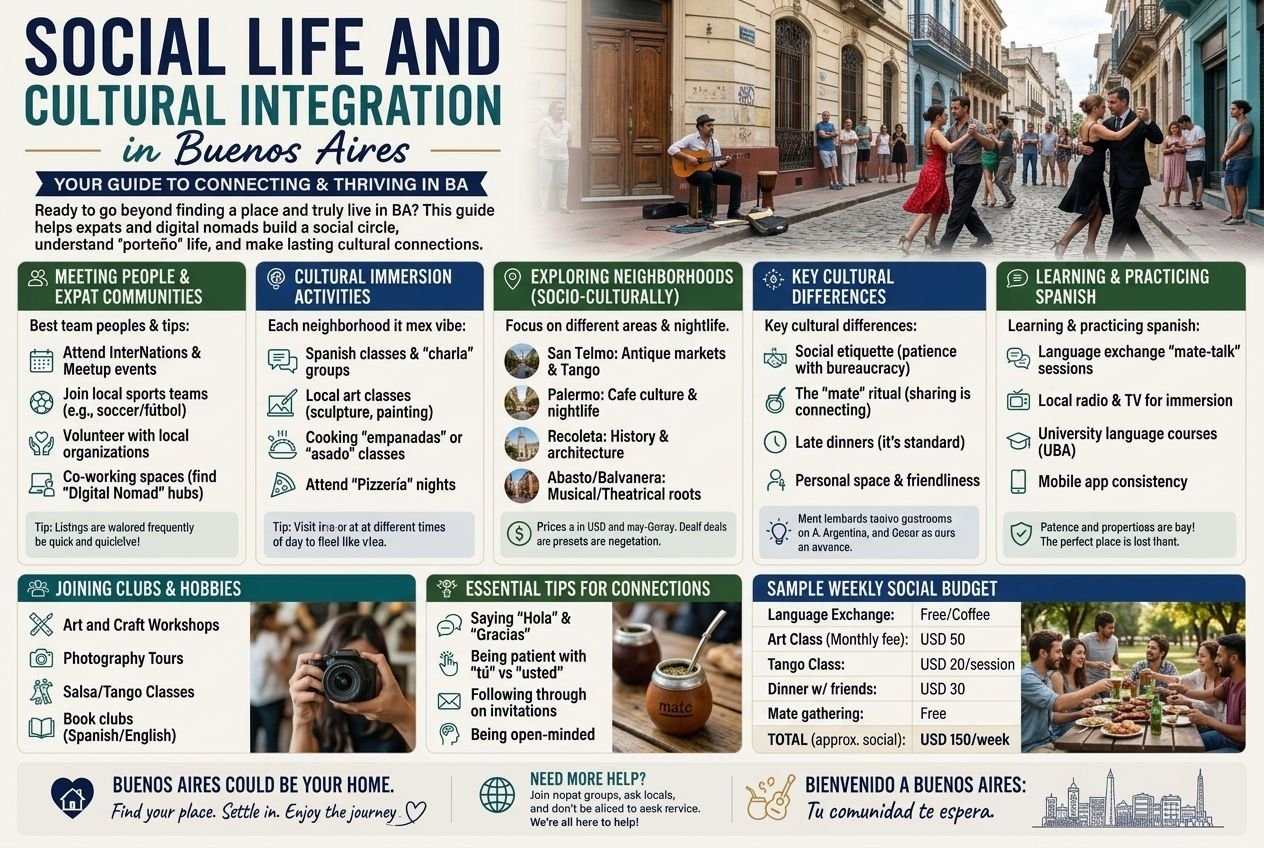
Building a social life in Buenos Aires is not difficult. Porteños are warm, curious about foreigners, and genuinely hospitable; the city has a rich and accessible social infrastructure; and the large expat and nomad community provides an immediate network for arrivals without local connections. The challenge, if there is one, is in understanding the specific social codes of Buenos Aires life so that you can navigate them confidently rather than inadvertently violating expectations.
The Buenos Aires Social Character
Porteños are among the most socially warm and psychologically complex urban populations in the world. Buenos Aires has the highest density of psychologists per capita of any city in the world (a fact Argentines mention with a combination of pride and self-awareness), which reflects a culture that takes inner life, social dynamics, and interpersonal complexity seriously. Conversations in Buenos Aires go deeper and more personal more quickly than in most European or North American social contexts.
The social culture is oriented around gatherings that run late and last long. A dinner invitation for 9pm means arriving at 9:30pm at the earliest; the dinner itself will run until midnight at a minimum; and if the evening is going well, extending until 2am or 3am is entirely normal. Adapting your internal schedule to this is one of the most important adjustments for living well in Buenos Aires.
The Argentine Table Culture
Food and drink is the central social institution in Buenos Aires. The asado (barbecue) is the defining social gathering: a long, slow event centred on the fire and the food that unfolds over many hours with multiple courses, much wine, and the kind of conversation that only happens when there is nowhere else to be and no reason to rush.
Being invited to an asado is a significant social marker; accept whenever the opportunity arises and contribute something (wine, beer, a dessert) when you attend.
The restaurant dinner is the other primary social format: a table for several people, arriving between 9pm and 10pm, eating and drinking until midnight or later. Buenos Aires restaurants understand and support this format; a good restaurant at 11pm on a Thursday is not clearing tables.
Where to Build a Social Network
The expat and nomad community: The fastest social onramp for most new arrivals. The Buenos Aires expat Facebook groups (BA Expats being the largest, with over 100,000 members) are active communities with event listings, advice threads, and connections. Expats who have been in the city for a year or more are generally generous with their time and knowledge toward new arrivals.
Language exchanges: Buenos Aires has an active language exchange culture, with regular meetup events where Spanish speakers wanting to practise English pair with English speakers wanting to practise Spanish. These events, typically held in bars or cafés in Palermo or San Telmo, are a genuine and low-friction entry point into meeting both locals and international community members.
Tango community: The milonga circuit is one of the most culturally specific and socially rich ways to meet Buenos Aires residents. The tango community is international and local simultaneously; regular attendance at a milonga produces ongoing social connections with a community that shares a significant cultural practice.
Coworking spaces: If you are working in a coworking space, the community events that most spaces organise (talks, social evenings, collaborative projects) are a professional and social network in one. The Palermo coworking community is particularly well-connected to the broader expat and Argentine tech and creative scene.
Learning Spanish
Spanish is essential for fully integrating into Buenos Aires social life. While English is widely understood in tourist-facing contexts and among younger professionals, Spanish is the language of deeper social engagement, of the relationships that develop beyond initial introductions, and of understanding the city at any level of complexity.
Buenos Aires has an excellent and affordable Spanish language school infrastructure. Private lessons (through platforms like italki or local teacher listings) cost USD 10 to 25 per hour. Group classes at the various language schools in Palermo and the Microcentro cost USD 50 to 150 per month. Most schools offer intensive options for those wanting rapid progress.
The Buenos Aires dialect (Rioplatense Spanish) differs from standard Castilian Spanish in specific ways: the vos form is used instead of tú; the double ll and y are pronounced as a soft “sh” sound (so “yo” sounds like “sho”); and the cadence and intonation have a characteristic musical quality that reflects the Italian immigrant heritage of the region.
Cultural Adjustment: What Takes Getting Used To
The schedule: Everything runs later than you expect. Meetings that start 15 minutes late are normal; social events that begin an hour after the stated time are not unusual. Adapting to this rather than fighting it is essential for stress-free Buenos Aires living.
Direct communication style: Porteños are often direct and can seem blunt in criticism; this is not rudeness but a communication style that values honesty over social smoothing. Learning to receive and give direct feedback in this style is part of cultural integration.
The complaining and irony as social currency: Buenos Aires has a rich culture of complaint (queja) and irony. Joining in with a well-timed observation about the traffic, the economy, the political situation, or the price of something is a form of social bonding. Taking it too seriously is a mistake; it is mostly a form of verbal play.
Argentine patriotism and cultural confidence: Argentines have a strong sense of their own cultural identity and a genuine belief that their food, their wine, their tango, and their literary culture are among the best in the world. This is not unfounded; engaging with this pride respectfully produces better social engagement than either dismissing it or being sycophantic about it.
Related: Digital Nomad Guide | Cost of Living | Neighborhoods | Buenos Aires Culture
The Argentine Friendship Dynamic
Friendships with Porteños follow a specific dynamic that differs from Northern European and North American social patterns and is worth understanding before arrival.
Initial warmth is immediate and genuine; Argentines are interested in foreigners, ask questions, and engage with energy and enthusiasm from the first meeting. This warmth is real, not performative.
Deepening the friendship requires time and repeated interaction. The warmth of the initial meeting does not automatically translate into a developed friendship without investment. Porteños have strong existing friendship networks (often built from childhood and university years) and integrating into them requires showing up: to the asado you were invited to, to the follow-up dinner, to the Sunday afternoon in the park. The investment is worth it; Argentine friendships, once established, tend to be remarkably generous and durable.
The plan-making culture: Argentine social plans often have a spontaneous and flexible character. A “definite” dinner plan may be confirmed the day before; a “maybe” dinner can become the best evening of the week. Calibrating expectations to this rhythm, rather than treating flexibility as unreliability, prevents unnecessary frustration.
Building Social Infrastructure from Zero
The most efficient approaches to building a Buenos Aires social life from scratch, in roughly decreasing order of effectiveness:
Being genuinely interested in Argentine culture and engaging with it: asking about the political situation, expressing genuine curiosity about tango or football or the literature, approaching the culture with openness rather than comparison to home. Porteños respond extraordinarily well to foreigners who engage with their culture genuinely.
Attending regular events consistently: the same milonga on the same night each week, the same language exchange, the same coworking social. Showing up repeatedly produces relationships in a way that one-time attendance does not.
Learning Spanish: not just as a communication tool but as a genuine expression of interest in Argentine culture. Porteños notice and appreciate the effort, regardless of the level of proficiency.
Accepting every invitation in the first month: before you have a social life, treating every invitation as an opportunity rather than an optional extra builds the social network from which more organic social activity then flows.
Social life in Buenos Aires, at its best, produces the kind of connections that reshape your understanding of what urban community can look like. The combination of genuine warmth, social intelligence, and the shared experience of living in a city with a complex and fascinating history creates friendships that persist long after the Buenos Aires chapter has ended. The social investment made during a Buenos Aires stay tends to have a long half-life.
A Final Note
Buenos Aires rewards visitors who arrive prepared and remain open. The practical preparation covered in this guide removes the friction that prevents engagement; the openness is yours to bring. The city that reveals itself to a visitor who knows what they are looking for, who has sorted the practical foundations, and who has the curiosity to follow what the city offers is one of the genuinely great urban experiences available anywhere in the world.
For questions, corrections, or feedback on this guide, the contact page is the right place. This site is updated regularly; if you visit Buenos Aires and find that conditions have changed from what this guide describes, telling us makes the guide better for the next reader.