
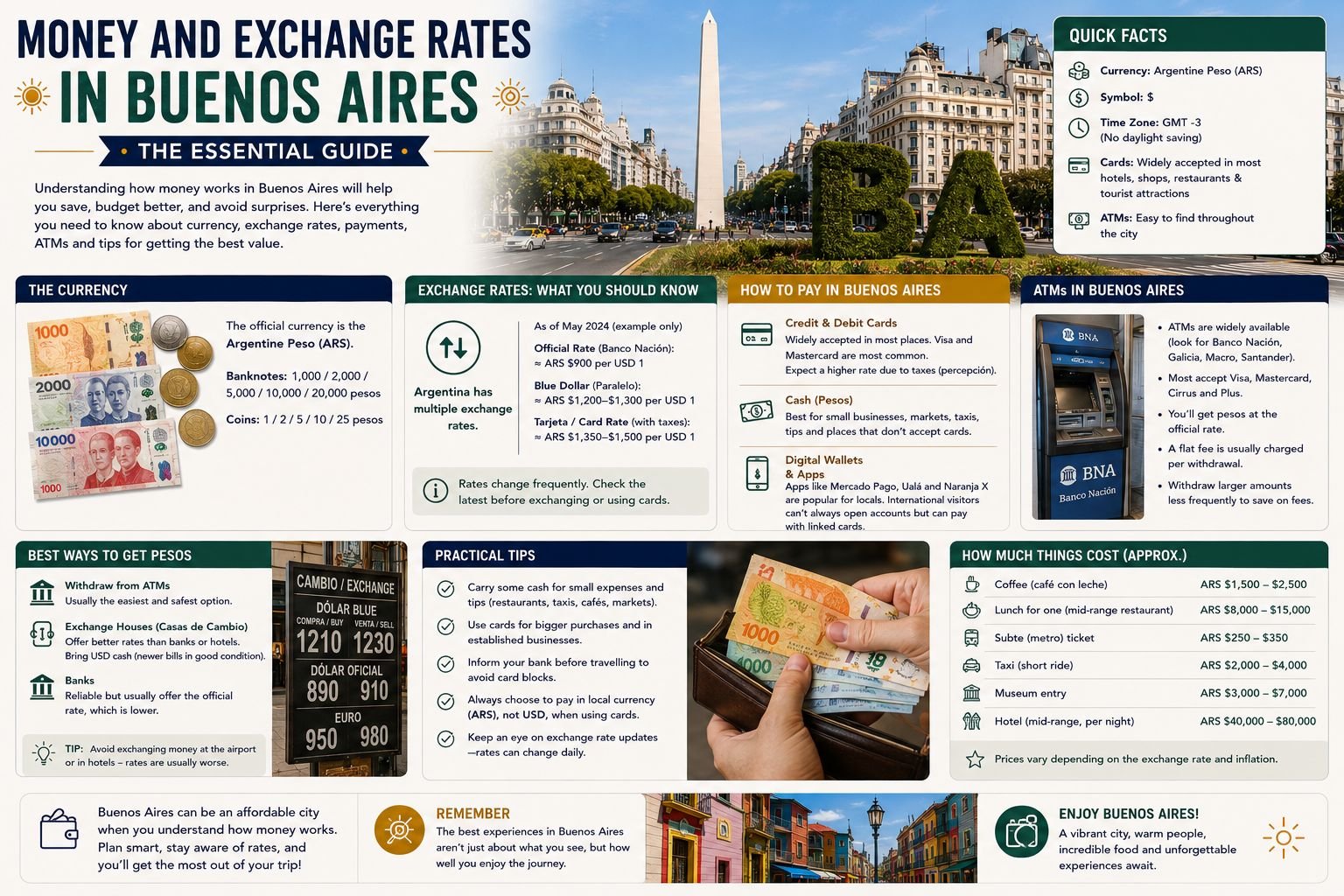
Argentina has one of the world’s most unusual currency situations for international visitors. Understanding how the exchange rate works, how to access the best legal rates, and how to manage money in Buenos Aires is the single most important practical preparation for a visit. This guide explains the situation clearly and gives you the specific information to navigate it well.
The Dual Exchange Rate System: Why It Matters
Argentina has experienced significant inflation and currency instability over the past decade. The Argentine government has historically maintained an official peso exchange rate that is significantly lower than the rate at which pesos actually trade in the broader economy. This has produced a persistent gap between the official rate and the rates available through other legitimate channels.
For visitors, the practical implication is significant: depending on how you exchange money, you may receive dramatically different amounts of Argentine pesos for the same amount of foreign currency.
The official rate: The rate you receive if you use a foreign bank card at a standard ATM, exchange money at a bank, or let your credit card process a transaction at the official exchange rate. This rate is substantially below what is available through legitimate tourist channels.
The tourist card rate and MEP dollar: Legal mechanisms that allow access to a much better exchange rate. The gap between the official rate and the MEP/tourist rate has varied significantly over time; at some points it has been close to parity, at others it has been a two-to-one or greater difference. Checking the current differential before travel gives you the most accurate picture of what the savings are.
In practical terms: if the MEP rate is 40 percent better than the official rate and your planned spending in Buenos Aires is USD 500, accessing the better rate saves you approximately USD 200 worth of spending power. This is not trivial.
How to Access the Better Rate Legally
The tarjeta turista (tourist card payment system): Argentine businesses that are registered to receive tourist card payments process foreign card transactions at the better rate rather than the official rate. When paying by card at restaurants, hotels, and shops, ask whether they accept “tarjeta turista” or whether they can process the payment at the blue rate (some businesses use this term informally even for the legal tourist rate mechanism).
Wise, Revolut, or similar fintech debit cards: Some fintech cards process international transactions at rates close to the interbank rate, which is typically close to the MEP rate. Testing your specific card before relying on it is advisable; the rate applied depends on how the processor handles the transaction.
Bringing USD or EUR in cash: Foreign currency in good physical condition (clean notes, no tears or marks) can be exchanged at legal cambios (currency exchange offices) or at some businesses at the better rate. The CITI exchange rate (a publicly displayed reference for legal exchanges) gives you a benchmark for what a legitimate exchange should provide.
What not to do: The blue dollar (informal parallel exchange market) is discussed in the [blue dollar guide](/practical-info/blue-dollar/). This guide does not recommend it; the legal alternatives have closed much of the gap that made it previously attractive, while the risks remain.
ATMs in Buenos Aires
ATMs are widespread throughout Buenos Aires. The main considerations:
Which ATMs to use: Banco Nación and Banco Ciudad ATMs generally offer better rates and lower fees than private bank ATMs. At Ezeiza airport, the Banco Nación machines in the international arrivals area are the best option for initial peso withdrawal.
Withdrawal limits: Argentine ATMs have daily and per-transaction withdrawal limits that are often low by international standards. Multiple withdrawals at different machines on the same day may be necessary for larger amounts.
ATM fees: Many Buenos Aires ATMs charge a fee per transaction that is applied to the foreign cardholder; the amount varies by machine. Some foreign bank accounts (Charles Schwab in the US, for example) reimburse international ATM fees. Check your bank’s policy.
Cash vs Card
Buenos Aires is a functional card-acceptance city in most tourist-facing businesses (restaurants, hotels, larger shops), but cash is still essential for:
Small cafés and local restaurants that do not have card terminals; transport (SUBE card recharging, some taxis); street food and market vendors; small shops and kiosks; and any situation where the tourist card rate is not available through a card payment.
Carrying a mix of both (some pesos in cash, plus cards for larger purchases) is the correct approach.
Practical Summary
Read the current exchange rate situation when booking your trip; the numbers change. The principle is stable: accessing the tourist rate or MEP rate saves meaningful money compared to the official rate, and this is done legally through the mechanisms described above. The [blue dollar guide](/practical-info/blue-dollar/) explains why the illegal alternative is not recommended. The budget guide uses the better rate for all its pricing benchmarks.
Related: Blue Dollar Explained | Budget and Costs | Getting Around | Practical Info Hub
The Day-to-Day Cash Management Routine
For visitors staying more than a few days, developing a routine for managing cash simplifies daily life significantly.
The weekly reload: Rather than visiting an ATM whenever the wallet is empty (which produces ATM-fee friction and the inconvenience of finding a machine), planning a weekly cash withdrawal of the estimated week’s spending reduces ATM visits and their associated fees.
The denominations issue: Argentine ATMs dispense a mix of denominations. Large-denomination notes (the highest current notes) are useful for accommodation payments; small-denomination notes are needed for colectivo SUBE top-ups, small purchases, and situations where change is not available. Actively requesting specific denominations from the exchange desk when using a cambio, or asking for cambio (change) when paying for small things with large notes, helps maintain a useful mix.
Digital payment alternatives: Mercado Pago, the dominant Argentine digital payment platform, is increasingly accepted at restaurants, cafés, and markets, and can be funded through international cards at rates close to the tourist rate. Setting up a Mercado Pago account (possible with a foreign phone number and passport) and using it for daily small payments reduces cash dependency for those staying more than a few weeks.
Tipping in Buenos Aires
Tipping is expected at sit-down restaurants (typically 10 to 15 percent of the bill, above the cubierto charge), at bars when a tab is run, and for service providers including taxi drivers (rounding up), hotel staff, and delivery riders. It is not expected in cafés for counter service, at fast food establishments, or in most retail contexts. The [tipping guide](/food-drink/tipping/) covers the specific norms in detail.
Money management in Buenos Aires is the most practically consequential preparation a visitor can make. The exchange rate advantage is real and significant; accessing it is not complicated but requires specific advance knowledge. Understanding the system before you arrive converts a potentially confusing first encounter with Argentine financial reality into a smooth, financially efficient experience that improves the value of the entire trip.
A Final Note
Buenos Aires rewards visitors who arrive prepared and remain open. The practical preparation covered in this guide removes the friction that prevents engagement; the openness is yours to bring. The city that reveals itself to a visitor who knows what they are looking for, who has sorted the practical foundations, and who has the curiosity to follow what the city offers is one of the genuinely great urban experiences available anywhere in the world.
For questions, corrections, or feedback on this guide, the contact page is the right place. This site is updated regularly; if you visit Buenos Aires and find that conditions have changed from what this guide describes, telling us makes the guide better for the next reader.
Argentine money management, once the principles are understood, is less complicated in daily practice than the initial description suggests. The core habit is simple: understand what rate you are receiving when you exchange money or pay by card, and use the mechanisms that produce the best legal rate. The blue dollar guide explains why the informal alternative is not recommended; the budget guide shows what good rates mean for your actual daily costs.
Buenos Aires rewards the traveller who arrives prepared and remains curious. Every guide in this site is designed to remove the friction between arrival and genuine engagement with the city; the engagement itself is yours to pursue. The city is inexhaustible, genuinely warm, and consistently surprising even to those who have been here many times. Whatever brings you to Buenos Aires, whether a first visit, an extended stay, or the beginning of a longer Argentine chapter, the preparation this guide provides is the starting point. What comes next is the city’s contribution.