
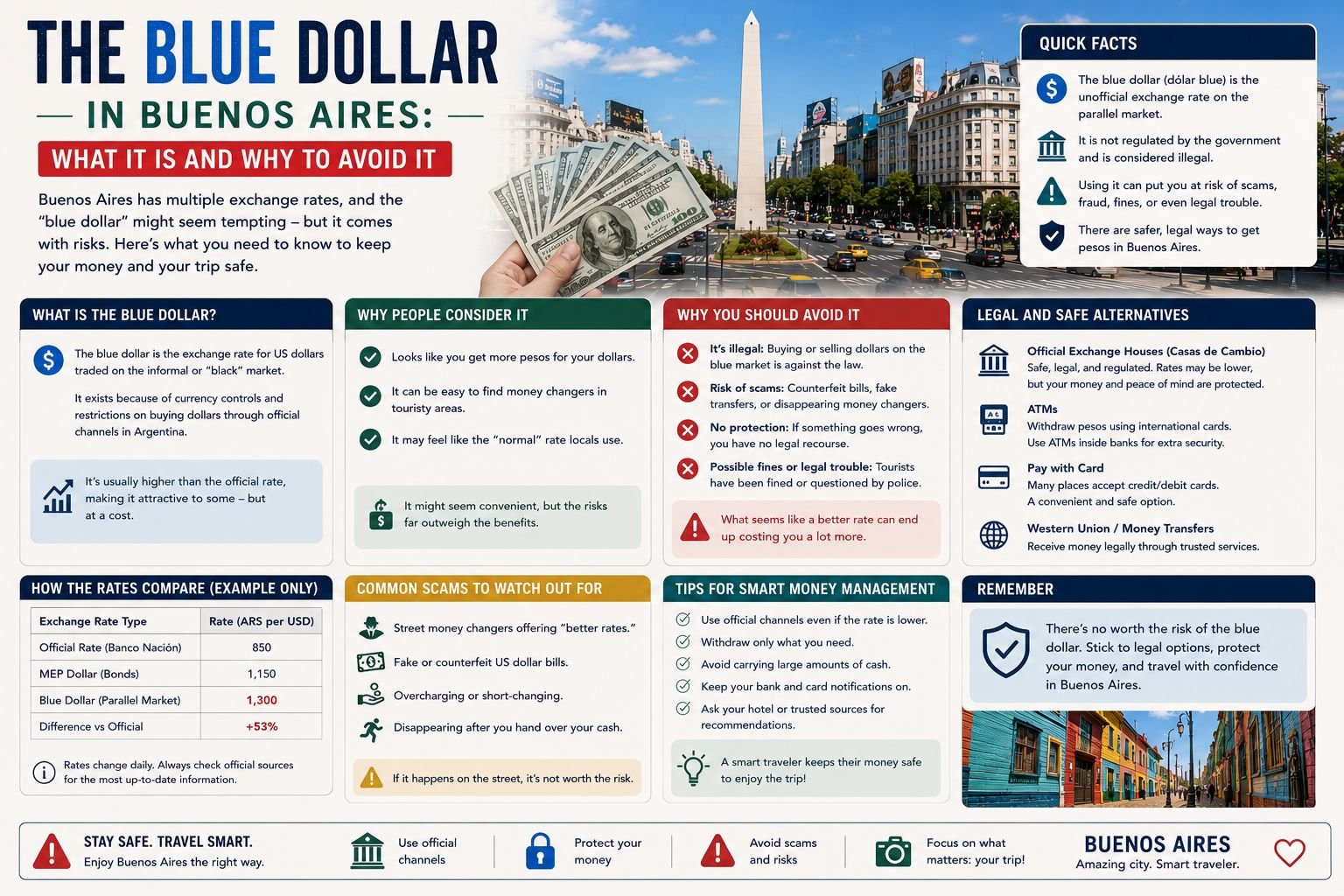
The “blue dollar” (dólar blue) is the most famous feature of Argentina’s complex currency landscape, and the subject of more confused advice directed at Buenos Aires visitors than almost any other topic. This guide explains what it is, why it exists, and why this site does not recommend using it for most visitors in 2025.
What Is the Blue Dollar?
The blue dollar is an informal parallel exchange market for US dollars and Argentine pesos. It exists because Argentina’s currency controls create a gap between the official peso exchange rate and the rate at which pesos trade in the broader economy; the blue dollar market represents the informal clearing of this gap.
For most of the past decade, the blue dollar rate was significantly better than the official rate, sometimes two to three times better. Visitors who exchanged USD for pesos through informal channels (typically in the “cuevas” or exchange houses operating in areas like the Florida walking street) received dramatically more pesos per dollar than through the official banking system.
Why the Situation Has Changed
The Argentine government has introduced several mechanisms in recent years that allow tourists to access better-than-official exchange rates through legal channels. These include:
The tarjeta turista system, under which foreign card payments in Argentina are processed at a rate significantly better than the official rate. Depending on current conditions, this rate can be close to or equal to the blue rate.
Various fintech mechanisms including apps and specific exchange services that allow legal access to the MEP or CCL dollar rate (the rates at which dollars trade on the Argentine stock market), which are typically very close to the blue dollar rate.
The practical result: the gap between what you can achieve legally and what the blue dollar offers has narrowed significantly. The risk-to-reward calculation for using informal channels has deteriorated.
The Risks of Using the Blue Dollar
Legal risk: While possession of foreign currency is legal in Argentina, exchanging currency outside the official system is technically illegal. The risk of prosecution for individual tourists is historically low but non-zero. More importantly, if you are carrying USD to exchange informally, you are carrying cash in amounts that attract attention.
Counterfeit peso notes: The informal exchange market is where counterfeit Argentine peso notes circulate. Receiving fake notes in exchange for genuine dollars is a real risk. At the moment of exchange, you are exchanging cash with someone you do not know, without any institutional protection. Detecting counterfeit notes requires specific knowledge and attention.
Scam risk: The Florida Street “cambio” offers that some tourists receive involve a range of scam variants: short-changing on the count, passing counterfeit notes, or in some cases more aggressive tactics. The professionalisation of these scams over years means that a visitor accepting a street cambio offer is in an unfavourable position.
No recourse: If something goes wrong with an informal exchange, there is no recourse. No bank to call, no chargeback to initiate, no complaint mechanism to use.
The Current Recommendation
Given that legal alternatives (tarjeta turista, fintech apps, cambios offering the MEP rate) have closed most of the gap between official and informal rates, this site’s recommendation is to use legal mechanisms exclusively. The savings from using the blue dollar are now modest relative to the best legal alternatives; the risks remain.
For visitors who arrive with cash USD to exchange, legal cambios that offer the MEP or CCL rate (advertised and visible) are the appropriate channel. The [money guide](/practical-info/money/) covers how to identify legitimate exchange services.
A Broader Note on Argentine Currency
The currency situation in Argentina reflects the country’s specific economic history and the tensions between its monetary policy, inflation, and the external value of the peso. For visitors, understanding that this situation has structural origins, rather than being a form of arbitrage uniquely available to tourists, is useful context. Argentine residents navigate these same dynamics daily; the specific forms available to tourists are a reflection of how the broader economy works rather than a special tourist phenomenon.
Related: Money Guide | Budget and Costs | Practical Info Hub | Safety
The Policy Context Behind the Blue Dollar
The blue dollar exists because of a specific set of Argentine policy choices rather than as an anomaly. Argentina has historically maintained currency controls (known as the cepo cambiario, currency trap) that restrict the purchase of foreign currency by Argentine residents. These controls create excess demand for foreign currency that cannot be satisfied through official channels; the blue dollar market is where this demand is met informally.
From a visitor’s perspective, this context is useful for understanding why the situation is complex rather than simply resolved: the Argentine government has strong incentives to maintain the official rate for its own financial management; Argentine citizens have strong incentives to access hard currency as a hedge against inflation; and the gap between these positions is where the informal market exists.
For those interested in Argentine economic history, the dynamics of the currency situation are closely connected to the broader story of Argentine economic instability, the 2001 financial crisis, and the recurring tensions between domestic monetary policy and external financial relationships. This is a legitimate and fascinating subject; it just doesn’t change the practical advice, which remains to use the legal tourist rate mechanisms rather than the informal market.
Keeping Current: Where to Check the Rate
The exchange rate situation changes frequently; no guide published more than a month ago has perfectly accurate current information. For current rates:
Ambito Financiero (ambito.com): The Argentine financial news site publishes daily exchange rate information including the dólar blue, the MEP dollar, and the official rate. The comparison between these gives you the current gap.
The expat forums: The Buenos Aires expat Facebook groups have active daily discussions of the exchange rate situation, including practical advice on which mechanisms are currently working best. Recent posts from other visitors with current experience are the most reliable source of practical, up-to-date advice.
The blue dollar is the most famous feature of Argentina’s economic landscape for international visitors and the one that generates the most confused advice. The honest current answer: the legal tourist rate mechanisms have closed much of the gap, the risks of informal exchange are real and not worth the modest remaining premium, and the most efficient path is to use the legitimate alternatives well. The money guide provides the practical mechanics; this guide provides the context for understanding why they are the better choice.
A Final Note
Buenos Aires rewards visitors who arrive prepared and remain open. The practical preparation covered in this guide removes the friction that prevents engagement; the openness is yours to bring. The city that reveals itself to a visitor who knows what they are looking for, who has sorted the practical foundations, and who has the curiosity to follow what the city offers is one of the genuinely great urban experiences available anywhere in the world.
For questions, corrections, or feedback on this guide, the contact page is the right place. This site is updated regularly; if you visit Buenos Aires and find that conditions have changed from what this guide describes, telling us makes the guide better for the next reader.
The blue dollar situation in Buenos Aires is a frequent topic of conversation among first-time visitors, who have often read about it online and are uncertain about the current picture. The most current and reliable information on the specific rate differential comes from the Buenos Aires expat community forums; no published guide, including this one, is as current as the community that is navigating the situation in real time. The principles are stable; the specific numbers change.
Buenos Aires rewards the traveller who arrives prepared and remains curious. Every guide in this site is designed to remove the friction between arrival and genuine engagement with the city; the engagement itself is yours to pursue. The city is inexhaustible, genuinely warm, and consistently surprising even to those who have been here many times. Whatever brings you to Buenos Aires, whether a first visit, an extended stay, or the beginning of a longer Argentine chapter, the preparation this guide provides is the starting point. What comes next is the city’s contribution.
Buenos Aires is one of the great cities of South America and one of the most rewarding for visitors who approach it with good preparation and genuine curiosity. The specific combination of European-influenced culture, Argentine character, extraordinary food and wine, and a social warmth that is entirely its own makes it unlike any other city in the world. Whatever aspect of the city this guide covers, it is one part of a whole that is considerably greater than its components.