
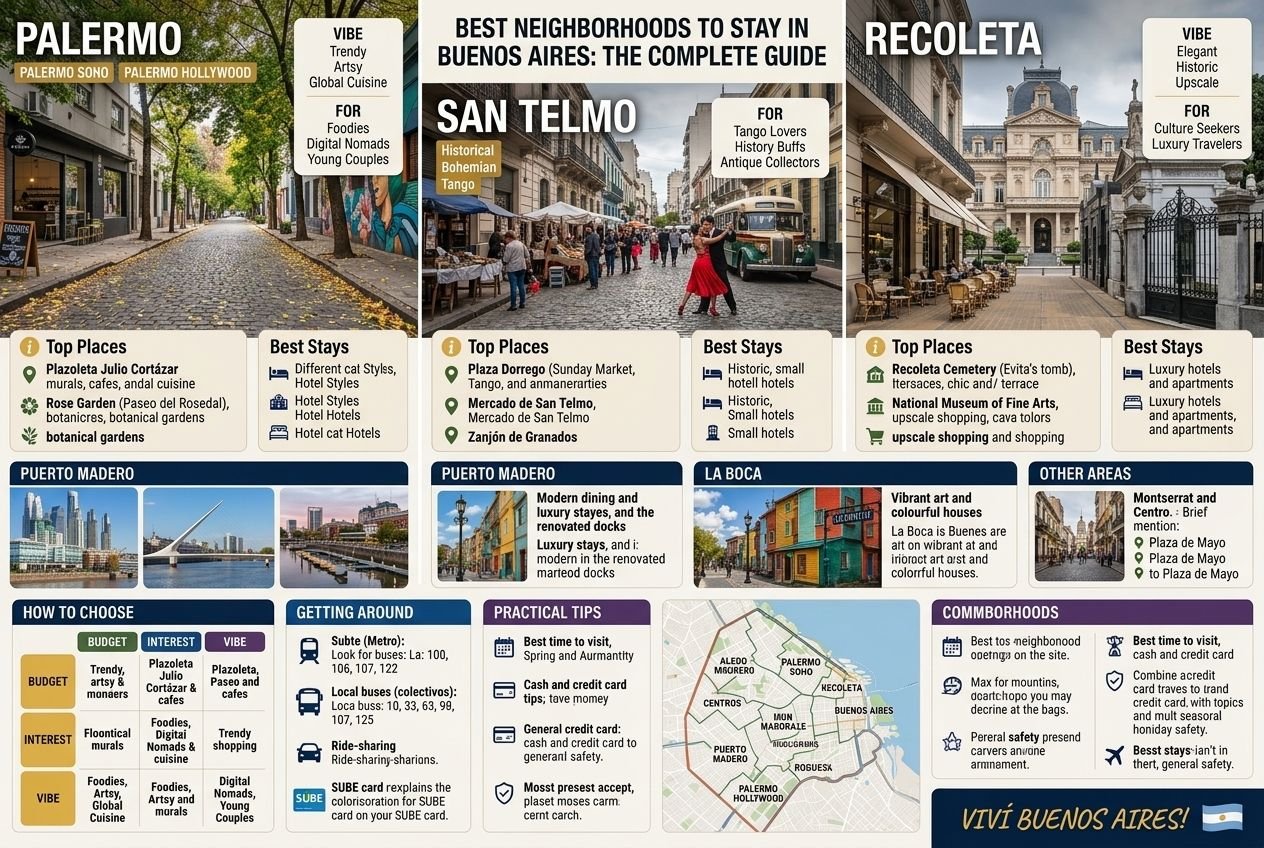
Where you stay in Buenos Aires shapes everything: your morning walk, your restaurant options, the feel of coming back at the end of the day. The city is large enough that the wrong neighbourhood base for your travel style produces daily friction; the right one means the city works for you from the moment you step outside. This guide covers the main options honestly.
The Short Version
For first-time visitors wanting the best all-round experience: Palermo Soho or Palermo Hollywood, specifically for the range of restaurants, the green spaces, and the safety.
For atmosphere and the most authentic Buenos Aires experience on a budget: San Telmo, particularly around Plaza Dorrego.
For elegance and the best hotel infrastructure: Recoleta, particularly if the Alvear Palace or Palacio Duhau represent the kind of travel you are doing.
For central access to everything: Microcentro or Tribunales, which lack neighbourhood character but make every transit shortest.
For digital nomads and long-stay visitors wanting the best quality of life: Palermo or Villa Crespo, which combine good living infrastructure with the city’s best work-from-café environment.
Palermo: The Default for Good Reason
Palermo is the most popular neighbourhood for visitors and deserves the reputation. It has the widest range of excellent restaurants (from casual lunch spots to internationally recognised fine dining), good green spaces, excellent café infrastructure, safe streets, and a social energy that runs from morning coffee through late-night dinners without a gap.
The sub-neighbourhood within Palermo matters:
Palermo Soho (around Thames, Honduras, and Gorriti) is the boutique and café heartland: dense, walkable, and good for both daytime exploration and evening eating. Staying within a few blocks of Plaza Armenia or Plaza Serrano puts you in the middle of everything.
Palermo Hollywood (north of Córdoba, around Bonpland and Fitz Roy) is slightly calmer than Soho, with some of the city’s best evening restaurants and a slightly more grown-up character.
Las Cañitas is quieter and more residential, with the restaurant strip on Báez convenient for evenings but less dense in daytime activity.
Who Palermo is for: First-time visitors, families, people who want the widest range of food and drink options, those planning to spend most evenings eating out, visitors who want easy access to green space.
Who Palermo is not for: Those who specifically want a historic, gritty, or atmospheric experience rather than a comfortable one; those who want to be in the heart of the historic city.
San Telmo: Character and Atmosphere at Lower Cost
San Telmo has the most atmospheric character of any Buenos Aires neighbourhood for visitors: cobblestone streets, century-old buildings, tango bars and milongas, traditional parrillas, and the city’s best street market on Sundays. For visitors who want to feel like they are in Buenos Aires rather than in an international city, San Telmo delivers this more directly than Palermo.
The trade-offs: San Telmo is less safe than Palermo (higher petty crime rate; certain streets require awareness after dark), the restaurant range is more limited, and the area around the tourist core is more variable in character. The neighbourhood has a genuinely working-class character alongside its tourist appeal, which is part of what makes it interesting and also means it requires slightly more active navigation.
Who San Telmo is for: Travellers who want history and atmosphere, tango enthusiasts who want to be near the milongas, budget travellers (accommodation is cheaper here than Palermo), and those doing a first visit who specifically want the “real Buenos Aires” experience.
Accommodation options: Several excellent boutique hotels in converted casas; a good selection of hostels; fewer apartment rental options than Palermo.
Recoleta: Elegance, But at a Price
Recoleta has the finest hotel infrastructure in Buenos Aires and access to the northern cultural institutions. It is the right neighbourhood for visits centred on the cemetery, the MALBA, and the Museo de Bellas Artes, and for those who want the formal, grand version of the city.
The trade-offs: Recoleta is more expensive than other areas (accommodation and restaurants); it has a more formal and less diverse restaurant scene than Palermo; and its character is slightly cool and less warm than the more residential barrios. It is magnificent but it is not cosy.
Who Recoleta is for: Luxury travellers, those making culture (museums, galleries) the focus of their visit, visitors who want the most European version of Buenos Aires.
Microcentro and Tribunales: Central Convenience
Staying in the Microcentro or the adjacent Tribunales neighbourhood puts you within 15 minutes’ walk of almost every major attraction in the city, on multiple Subte lines, and in the most central possible location. The neighbourhood itself, however, has limited character outside business hours; it is busy and interesting on weekdays and quiet on weekends.
Who the Microcentro is for: Business travellers, very short stays where minimising transit time is the priority, and travellers who specifically want to be in the historical centre.
A Note on Budget
Across all these neighbourhoods, Buenos Aires accommodation represents excellent value compared to European or North American equivalents. A boutique hotel room in Palermo that would cost USD 200 to 300 in Paris or New York typically costs USD 80 to 130 here, at comparable quality. The key to finding the right accommodation is to understand the neighbourhood implications of each option rather than to optimise purely on price.
Related: Neighborhoods Hub | Palermo | San Telmo | Recoleta | Accommodation Hub
The Accommodation Decision Framework
Making the neighbourhood and accommodation type decision in the right order matters. The sequence that works best:
First: Decide what neighbourhood character you want. Are you optimising for restaurant range (Palermo), atmosphere and character (San Telmo), elegance (Recoleta), or central convenience (Microcentro)?
Second: Decide on accommodation type within that neighbourhood: hotel (predictable quality and service), apartment (space and kitchen access), hostel (social environment and budget), or boutique hotel (character and personalised service).
Third: Research specific properties within your chosen neighbourhood and type, using recent reviews filtered for travellers with similar priorities to yours.
This sequence, rather than searching broadly for “best hotels in Buenos Aires” without neighbourhood pre-commitment, produces significantly better results because it prioritises the daily experience of the city over the property-level characteristics.
Accommodation Costs: Honest Buenos Aires Benchmarks
All prices at the time of writing in USD; Buenos Aires costs in peso terms change with inflation, but the USD equivalents at the tourist rate are more stable.
Budget hostel dorm: USD 15 to 25 per night
Budget hostel private room: USD 45 to 70 per night
Budget hotel double: USD 55 to 90 per night
Mid-range boutique hotel: USD 90 to 160 per night
Good apartment (1 bed, Palermo): USD 75 to 120 per night, or USD 800 to 1,200 monthly
Premium boutique hotel: USD 150 to 250 per night
Luxury hotel (Alvear, Faena, Four Seasons level): USD 250 to 500+ per night
For comparison: equivalent quality in London, Paris, or New York would be two to four times higher at every price point. This is the most tangible expression of the Buenos Aires affordability advantage.
Choosing the right neighbourhood for your stay is one of the decisions that pays the most consistent dividends throughout a Buenos Aires visit. The neighbourhood shapes every morning (the café where you have breakfast), every evening (the streets you walk home through), and every spontaneous discovery (the market you pass on the way to somewhere else). Getting this decision right, based on honest assessment of your own travel style rather than generic recommendations, sets the foundation for a Buenos Aires experience that is genuinely yours.
A Final Note
Buenos Aires rewards visitors who arrive prepared and remain open. The practical preparation covered in this guide removes the friction that prevents engagement; the openness is yours to bring. The city that reveals itself to a visitor who knows what they are looking for, who has sorted the practical foundations, and who has the curiosity to follow what the city offers is one of the genuinely great urban experiences available anywhere in the world.
For questions, corrections, or feedback on this guide, the contact page is the right place. This site is updated regularly; if you visit Buenos Aires and find that conditions have changed from what this guide describes, telling us makes the guide better for the next reader.
The neighbourhood decision is the accommodation decision that most directly determines the character of the Buenos Aires visit. Get it right based on honest self-assessment of your travel style, and the rest of the stay benefits from a home base that suits you. The options covered in this guide are all genuinely good for the specific profiles they suit; the task is matching your profile to the right option.
Buenos Aires rewards the traveller who arrives prepared and remains curious. Every guide in this site is designed to remove the friction between arrival and genuine engagement with the city; the engagement itself is yours to pursue. The city is inexhaustible, genuinely warm, and consistently surprising even to those who have been here many times. Whatever brings you to Buenos Aires, whether a first visit, an extended stay, or the beginning of a longer Argentine chapter, the preparation this guide provides is the starting point. What comes next is the city’s contribution.