
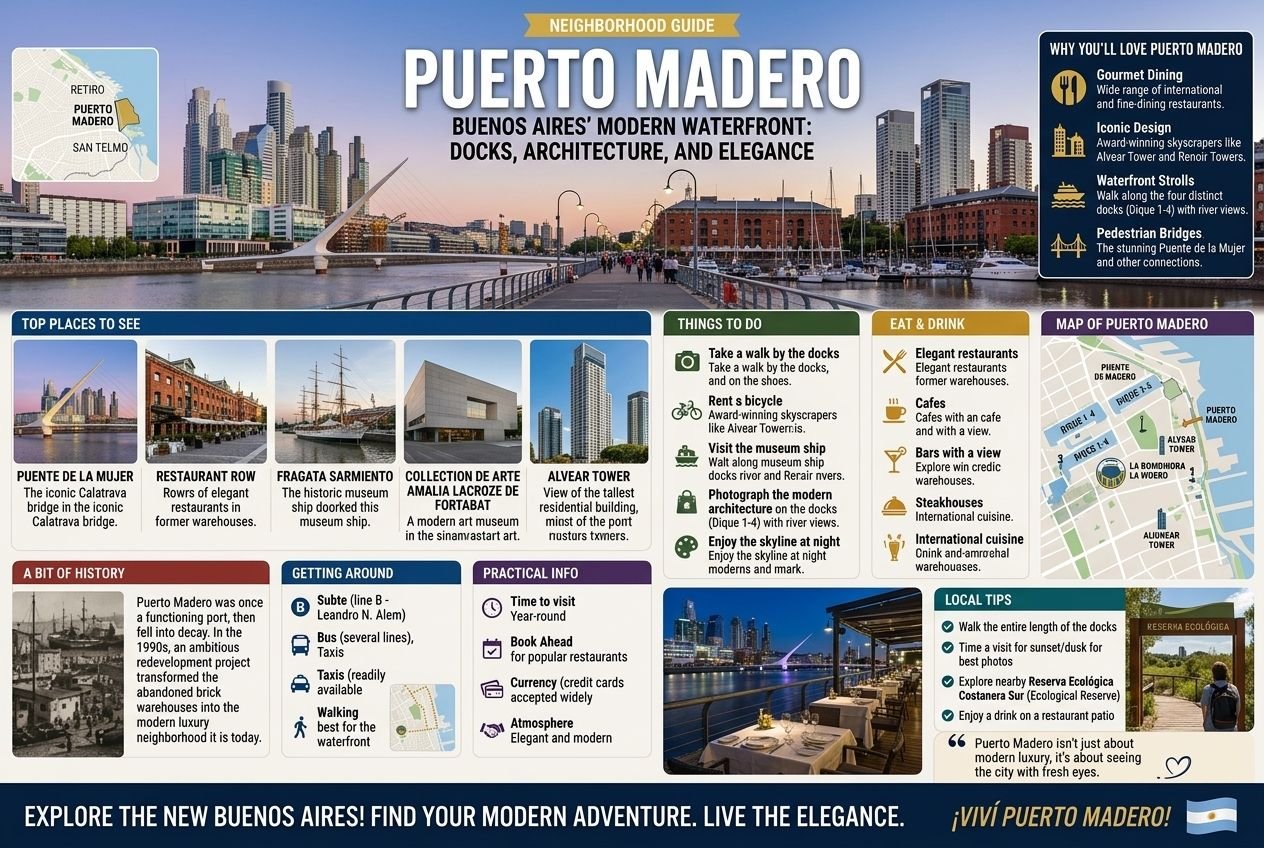
Puerto Madero is Buenos Aires’ most modern neighbourhood and its most recent: the old port district along the eastern edge of the city centre, abandoned as a working port in the 1990s, was redeveloped over the following decade into the upscale mix of restaurants, apartments, and offices that it is today. It is the most self-consciously contemporary area of a city whose identity is largely built on its European-influenced historic fabric, and the contrast makes it interesting rather than irrelevant.
Character and Context
Puerto Madero occupies both sides of the Riachuelo dock: the western side (Dique 1 to Dique 4), where the old brick port warehouses have been converted into restaurants, offices, and commercial spaces; and the eastern side, where modern glass apartment towers and luxury hotels face the Río de la Plata. The Puente de la Mujer, a rotating pedestrian bridge designed by Santiago Calatrava and opened in 2001, connects the two sides and is the neighbourhood’s signature image.
The neighbourhood is expensive by Buenos Aires standards: restaurants here are among the priciest in the city, hotel rates are at the top of the Buenos Aires range, and the overall feel is of a place designed for the corporate lunch and the luxury weekend rather than for neighbourhood living. This is not a criticism; it is a description. Puerto Madero delivers on its own terms: the restaurants are good, the waterfront walk is pleasant, and the architecture (particularly the old warehouses) is excellent.
The Puente de la Mujer
The Puente de la Mujer (Bridge of Women) is a rotating pedestrian bridge on Dique 3. Designed by the Spanish architect Santiago Calatrava as a gift from the Spanish community to Buenos Aires, it opened in 2001 and has become one of the most photographed structures in the city. The bridge is designed to represent a couple dancing tango; it rotates 90 degrees on a central pivot to allow boats to pass. The rotation is performed infrequently; most visitors see it in its fixed pedestrian position, but the structure is striking regardless.
The Reserva Ecológica Costanera Sur
Immediately east of Puerto Madero, the Reserva Ecológica Costanera Sur is one of Buenos Aires’ most unexpected places: a nature reserve of approximately 350 hectares of wetlands, marshes, and grasslands on land reclaimed from the Río de la Plata that has been left to naturalise over the past four decades.
The reserve is home to over 350 species of birds, including Southern lapwings, burrowing owls, and various waterbirds. Carpincho (capybara, the world’s largest rodent) are often visible near the water. There are walking and cycling paths through the reserve, and the contrast between the urban city immediately to the west and this genuinely wild environment is extraordinary.
The reserve is most impressive in the early morning, when birdwatching is easiest, or at sunset, when the light over the río is spectacular. Entry is free; the main gate is on Avenida Tristán Achával Rodríguez.
Where to Eat in Puerto Madero
Puerto Madero’s restaurant scene is the most expensive in Buenos Aires and concentrated on the western side of the dock in the converted warehouses.
Cabaña Las Lilas: One of the most famous parrillas in Buenos Aires, with a waterfront setting and a reputation for exceptional beef quality. Expensive by Buenos Aires standards (USD 60 to 80 per person); the quality justifies the premium if budget allows.
Chila: A creative contemporary Argentine restaurant on the eastern dock, focusing on seasonal Argentine produce interpreted through modern techniques. One of the top restaurant experiences in the country.
Siga la Vaca: A large, canteen-style parrilla offering unlimited grilled meats for a fixed price; one of the better-value options in an area where value is in short supply.
Where to Stay in Puerto Madero
Puerto Madero has several of the best luxury hotels in Buenos Aires:
The Faena Hotel: The most iconic property in the neighbourhood, designed by Baz Luhrmann and Philippe Starck in an old red-brick port warehouse. The aesthetic is maximum; the rooms and service are excellent.
Hilton Buenos Aires: A reliable luxury option on the eastern dock with good river views and corporate-grade facilities.
Madero Hotel: Good value by Puerto Madero standards, with a central location on the docks.
Getting to Puerto Madero
Puerto Madero is immediately east of the Microcentro and a short walk (10 to 15 minutes) from the city centre. The Subte Line B has a station at Alem that provides access from the north; Line A connects from the Microcentro. Taxis and Uber from central neighbourhoods take 5 to 15 minutes depending on traffic.
Puerto Madero in the Context of Buenos Aires
Puerto Madero is the neighbourhood that least represents the character of Buenos Aires as most visitors experience it, but it provides a specific counterpoint: the city that is forward-looking and confident alongside the city that looks backward at its European heritage. The combination of the Reserva Ecológica (completely wild, almost rural) and the Faena Hotel (completely polished, completely expensive) a few hundred metres apart is somehow very Buenos Aires.
Related: La Boca | Neighborhoods Hub | Accommodation | Food and Drink
Puerto Madero’s Internal Contradictions
Puerto Madero is the Buenos Aires neighbourhood that most clearly embodies the contradictions of 21st-century urban development in Latin American cities. It sits alongside the poorer barrios of the southern city; its luxury towers and expensive restaurants are visible from the shanty towns of the adjacent south; and its creation involved the displacement of activities and communities that previously occupied the port area.
None of this prevents a visit being worthwhile, and raising it is not an argument against the neighbourhood. It is, rather, context that makes walking through Puerto Madero more interesting than accepting it at face value as simply a successful waterfront development. The specific choices made in developing the neighbourhood, the architectural languages used, the communities included and excluded, and the relationship between the physical environment and the social reality around it are all legible if you are looking.
The Puerto Madero Hotel as City Luxury Experience
The hotels in Puerto Madero, particularly the Faena, represent a specific Buenos Aires luxury experience that is worth understanding even for visitors not staying there. The Faena, designed by Baz Luhrmann and Philippe Starck in an old port warehouse, is one of the most fully realised aesthetic environments in Argentina: the red-draped bar, the white horsehair chandeliers, the theatrical approach to every element of the hotel experience. Visiting the bar or the restaurant as a non-guest is entirely possible and gives access to the aesthetic experience without the room rate.
The pool at the Faena, visible from the street and from the rooms that face it, was a deliberate provocation when the hotel opened: opulent, theatrical, and positioned to be seen. It worked; the Faena pool became one of the images most associated with the particular Buenos Aires luxury moment of the early 2000s, and the hotel remains the reference point for the aesthetic.
Puerto Madero is the Buenos Aires neighbourhood that most clearly demonstrates the city’s ambitions and contradictions. Worth visiting for the architecture, the waterfront, the ecological reserve, and the best of its restaurants; worth understanding as the product of specific choices about urban development and about who the city’s public spaces are designed for. Both of these readings are available simultaneously, and holding both produces a more honest picture of Buenos Aires than either alone.
A Final Note
Buenos Aires rewards visitors who arrive prepared and remain open. The practical preparation covered in this guide removes the friction that prevents engagement; the openness is yours to bring. The city that reveals itself to a visitor who knows what they are looking for, who has sorted the practical foundations, and who has the curiosity to follow what the city offers is one of the genuinely great urban experiences available anywhere in the world.
For questions, corrections, or feedback on this guide, the contact page is the right place. This site is updated regularly; if you visit Buenos Aires and find that conditions have changed from what this guide describes, telling us makes the guide better for the next reader.
Puerto Madero is worth half a day of any Buenos Aires visit: the waterfront walk, the Puente de la Mujer, the ecological reserve, and the best of the restaurants all provide genuinely worthwhile experiences. It is not the neighbourhood where you want to spend most of your time, and it is not the neighbourhood that gives you Buenos Aires as it is most characteristically itself. But in combination with the rest of the city, it provides the contemporary counterpoint to the historical fabric that makes the full picture of Buenos Aires more complete.