
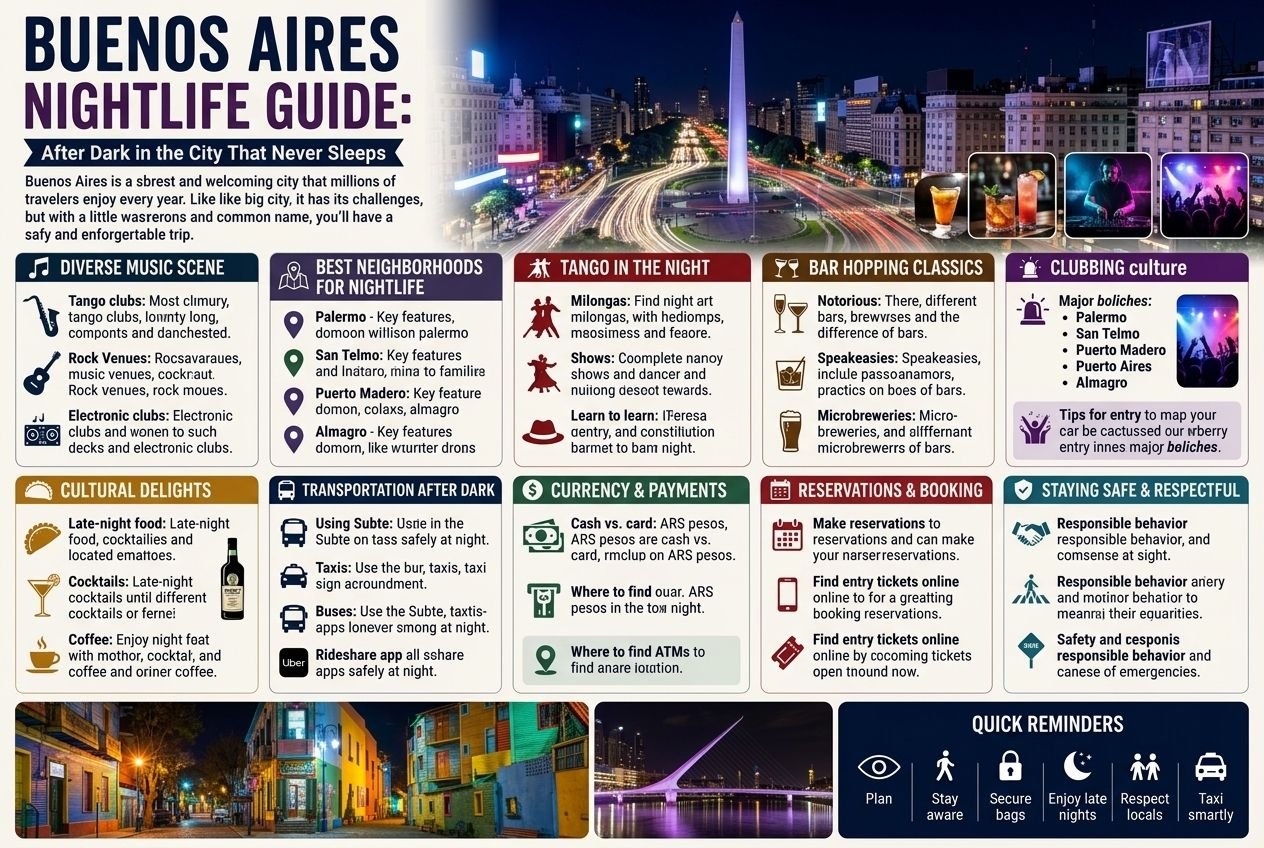
Buenos Aires is famous for its nightlife, and the reputation is earned. This is a city where dinner at 10pm is early, where bars begin filling up around midnight, where clubs do not reach capacity until 2 or 3am, and where asking what time something closes often produces a genuinely uncertain answer. The social life of Buenos Aires operates on a schedule that rewards acceptance over resistance; visitors who try to fit the city into a standard European going-out timeline consistently feel they have missed something.
Understanding the Buenos Aires Timeline
The Buenos Aires nightlife schedule operates approximately two to three hours later than Western European equivalents. Calibrating to this is the most important practical adjustment for experiencing the city after dark.
A typical Buenos Aires evening:
9pm to 10pm: Dinner. Early by local standards; restaurants fill from 9pm onwards, peaking around 11pm.
Midnight to 1am: Bars begin filling up. The pre-boliche (pre-club) phase: aperitivo, conversations, a bar round or two.
2am to 3am: Clubs and boliches open properly. The main event begins.
4am to 6am: Peak club hours. The city’s serious clubs are fullest in this window.
7am to 8am: Closing time for the most committed establishments.
This schedule is not exaggerated or confined to a particular type of nightlife; it applies broadly to the social life of the city.
Buenos Aires Nightlife by Type
Tango
Tango is covered separately in the [tango shows guide](/things-to-do/tango-shows/) and the [milongas guide](/things-to-do/milongas/), but it belongs in any Buenos Aires nightlife overview because it is the city’s most distinctive and culturally specific after-dark experience. Milongas run from approximately 10pm to 4am; the social tango culture at a good milonga at midnight is one of the most memorable experiences the city offers.
Bars and Cocktail Culture
Buenos Aires has a sophisticated cocktail culture centred on classic cocktail bars and the Argentine aperitivo tradition. The key distinction between different types of bar:
Craft cocktail bars: The Buenos Aires craft cocktail scene is concentrated in Palermo and San Telmo. Florería Atlántico, located below a flower shop on Arroyo in Retiro, is one of the most acclaimed cocktail bars in Latin America and worth the reservation (book well in advance). The drinks programme is built around Argentine botanicals and spirits.
Bar de vino (wine bars): Gran Bar Danzón on Libertad is the foundational Buenos Aires wine bar, with a comprehensive Argentine wine list and food designed to pair with it. Multiple new wine bars have opened in Palermo and Villa Crespo in the past decade, most with serious by-the-glass selections.
Neighbourhood bars and almacenes: The traditional Argentine almacén (combination grocery and social space) and the neighbourhood bar operate as the everyday social fabric of the city. These are the places Porteños go without a plan; comfortable, inexpensive, and typically full of locals.
Live Music
Buenos Aires has an extraordinary live music scene across every genre. The most distinctive Buenos Aires musical traditions are:
Tango: See above. The live orchestras at Buenos Aires’ milongas are among the most extraordinary musical experiences in the city.
Folklore and chamame: The music of the Argentine interior, particularly from the northeastern provinces, has its own dedicated venues (peñas) across Buenos Aires. Peña del Colorado in Palermo is the most established; folk music evenings here combine excellent northern Argentine food with live performances.
Rock and pop: Buenos Aires has produced some of the most significant rock music in Latin American history (Soda Stereo, Fito Paez, and many others); the live rock scene remains strong, with venues across the city at all levels from small clubs to large concert spaces.
Jazz: A sophisticated jazz scene centred on a handful of specific venues in Palermo and San Telmo.
The Club Scene: Boliches and Discotecas
Buenos Aires’ club scene, the boliches, is one of the largest in Latin America. Several key venues have operated for decades; others represent more recent developments in the city’s electronic music culture.
Crobar: One of the most established clubs in Palermo, running for over two decades and hosting major international DJs alongside resident lineups. The production quality is exceptional; the crowd is mixed in age and international in character.
Bahrein: A large multi-room club in the Microcentro, occupying the space of a former bank. One of the largest clubs in South America; known for long nights and the kind of scale that produces genuine collective experience.
Privilege: One of the city’s premiere electronic music venues, with a focus on deep and tech house that has established it as a destination club in the international DJ touring circuit.
Small clubs and alternative spaces: Buenos Aires has a significant underground and alternative club culture, with events in warehouses, social clubs, and spaces that change regularly. The Resident Advisor events listings for Buenos Aires provide the most current information on this scene.
LGBTQ+ Nightlife
Buenos Aires has one of the most established and openly active LGBTQ+ scenes in Latin America. The city legalized same-sex marriage in 2010 (the first in Latin America to do so) and has a genuine culture of LGBTQ+ social life.
Palermo and the San Telmo area have the highest concentrations of LGBTQ+-friendly venues. Amerika, one of the most prominent gay clubs in Latin America, has operated in Palermo for over two decades and is a significant destination venue.
Practical Notes
Getting home: At 3 or 4am, public transport is limited. Uber and Cabify operate well into the early morning hours. Having the app open and a working data connection (see the [SIM cards guide](/practical-info/sim-cards/)) makes the return journey reliable regardless of the hour.
Dress codes: Most Buenos Aires clubs have dress codes that lean toward smart casual. Trainers (trainers, not running shoes specifically) are often accepted; flip-flops and very casual beach-style clothing generally are not. The specific standards vary by venue.
Cover charges: Buenos Aires clubs typically charge a cover (entrada) of USD 10 to 30 depending on the venue and the night. The cover often includes a drink. Weekend nights (Friday and Saturday) are higher than weeknights.
Related: Tango Shows | Milongas | Food and Drink Hub | Neighborhoods
The Buenos Aires After-Party Culture
Buenos Aires nightlife does not end at the club. The after-party culture, specific to the city, involves moving from the club to a private home or a small gathering space in the very early morning, continuing the social evening (with music, conversation, and food) until dawn or beyond.
This culture is not accessible to tourists as a direct experience but is worth knowing about because it explains the specific social rhythm of Buenos Aires: the person you meet at a club at 3am who invites you to a continuación (continuation) at a friend’s apartment is participating in a genuine social tradition, not merely extending the party. For those who develop local friendships, these continuaciones represent the deepest level of Buenos Aires social life that visitors can access.
Drinking Culture: The Argentine Approach
Argentine drinking culture is notably different from Northern European binge-drinking culture. The social context for alcohol in Buenos Aires is almost always a long meal, a social gathering with food, or a dance event; the concept of drinking specifically to get drunk as a social goal is less present than in British, German, or Scandinavian drinking culture.
Wine is the dominant drink at dinner; Fernet con Cola (Fernet Branca mixed with Coca-Cola, a drink that is almost exclusively consumed in Argentina) is the dominant bar and nightclub drink; beer is widely consumed but is secondary to wine in the food context.
Pace is slower than in Northern European drinking culture; a bottle of wine over three hours at dinner is standard. The Argentine hangover is generally less catastrophic than the consequences of the Northern European approach to drinking, which may be one reason Buenos Aires nights can run so late without producing the complete next-day incapacitation that British-style drinking nights often produce.
A Note on Safety After Dark
Buenos Aires nightlife is generally safe within the main social areas, but a few specific practices reduce the small risks that exist:
Use apps for transport home rather than flagging street taxis in the early morning hours.
Be aware of where you put your phone in club environments; phone theft by snatching is one of the risks of crowded club environments globally.
If you have been drinking, Uber and Cabify apps are easier and safer to navigate than negotiating with street taxi drivers at 4am.
Let someone know your general plans for the evening, particularly if you are going somewhere new with people you do not know well.
Buenos Aires nightlife rewards commitment to the schedule. The visitor who adjusts to the local timing and gives a milonga or a good bar the late hours it requires will have a fundamentally different experience from the one who arrives at 9pm, finds the place empty, and concludes that the city’s reputation for nightlife is exaggerated. The city genuinely comes alive late; meeting it at its own hours is the necessary condition for experiencing what it is.