
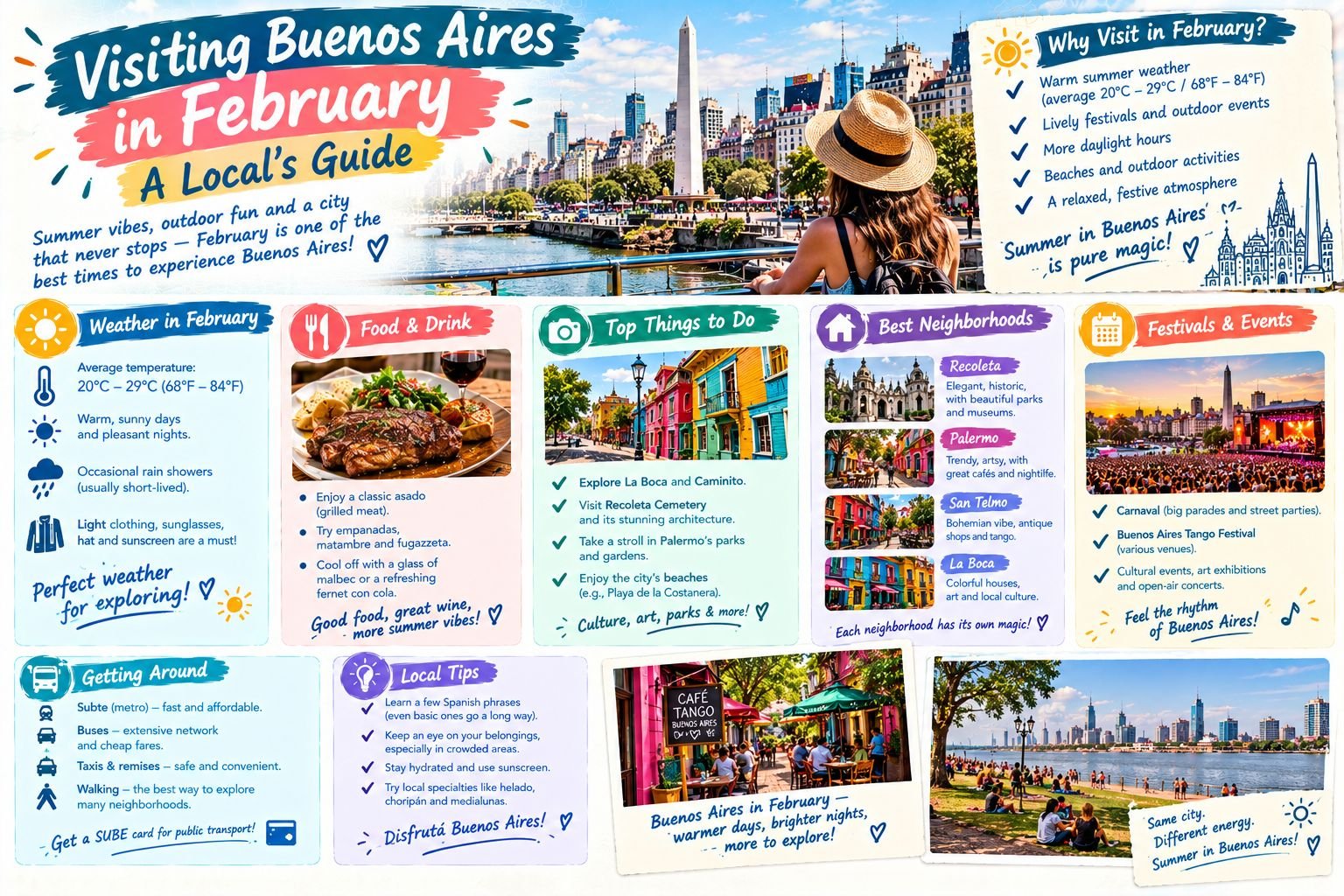
February shares January’s heat and holiday rhythm, but it brings one thing January doesn’t: Carnival, which gives the month a cultural identity of its own even in a city that doesn’t celebrate Carnival with the intensity of Rio or Montevideo.
By Natalia Romero · Plan Your Trip → Best Time to Visit → February
Weather in February
February remains hot and humid, similar to January, with average highs around 29-31°C (84-88°F) and frequent afternoon thunderstorms. Late February typically brings the first hints of the heat starting to break, though this varies year to year and the shift is gradual rather than sudden. Dress for heat and humidity exactly as you would in January.
Carnival in Buenos Aires
Unlike Rio de Janeiro or Montevideo, Buenos Aires does not shut down for Carnival, but the city does have its own, distinctly Argentine version of the celebration, centred on murgas, neighbourhood percussion and dance troupes in elaborate, colourful costumes who parade through specific barrios (particularly in the outer neighbourhoods rather than the tourist core) with drumming, choreography, and genuine community pride. If your dates align with Carnival weekends, seeking out a neighbourhood murga performance is a considerably more authentic experience than expecting a Rio-scale spectacle in the centre, and it’s a side of porteño culture few tourist itineraries include.
Argentina’s national Carnival holidays (Carnival Monday and Tuesday) fall on the Monday and Tuesday before Ash Wednesday, meaning the exact dates shift each year with the Christian calendar; check the specific dates for your travel year, as this affects some business hours and transport schedules.
Continuing Summer Rhythm
Much of what applies to a January visit continues into February: the porteño summer exodus to the coast is often still underway for much of the month (many Argentines take their holiday specifically in the first half of February rather than January), meaning the same quieter-city, still-busy-for-tourists dynamic persists through much of the month, easing up as the month progresses toward March.
What to Do in February
The same heat-management approach that works in January applies here: parks and green space in the cooler parts of the day, air-conditioned museums during peak heat, and rooftop bars and pools in the evening. February is also a reasonable month to catch outdoor summer festival programming that continues from January, including open-air cinema and informal live music.
Beyond Carnival itself, February doesn’t carry the dense festival calendar that spring and autumn bring, which some visitors actually prefer: a genuinely relaxed, unhurried version of the city, well suited to long lunches, extended museum visits, and the kind of unstructured wandering that Buenos Aires’ neighbourhoods reward.
Practical Tips for a February Visit
Same heat precautions as January apply: confirm air conditioning, hydrate consistently, and plan outdoor time around the cooler hours. If Carnival dates fall within your trip, check with your accommodation or a local source about which neighbourhoods are hosting murga performances that particular weekend, since the schedule rotates across different barrios rather than concentrating in one central location the way Rio’s parade route does.
Comparing February to January
Visitors choosing between January and February for a summer trip should weigh a few genuine differences: February generally sees the porteño exodus continuing but beginning to wind down as the month progresses, meaning late February can feel noticeably more locally populated than deep January. Carnival gives February a distinct cultural anchor January lacks entirely, worth prioritising specifically if experiencing a uniquely Argentine take on a widely celebrated tradition appeals. Weather-wise the two months are close enough that this shouldn’t be a deciding factor either way; both are reliably hot and humid.
Where to Catch Murga Performances
Murga performances during Carnival rotate across different neighbourhood corsos (parade routes) on different weekends, concentrated particularly in barrios like Boedo, Mataderos, and other neighbourhoods outside the main tourist core rather than in Palermo or Recoleta. This means seeking out the experience takes slightly more effort than most of the city’s tourist-facing attractions, but it rewards visitors willing to venture a bit further with a genuinely unstaged slice of porteño community culture. Local event listings and your accommodation host are generally the most reliable source for the current year’s specific corso schedule and locations, since the rotation shifts.
Sample February Days
With Carnival weekends as an anchor, a February itinerary works well built around the same heat-management rhythm as January, indoor or shaded activity through the hottest hours, outdoor time in the morning and evening, with one or two evenings specifically reserved for tracking down a neighbourhood murga performance if the dates align. Outside of Carnival weekends, the month otherwise rewards the same unhurried, heat-adjusted pace: parks and museums early, rooftop bars and pools as the day cools.
Frequently Asked Questions About Visiting in February
Is Buenos Aires Carnival like Rio’s? No, and it’s worth adjusting expectations accordingly. It’s a smaller-scale, neighbourhood-level tradition centred on murga troupes rather than a single massive centralised parade, genuinely worth seeking out but a different kind of experience entirely.
Does February have the same heat as January? Yes, essentially. Both months sit at the peak of summer with comparable temperature and humidity; pack and plan the same way for either.
Is February a quieter month for tourism? International visitor numbers remain solid through February, similar to January, even as the local porteño population gradually returns from its own summer holidays as the month progresses.
Related: Best Time to Visit | January in Buenos Aires | Buenos Aires Travel Costs | Free Things To Do

Hi, I’m Natalia, an Argentine writer born and raised in Buenos Aires, and I’ve been writing about this city for 9 years.
I cover Buenos Aires the way only a local can: the neighbourhoods that don’t make the highlight reels, the ferias worth getting up early for, the parrillas where the menu isn’t in English, and the safety picture by barrio — honest, not sanitized. I’ve taken 40+ solo trips across Argentina, Uruguay, Chile, Bolivia and Peru, and I write in both Spanish and English, which means the local forums, neighbourhood Facebook groups and municipal notices that never get translated are all fair game for me.
My writing covers two things I know from the inside: Buenos Aires as a destination — what to do, where to stay, how to navigate the city as a visitor — and Buenos Aires as a place to live. The expat life content comes from real experience: the paperwork that defeats everyone, the healthcare system that surprises you, the cost of living that changes faster than any guidebook can track, and the parts of porteño life that make it worth all of it.
If you’re visiting for a week or moving here for a year, I aim to be the honest friend who actually lives here — not the one who visited once and wrote a listicle.