
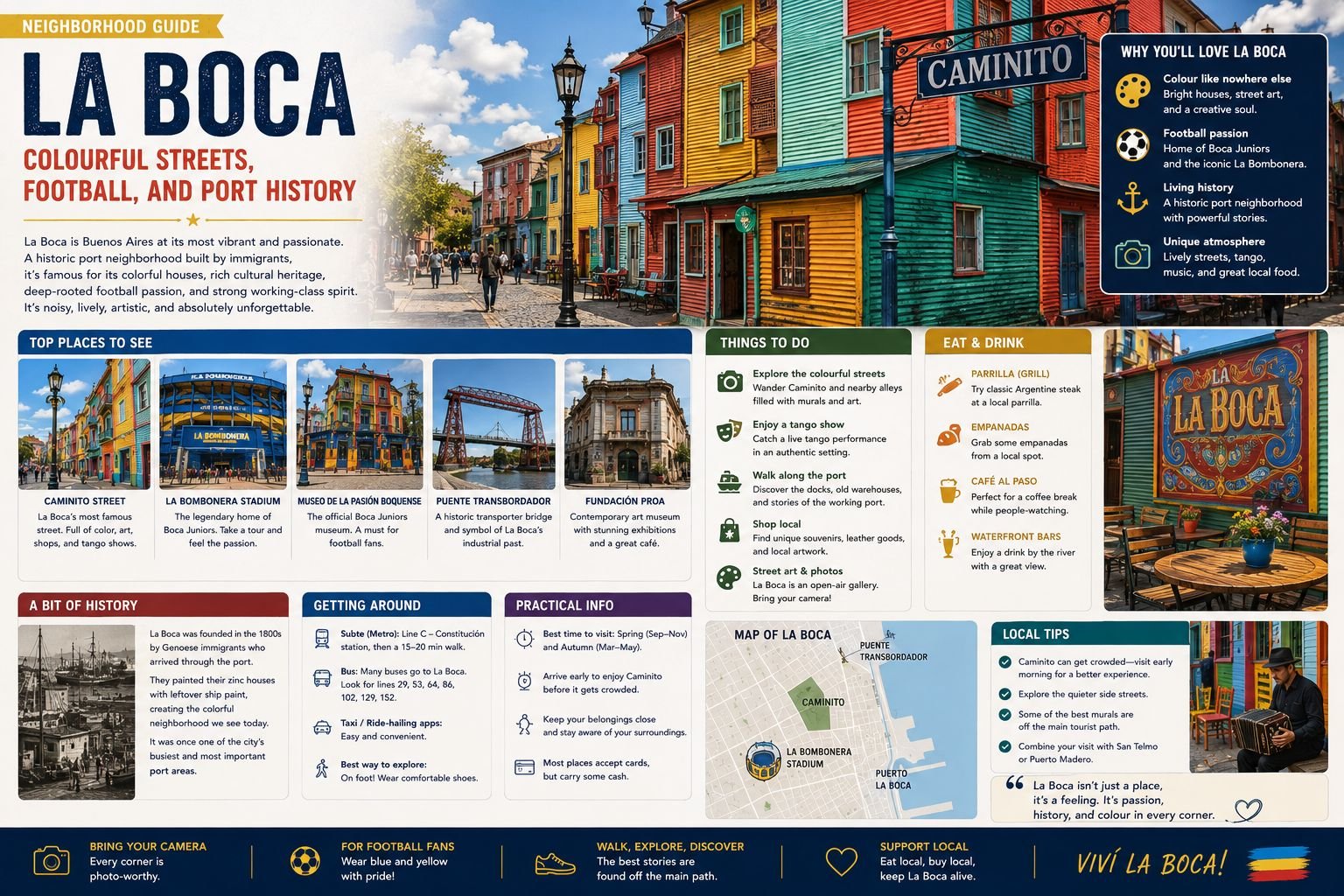
La Boca is the most photographed neighbourhood in Buenos Aires and one of the most misunderstood. The Caminito, with its brightly painted corrugated metal houses and street performers, exists within a small, carefully maintained tourist precinct; the neighbourhood surrounding it is a working-class area with a genuine character and a genuine reputation for being unsafe for visitors who wander away from the tourist zone. Understanding this distinction, and visiting accordingly, makes La Boca one of the most interesting hours you can spend in Buenos Aires.
History: The Immigrant Port Neighbourhood
La Boca (the mouth, referring to the mouth of the Riachuelo river) was the first port area of Buenos Aires, where the ships from Genoa, Naples, and Spain docked in the 19th century. The Genoese immigrants who settled here built their houses from the corrugated metal sheets from the ships, painting them in the bright primary colours that are now the neighbourhood’s signature aesthetic. The name caminito (little path) belongs to a disused rail track turned street-museum, named after a famous tango song; the Caminito is the tourist heart of La Boca.
The neighbourhood is also the home of Club Atlético Boca Juniors, one of the two great Buenos Aires football clubs (the other being River Plate in Núñez). The Bombonera stadium, named for the distinctive shape of its three-sided stands, is one of the most famous football grounds in the world. The club’s historical connection to the neighbourhood’s Italian immigrant community is part of what makes its cultural identity so specific; going to a Boca match, or visiting the Museo de la Pasión Boquense (the club museum), is one of the genuinely moving cultural experiences the city offers, even for non-football fans.
The Caminito: What to Expect
The Caminito is a block-long pedestrian street lined with colourful buildings, vendors selling local crafts and art, street performers, and tango dancers who perform for tips and photo opportunities. It runs from the Vuelta de Rocha (the bend in the Riachuelo) south for about 100 metres and is dense with visitor activity between 10am and 5pm.
The experience is touristic by design: the colourful facades are maintained for aesthetic effect; the street performers are professional; the vendors are oriented toward selling to visitors. This does not make it inauthentic in any meaningful sense, as the neighbourhood genuinely looks like this and the craft market is genuinely local. But it is a different kind of experience from wandering an unreconstructed neighbourhood, and calibrating expectations accordingly prevents disappointment.
When to visit: Early morning, before 10am, or late afternoon after 5pm, when the tour buses have left and the street has a more genuinely local character. Midday is the most crowded and the least interesting time to be there.
The surroundings: The streets immediately adjacent to the Caminito, including El Caminito itself and the blocks toward the stadium, are the appropriate zone for visitors. Walking more than two or three blocks away from this area is not advisable; La Boca has a high rate of street crime compared to the rest of Buenos Aires.
Fundación PROA
On the Avenida Pedro de Mendoza riverfront, a five-minute walk from the Caminito, the PROA Foundation is one of the most respected contemporary art institutions in the city. The building, designed on the ground floor of a restored old house, hosts temporary exhibitions of Argentine and international contemporary art that are consistently at the level of the better European contemporary art foundations. Opening hours vary by exhibition; check before visiting.
Boca Juniors: The Club and the Museum
The Bombonera stadium, at Brandsen 805, dominates the eastern end of La Boca. It holds approximately 57,000 people and is famous for the noise levels it generates, attributed to the unusual three-sided design that concentrates sound rather than dispersing it.
The Museo de la Pasión Boquense, inside the stadium complex, covers the full history of Boca Juniors with a level of devotion and production value that makes it worthwhile even for those with limited football interest. The museum includes a 360-degree cinema showing key moments in Boca history, the historical jersey collection, and interactive displays. The stadium tour (which takes you into the stands and pitch-side tunnels) can be added to the museum visit.
Attending a Boca Juniors match is one of the most intense stadium experiences in the world; tickets for popular matches are difficult to obtain through official channels and are usually acquired through tour operators who package the match with transport and access.
Getting to La Boca
La Boca has no Subte station. The most practical access is by taxi or Uber (10 to 15 minutes from San Telmo, 15 to 25 minutes from Palermo), or by colectivo (buses 29, 33, and 64 connect La Boca with the city centre and other neighbourhoods). Driving to La Boca is complicated by the narrow streets and limited parking.
Important: The journey to and from La Boca by taxi or Uber is strongly recommended over walking from the nearest Subte stations; the route passes through areas where tourist safety requires specific awareness.
How Long to Spend in La Boca
A morning or afternoon of 2 to 3 hours covers the essential La Boca experience: the Caminito and its immediate surroundings, the PROA foundation, the Boca Juniors museum, and a walk along the waterfront. Combining La Boca with a visit to Puerto Madero (a 15-minute drive or 20-minute walk along the waterfront) makes a natural half-day pairing.
What La Boca Is Really About
Beyond the tourist presentation, La Boca is interesting for what it tells you about Buenos Aires: the Italian immigrant culture that shaped the city’s food, language, and social culture; the football tribalism that is one of the city’s most distinctive social institutions; the persistence of working-class neighbourhood identity in a globalising city; and the specific local aesthetic, the corrugated metal coloured with whatever paint was available, that became one of South America’s most recognisable visual signatures. Engaging with these layers makes a visit to La Boca more than just a photo opportunity.
Related: San Telmo | Puerto Madero | Neighborhoods Hub | Things to Do
La Boca and the River: The Riachuelo Context
La Boca’s character is inseparable from its relationship with the Riachuelo, the small river that forms the southern boundary of the neighbourhood and separates Buenos Aires from the municipality of Avellaneda. The Riachuelo, heavily polluted for most of the 20th century by the industrial activity along its banks, is the subject of a long-running remediation project; its current state is significantly better than its historic low point but not yet the restored river the project aims to produce.
The Vuelta de Rocha, the bend in the river at the northern end of La Boca, is the oldest part of the neighbourhood and the area that has been least altered by tourist development. Walking along the waterfront here, past the old port infrastructure and the views across the Riachuelo to Avellaneda, gives a sense of the neighbourhood’s working-port origins that the Caminito presentation does not.
The La Boca Street Art Scene
La Boca has one of the densest concentrations of political street art in a city that takes street art seriously. Beyond the explicitly commercial painted facades of the Caminito, the neighbourhood’s walls carry work that engages with Argentine history, political events, and the social conditions of the barrio in ways that are politically charged and often aesthetically significant.
Walking through the transitional zone between the tourist area and the residential barrio (staying on the main avenues rather than side streets) reveals layers of muralism that range from neighbourhood-commissioned community art to individual artists’ interventions. This street art is the honest expression of the neighbourhood; it is more interesting than the posed commercial version on the Caminito.
La Boca is a neighbourhood that rewards going beyond the obvious. The Caminito is worth seeing; the PROA is genuinely excellent; the Boca Juniors museum is worth an hour. Beyond these, engaging with the neighbourhood’s history, its relationship with the river, and its complex present as a community navigating the tension between its tourist identity and its working-class reality produces a richer understanding of Buenos Aires as a whole than is available from any of the city’s more straightforwardly pleasant barrios.
A Final Note
Buenos Aires rewards visitors who arrive prepared and remain open. The practical preparation covered in this guide removes the friction that prevents engagement; the openness is yours to bring. The city that reveals itself to a visitor who knows what they are looking for, who has sorted the practical foundations, and who has the curiosity to follow what the city offers is one of the genuinely great urban experiences available anywhere in the world.
For questions, corrections, or feedback on this guide, the contact page is the right place. This site is updated regularly; if you visit Buenos Aires and find that conditions have changed from what this guide describes, telling us makes the guide better for the next reader.