
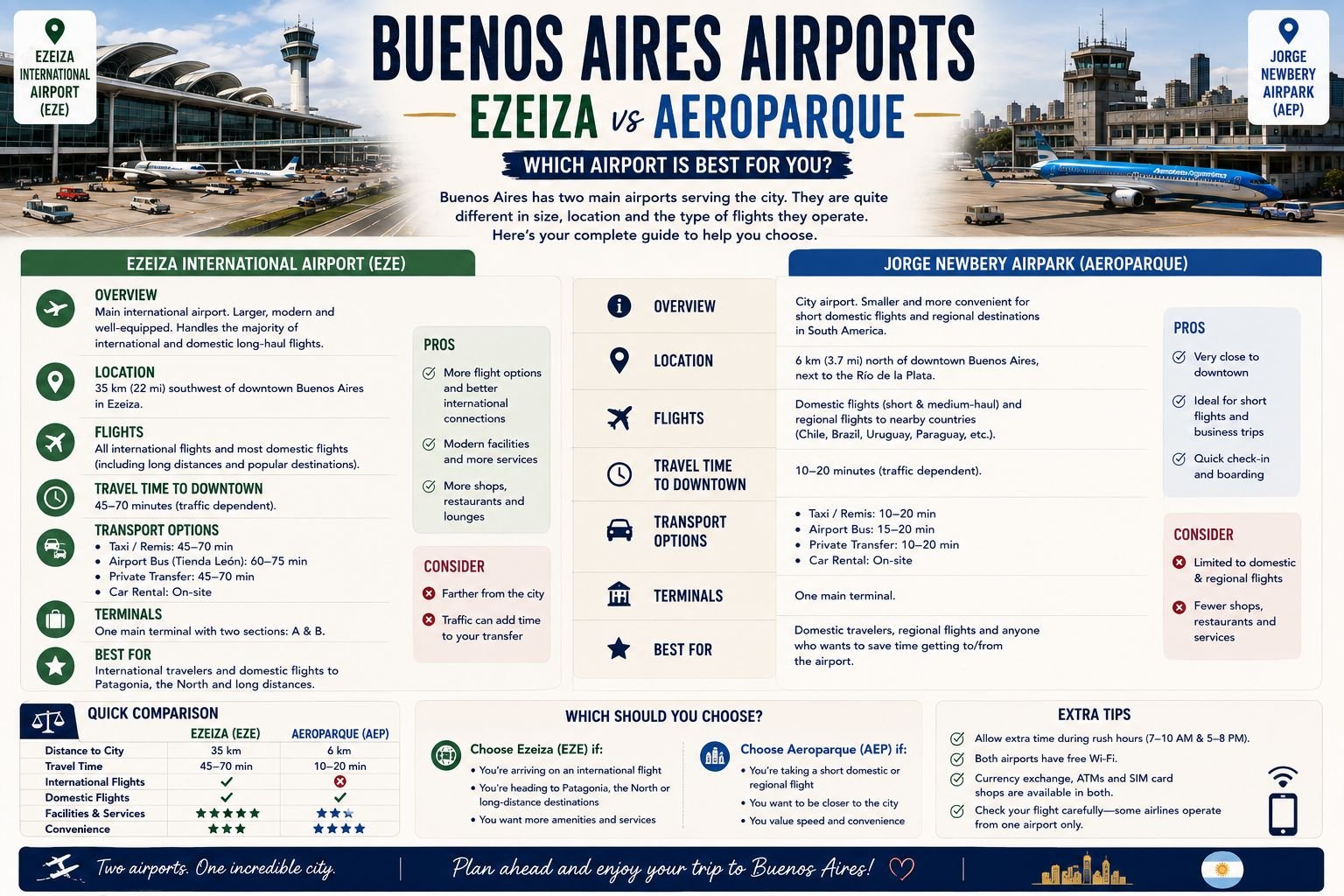
Buenos Aires is served by two airports that serve very different purposes. Most international visitors arrive at Ezeiza; most domestic and some regional flights use Aeroparque. Understanding which airport you are using for each leg of your journey, and how to get between the airport and the city, is the first logistics question to resolve for any Buenos Aires visit.
Aeropuerto Internacional Ezeiza (EZE)
Ezeiza (official name: Aeropuerto Internacional Ministro Pistarini, IATA code EZE) is the main international airport of Buenos Aires, located in the town of Ezeiza, approximately 35 kilometres southwest of the city centre. Most long-haul international flights use Ezeiza; airlines serving this airport include Aerolíneas Argentinas, LATAM, Air France, Iberia, British Airways, Alitalia, Lufthansa, Delta, American Airlines, and most other international carriers.
The airport: Ezeiza has two international terminals (Terminal A and Terminal B) connected by a walkway. The airport has reasonable food and retail options, ATMs (see the money guide for which to use), currency exchange desks, and a WiFi network. Arriving passengers go through immigration (which can have long queues on morning-arrival flights from Europe) and then customs before exiting to the arrivals hall.
Journey time to the city: 35 to 70 minutes depending on traffic. The journey along the Autopista Ricchieri can be significantly longer during peak traffic periods (Monday to Friday mornings and evenings); arriving mid-morning or on a weekend typically produces the shorter end of this range.
Aeroparque Jorge Newbery (AEP)
Aeroparque (IATA code AEP) is the domestic airport, located in the Palermo neighbourhood approximately 7 kilometres from the city centre, directly on the bank of the Río de la Plata. Most domestic Argentine flights use Aeroparque; it also serves some regional international routes, including services to Montevideo, Asunción, and other nearby capital cities.
The proximity to the city centre makes Aeroparque significantly more convenient than Ezeiza for domestic travel. A taxi from Aeroparque to Palermo or Recoleta takes 10 to 15 minutes; to San Telmo or the Microcentro, 15 to 25 minutes depending on traffic.
Which Airport to Use
Arriving from outside South America: You will arrive at Ezeiza. There is no choice here; international long-haul flights use Ezeiza.
Domestic flights within Argentina: You will use Aeroparque for most destinations; Córdoba, Mendoza, Bariloche, Salta, Mar del Plata, and other major domestic destinations are served from Aeroparque.
Regional international routes (Uruguay, Chile, Brazil, Paraguay): These can use either airport depending on the airline and route. LATAM flights from Santiago sometimes use Ezeiza; LATAM and Aerolíneas Argentinas flights to Montevideo typically use Aeroparque. Check your booking.
Getting from Ezeiza to the City
The getting-from-Ezeiza-to-city question deserves detailed treatment because it is the first practical challenge most visitors face, and the options vary significantly in cost, reliability, and convenience.
Remis (private car service): The recommended option for most visitors. In the arrivals hall at Ezeiza, there are official transport desks where pre-paid remis services are booked; the price is fixed in advance and you pay at the desk before getting in the car. The desk system eliminates the risk of meter manipulation or overcharging that can occur with unmetered taxis outside the terminal. Current prices to the city centre are approximately USD 25 to 40 depending on destination; confirm the current price at the official desk. The full guide to all Ezeiza transfer options is in the [Ezeiza to city guide](/practical-info/ezeiza-to-city/).
Tienda León shuttle bus: A shuttle bus service running from Ezeiza to a central terminal in the Microcentro (at Madero and San Martín, near Puerto Madero) and Palermo, with comfortable coaches and a fixed price around USD 10 to 15. The slowest option (makes multiple stops) but the cheapest bus alternative to the remis. Departs from outside the arrivals hall.
Taxi: Available at the official taxi stand outside arrivals. Buenos Aires airport taxis are metered but the meter structure at airports can produce higher fares than remis services for the same journey. Ensure you use the official taxi stand rather than accepting offers from drivers who approach you in the arrivals hall.
Uber: Uber picks up at Ezeiza from a designated area outside the terminal. This option requires a working Argentine data connection or airport WiFi to book. The price is typically comparable to the remis.
Getting from Aeroparque to the City
Taxi or Uber: The most practical option. The short distance to Palermo and the city centre makes these services very cheap from Aeroparque; expect USD 5 to 12 for most city centre destinations.
Bus 33 (colectivo): Bus 33 runs from Aeroparque along Costanera Norte to the city centre. Cheap (under USD 1) but requires a SUBE card and comfort with the bus system. For those without luggage or with very light bags, a viable option.
Practical Notes for Both Airports
ATMs: Both airports have ATMs. For Ezeiza, the Banco Nación ATMs in the international arrivals hall dispense pesos; the exchange rate available at these ATMs reflects the current tourist rate or close to it. Avoid the commercial currency exchange desks in the terminal, which offer poor rates. The [money guide](/practical-info/money/) covers this in detail.
SIM cards: Both airports have mobile operator kiosks in arrivals where Argentine tourist SIMs can be purchased. Buying a SIM at the airport immediately on arrival means you have data for transport apps from the moment you exit.
Related: Ezeiza to City | Getting Around | Practical Info Hub | Plan Your Trip
Immigration and Customs: What to Expect
Immigration at Ezeiza: After landing and taxiing to the gate, you will proceed to passport control. The queues can be substantial for busy flight arrivals (particularly European overnight flights landing between 7am and 10am). Argentines and MERCOSUR citizens have dedicated lanes; all other nationalities queue in the general immigration line. Having your completed immigration form ready (completed on the plane or available to fill in before reaching the queue) saves time.
At the desk, the officer will stamp your passport with the entry date and permitted stay duration. Keep the tourist card (tarjeta de turismo) you are given, or the details recorded in your passport; you may need to present it on departure.
Customs at Ezeiza: After collecting luggage, you pass through customs. Argentine customs requires declaration of: cash over USD 10,000; commercial quantities of goods (including goods purchased abroad that are not for personal use); food products (many are restricted); and certain electronic items. Tourists with personal luggage generally pass through the green (nothing to declare) channel without incident.
At Aeroparque: The domestic terminal processes faster than Ezeiza; identity document checks (not full passport control for domestic travellers) and the absence of customs processing make the Aeroparque experience significantly quicker than Ezeiza.
Airport Facilities
Ezeiza facilities: ATMs (use the Banco Nación machines for the best rates), currency exchange desks (rates are poor; use sparingly if at all), several cafés and restaurants, a duty-free shop in the departure area, WiFi throughout the terminal (connect to the network and follow the registration process), and a tourist information desk in arrivals.
Aeroparque facilities: Smaller range of amenities than Ezeiza, but all the essentials: cafés, ATMs, WiFi, and ground transport options outside the terminal.
The Buenos Aires airport situation is straightforward once understood: Ezeiza for international arrivals and most international departures; Aeroparque for domestic travel and some regional routes. The getting-from-Ezeiza-to-city question has clear, well-established answers that cost a predictable amount and take a predictable time. Knowing these answers before you land makes the first hours in Argentina significantly less stressful.
A Final Note
Buenos Aires rewards visitors who arrive prepared and remain open. The practical preparation covered in this guide removes the friction that prevents engagement; the openness is yours to bring. The city that reveals itself to a visitor who knows what they are looking for, who has sorted the practical foundations, and who has the curiosity to follow what the city offers is one of the genuinely great urban experiences available anywhere in the world.
For questions, corrections, or feedback on this guide, the contact page is the right place. This site is updated regularly; if you visit Buenos Aires and find that conditions have changed from what this guide describes, telling us makes the guide better for the next reader.
Related guides are linked throughout. The [Start Here](/start-here/) page provides an overview of the entire site for visitors approaching Buenos Aires for the first time.
The Buenos Aires airport experience, while not the most refined in South America, is entirely manageable with advance preparation. Knowing which airport you are using, how you will reach the city, what cash you need in what currency, and where the relevant transport options are located converts a potentially disorienting first arrival into a smooth beginning to the Buenos Aires visit.
Buenos Aires rewards the traveller who arrives prepared and remains curious. Every guide in this site is designed to remove the friction between arrival and genuine engagement with the city; the engagement itself is yours to pursue. The city is inexhaustible, genuinely warm, and consistently surprising even to those who have been here many times. Whatever brings you to Buenos Aires, whether a first visit, an extended stay, or the beginning of a longer Argentine chapter, the preparation this guide provides is the starting point. What comes next is the city’s contribution.