
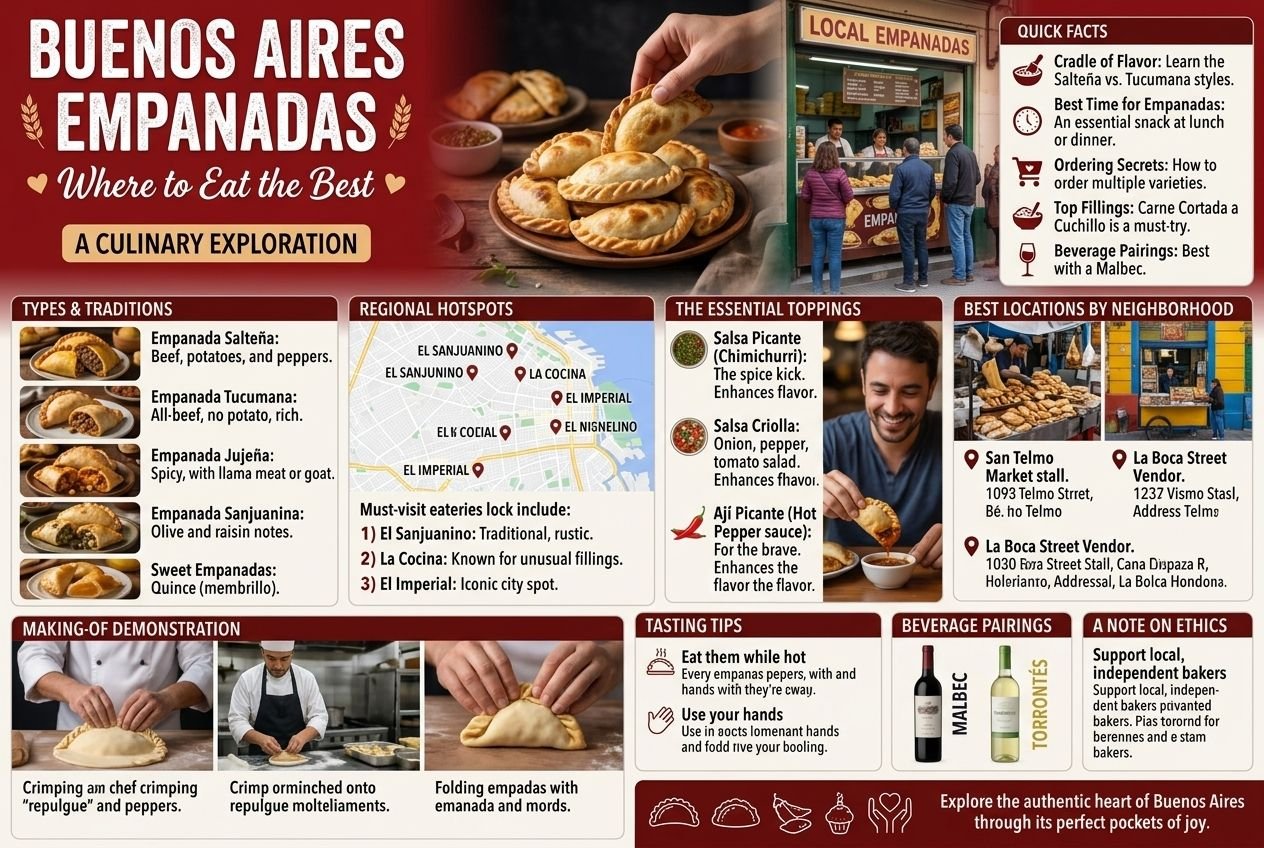
The empanada is Argentina’s most beloved and ubiquitous food: a small, hand-made pastry pocket filled with savoury filling, baked or fried, eaten everywhere from formal restaurants to street stalls to kitchen tables across the country. Buenos Aires has an extraordinary range of empanada options, from the city’s own Italian-influenced baked versions to the regional varieties imported from the northern provinces by the restaurants and bakeries that Porteños from outside the capital have established in the city.
The Empanada Basics
An Argentine empanada is a half-moon-shaped pastry pocket, typically about the size of a cupped hand, sealed along the curved edge by a specific crimping technique (the repulgue) that varies by region and often by filling. The dough is typically made with wheat flour, lard or vegetable fat, and water; a well-made empanada dough is thin, flaky, and slightly translucent when baked.
Baked vs fried: Argentine empanadas are most commonly baked (al horno) rather than fried. Baked empanadas have a flaky, golden pastry exterior and a dry-but-not-crisp texture. Fried empanadas are available but less common in Buenos Aires than in some other Latin American countries; when fried well, the pastry is crisp and the interior is very juicy.
The repulgue: The crimped edge that seals the empanada also identifies the filling in traditional bakeries and restaurants. The pattern of the crimp varies by filling; a skilled empanadería will use different repulgue patterns for different fillings so that a tray of mixed empanadas can be navigated without opening each one.
The Classic Fillings
Carne (beef): The most common and, for many, the definitive Argentine empanada filling. The classic preparation is ground or finely chopped beef (picadillo) cooked with onion, paprika, cumin, hard-boiled egg, and green olives. The egg and olives are specific to the Argentine tradition; the filling should be moist but not wet, and the spicing restrained rather than aggressive.
Carne picante (spicy beef): A variation on the above with chilli; not very spicy by international standards but worth trying for the contrast.
Humita: A filling of creamed corn, onion, and cheese; one of the most traditional Argentine fillings and the most distinctly pre-colonial in its origins. Good versions are smooth, sweet, and not at all like what the word “corn” might suggest to a North American reader.
Jamón y queso (ham and cheese): The simplest and most universal filling; the quality depends almost entirely on the quality of the ham and cheese used.
Espinaca y queso (spinach and cheese): The standard vegetarian option; the best versions use fresh spinach and good-quality cuartirolo cheese.
Verdura (vegetables): Variations on the spinach and cheese theme using whatever seasonal vegetables the baker prefers.
Pollo (chicken): Less traditional than beef but widely available; cooked chicken with onion, tomato, and spices.
Regional Variations Worth Knowing
Salteñas (from Salta): The empanadas of the northern province of Salta have a wetter filling with more broth, a slightly sweeter pastry, and a more aggressive spicing. Several Salta-style restaurants in Buenos Aires offer this version, which is excellent and worth trying for the contrast with the Buenos Aires standard.
Tucumanas (from Tucumán): Tucumán is sometimes called the empanada capital of Argentina, and the Tucumán version uses a fried pastry with a very moist filling and typically a more intense flavour. Smaller and more intensely flavoured than Buenos Aires empanadas.
Where to Eat Empanadas in Buenos Aires
El Sanjuanino (Posadas 1515, Recoleta): One of the most celebrated empanada restaurants in Buenos Aires, known for serving the northern provincial styles in an authentic format. The empanadas from San Juan province are less well known than the Salta or Tucumán versions but are excellent. Casual, inexpensive, and consistently reliable.
Peña del Colorado (Güemes 3657, Palermo): A traditional peña (a restaurant hosting folk music performances) that serves excellent northern empanadas alongside Argentine folk music. The combination of the music, the food, and the atmosphere makes it one of the more distinctive experiences in the city.
La Cocina (Pueyrredón 1508, Palermo/Recoleta border): A popular empanada chain known for large, well-filled empanadas at very reasonable prices. Better value than the tourist-facing options in San Telmo.
El Preferido de Palermo (Borges 2108, Palermo): A classic Porteño almacén (combination grocery, bar, and restaurant) that serves excellent baked empanadas alongside its full restaurant menu. One of the most atmospheric restaurants in the city.
Empanadas de Belgrano: The Belgrano neighbourhood has a cluster of good empanada shops serving the local community rather than tourists; these are typically cheaper and often very good.
Empanadas at Markets and Bakeries
Some of the best empanadas in Buenos Aires are not found at restaurants but at the panadería (bakeries) and small empanadería shops that produce and sell freshly baked empanadas throughout the day. These typically offer 6 to 12 filling varieties, sell individual empanadas for a few hundred pesos each, and are consumed on the spot or taken away. The quality of a good neighbourhood panadería’s empanadas is often higher than an equivalent restaurant option.
The San Telmo Sunday market has several empanada vendors in the surrounding streets; the quality ranges from tourist-grade to excellent, and navigating toward the vendors with the longest local queues (rather than the most prominent tourist signage) typically identifies the better options.
Related: Food and Drink Hub | Best Parrillas | Markets | Plan Your Trip
Making Empanadas: The Cultural Dimension
The empanada-making session (the tarde de empanadas) is one of the most significant social rituals of Argentine domestic life. Gathering to make empanadas together, with different people assigned to different fillings, and the specific competition over who achieves the best repulgue (the crimped edge), is as much a social occasion as a cooking one. This cultural context is worth knowing because it explains why the empanada is taken so seriously in a way that its physical simplicity might not immediately suggest.
Empanadas by Region: A Tasting Tour
For food-curious visitors, tracking down the regional varieties is a rewarding project that takes you beyond the tourist-facing restaurants:
Tucumán style (smaller, fried, intensely flavoured): Available at several tucumano-owned restaurants and market vendors in the Once neighbourhood and in the Tucumán cultural centre.
Salta style (wet filling with broth, slightly sweet pastry): Several Salta-style restaurants operate in Palermo and San Telmo; Peña del Colorado and El Sanjuanino are the most reliable.
Mendoza style (drier filling, larger size, more paprika): Available at Mendocino-themed restaurants and some of the wine bar restaurants that specifically pair wines with regional food.
Jujuy style (sometimes made with llama meat, a yellow corn dough in some versions): Harder to find in Buenos Aires but available at some northern Argentine restaurants in the Balvanera neighbourhood.
The Buenos Aires empanada itself, the standard version found everywhere, is an excellent thing; but exploring the provincial variations gives a sense of Argentina’s enormous regional diversity through one of its most universal foods.
Empanadas at Home: The Bakery Alternative
The best value empanadas in Buenos Aires are not found at tourist-facing restaurants but at the neighbourhood panaderías (bakeries) that sell freshly baked empanadas throughout the day. These are typically sold at the price per unit (by the half-dozen or dozen); the fillings change daily and the quality, at a good neighbourhood bakery, often exceeds dedicated restaurant options.
Finding the best panadería in your neighbourhood is a matter of asking the person at the nearest café, or following the local queue at lunch hour. The queue at the right bakery tells you more than any guide.
Empanadas are to Buenos Aires what pizza is to Naples: a food so embedded in the culture that ordering one is both a gustatory act and a cultural statement. The best version you eat in Buenos Aires will probably not be at a restaurant but at a bakery window, or at a street stall, or from a plate produced by someone who learned the technique from their grandmother. Part of the Buenos Aires food experience is finding your own best empanada rather than relying on any list.
A Final Note
Buenos Aires rewards visitors who arrive prepared and remain open. The practical preparation covered in this guide removes the friction that prevents engagement; the openness is yours to bring. The city that reveals itself to a visitor who knows what they are looking for, who has sorted the practical foundations, and who has the curiosity to follow what the city offers is one of the genuinely great urban experiences available anywhere in the world.
For questions, corrections, or feedback on this guide, the contact page is the right place. This site is updated regularly; if you visit Buenos Aires and find that conditions have changed from what this guide describes, telling us makes the guide better for the next reader.
The Buenos Aires empanada experience is both a culinary pleasure and a cultural one. The specific crimping of the pastry, the regional variations in filling, the bakery windows that produce them fresh throughout the day, and the social contexts in which they are consumed all reflect something specific about Argentine food culture: the combination of Italian and Spanish immigrant traditions with native Argentine ingredients, producing something that is distinctly neither European nor indigenous but genuinely Argentine.