
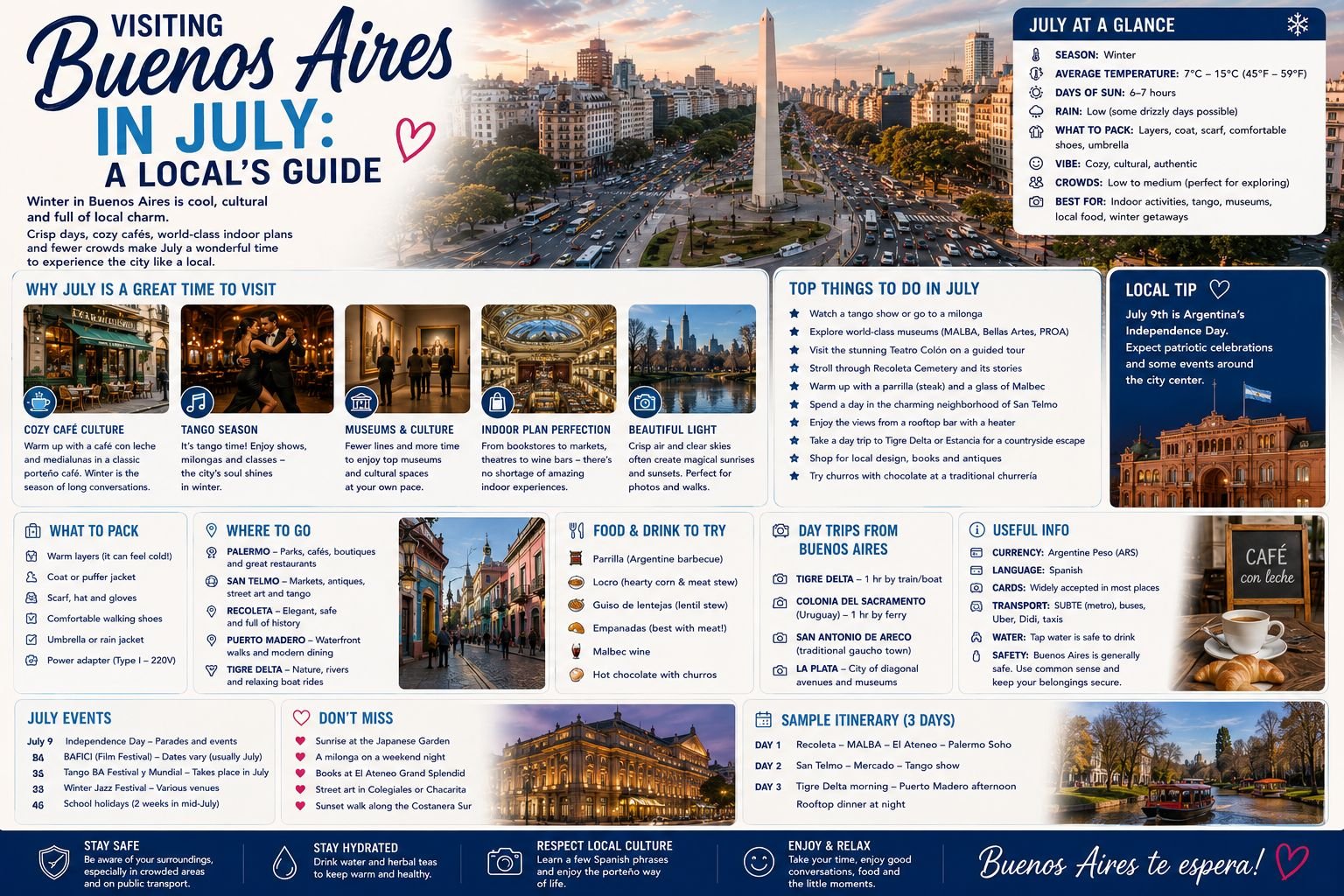
July is midwinter in Buenos Aires, the coolest month of the year, but it’s also home to the country’s Independence Day and Argentina’s winter school holiday period, both of which give the month a genuine buzz that counters the idea of winter as a dead season.
By Natalia Romero · Plan Your Trip → Best Time to Visit → July
Weather in July
July is the coldest month, with daytime highs around 14-15°C (57-59°F) and nights dropping to around 6-7°C (43-45°F). Expect occasional damp, grey days; Buenos Aires’ winter is more about persistent cool dampness than dramatic cold snaps. Layering, a good coat, and comfortable waterproof footwear are all worth prioritising for a July trip.
Events and Culture in July
Independence Day (July 9): Argentina’s most important national holiday, commemorating the 1816 declaration of independence from Spain. A major public holiday with significant ceremonies, and one of the more meaningful dates to be in Buenos Aires if your dates align, offering genuine insight into Argentine national pride and identity. Expect closures at government buildings and a festive, patriotic atmosphere across the city.
Winter School Holidays: Argentine schools break for roughly two weeks in July (dates shift slightly year to year), which means a domestic tourism uptick as Argentine families travel, including to destinations like Bariloche for skiing. This has a modest effect on Buenos Aires itself, some domestic visitors passing through or extending stays, more families visible at major attractions, rather than the significant population shift January’s coastal exodus creates.
Uptick in Visitor Numbers: July sees a small increase in international visitor numbers compared to the deeper winter lull of June, largely reflecting the northern hemisphere’s summer school break, when North American and European families with more schedule flexibility travel.
What to Do in July
July rewards the same indoor-friendly, cosy approach that works in June: museums, historic cafés, and long parrilla lunches all suit the season well. This is genuinely one of the better months for tango, both shows and milongas, since the contrast between the cold outside and the warm, intimate, dimly lit venues adds to the atmosphere in a way summer doesn’t replicate.
Independence Day itself, if it falls within your visit, is worth building time around specifically: the public ceremonies and general atmosphere around Plaza de Mayo and the Casa Rosada offer a genuine, non-touristy glimpse into Argentine civic life.
Crowds and Pricing
July sits slightly above June in visitor numbers and, correspondingly, pricing, but remains solidly in low-season territory compared to the spring, autumn, and summer peak periods. Good value remains the month’s main draw for budget-conscious visitors willing to trade ideal weather for lower costs and thinner crowds.
Practical Tips for a July Visit
Dress warmly and expect some grey, damp days; this is not a month for relying on sunny outdoor sightseeing as the backbone of an itinerary. If Independence Day falls within your trip, check current-year event details, as public ceremony locations and timing can shift.
July for Visitors Combining Buenos Aires with Patagonia or Ski Travel
Because July’s winter school holidays coincide with Argentina’s ski season further south (Bariloche and the broader Patagonian lake district being the main draw), July is a common month for itineraries that combine a few days in Buenos Aires with a longer stretch in Patagonia, either for skiing or for winter landscape travel. If this describes your trip, note that domestic flights from Aeroparque to Bariloche and similar destinations can book up more than usual during the July school holiday window specifically, worth booking further ahead than you might for the same route at other times of year.
Independence Day Beyond the Ceremony
Beyond the formal public ceremonies, July 9th also tends to bring a genuinely festive private mood to the city: family gatherings, national colours displayed on balconies and storefronts, and a general sense of civic pride that visitors can feel even without attending any specific organised event. Simply being out in the city, in the Microcentro or a residential neighbourhood alike, on the day itself offers a distinctive atmosphere worth experiencing even without a specific itinerary item planned around it.
Sample July Days
July suits a similar indoor-leaning rhythm to June, with Independence Day, if it falls within your trip, as a natural centrepiece: spend that specific day near Plaza de Mayo and the Casa Rosada taking in the public ceremony and atmosphere, and build the rest of your itinerary around museums, historic cafés, and an evening tango show or milonga, exactly the kind of programming that suits July’s cold, damp character best. If combining Buenos Aires with Patagonia or a ski trip, sequence the city portion of your trip either before or after the mountain leg rather than splitting it awkwardly across the middle.
Frequently Asked Questions About Visiting in July
Is July the coldest month to visit? Yes, July is Buenos Aires’ coldest month on average, though as noted, “cold” here is relative and rarely extreme.
Does Independence Day affect museum and attraction opening hours? Government buildings and some businesses close for the public holiday itself; check specific attractions you plan to visit for their July 9th hours in advance, as this varies by venue.
Is it worth combining Buenos Aires with a Patagonia trip in July? Yes, this is a common and logistically sound combination given the overlapping winter season and Argentina’s domestic flight network, though book domestic flights to ski destinations further ahead than usual given the July school holiday demand.
Related: Best Time to Visit | June in Buenos Aires | August in Buenos Aires | Tango Shows | Milongas

Hi, I’m Natalia, an Argentine writer born and raised in Buenos Aires, and I’ve been writing about this city for 9 years.
I cover Buenos Aires the way only a local can: the neighbourhoods that don’t make the highlight reels, the ferias worth getting up early for, the parrillas where the menu isn’t in English, and the safety picture by barrio — honest, not sanitized. I’ve taken 40+ solo trips across Argentina, Uruguay, Chile, Bolivia and Peru, and I write in both Spanish and English, which means the local forums, neighbourhood Facebook groups and municipal notices that never get translated are all fair game for me.
My writing covers two things I know from the inside: Buenos Aires as a destination — what to do, where to stay, how to navigate the city as a visitor — and Buenos Aires as a place to live. The expat life content comes from real experience: the paperwork that defeats everyone, the healthcare system that surprises you, the cost of living that changes faster than any guidebook can track, and the parts of porteño life that make it worth all of it.
If you’re visiting for a week or moving here for a year, I aim to be the honest friend who actually lives here — not the one who visited once and wrote a listicle.