
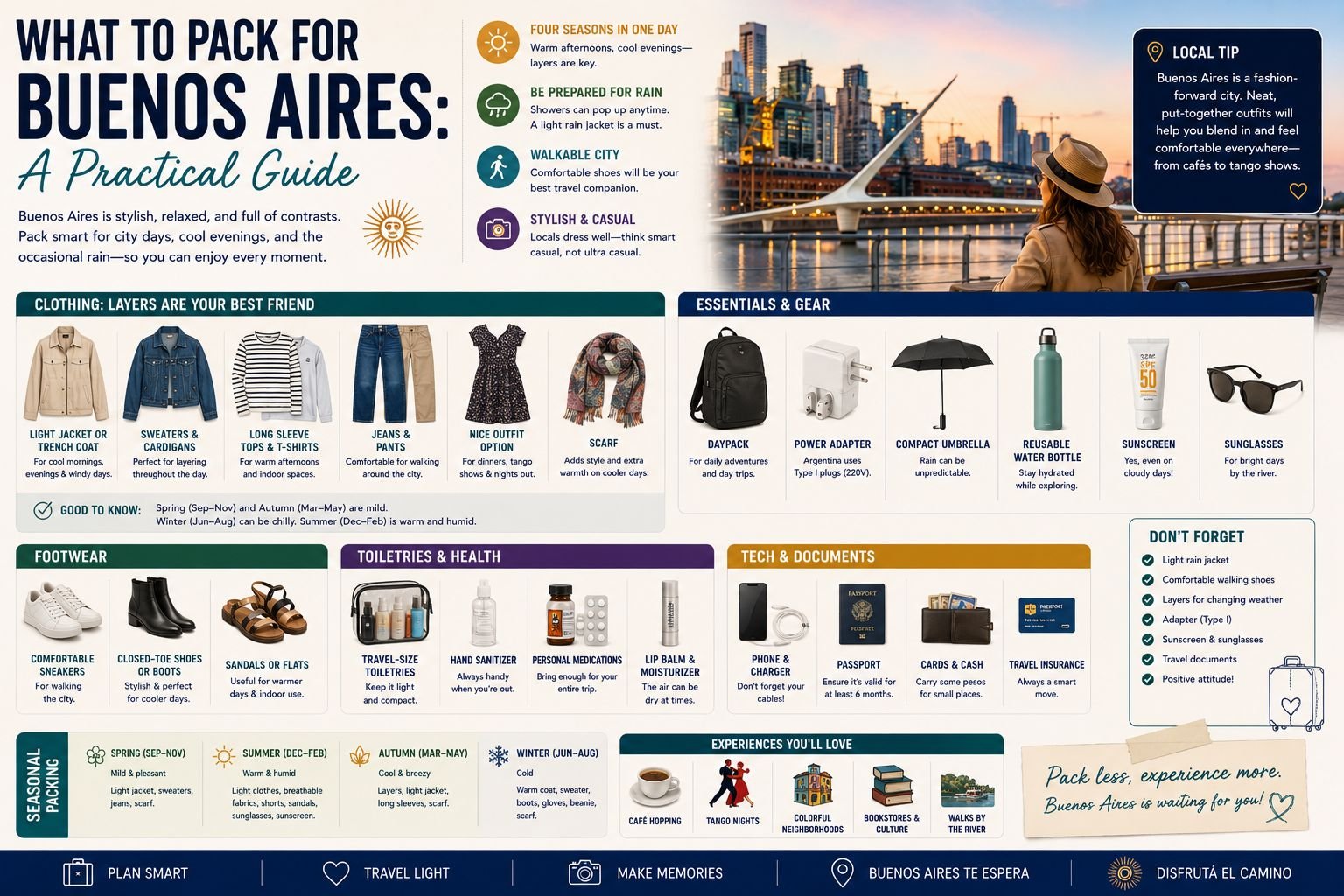
Buenos Aires has a temperate four-season climate and a relatively formal dress culture by South American standards. Packing for it is not difficult, but a few specific considerations make the difference between having what you need and wishing you had thought more carefully.
The Basics: Climate by Season
Summer (December to February): Hot and humid. Average highs of 28 to 32°C with humidity that makes it feel higher. Pack lightweight, breathable fabrics. Cotton and linen work well. Air conditioning is very widespread, so carry a light layer for restaurants and museums where the air conditioning is aggressive.
Autumn (March to May): Cooling from warm summer temperatures to proper autumn coolness. March and April are ideal packing: a light jacket and layers cover the range. May can be genuinely cold in the evenings; a mid-weight coat is useful.
Winter (June to August): Cool and damp. Average temperatures 8 to 14°C, colder in the evenings. Pack as you would for a cool European spring: a proper coat, layers underneath, and clothing that works both indoors (air conditioning can be cold even in winter) and outside.
Spring (September to November): Mirror of autumn. September is variable; October and November are reliably warm and pleasant. Layers are still useful for September evenings.
Clothing: What Buenos Aires Specifically Requires
A smart outfit for evenings: Porteños dress well for evening meals and social events. The standard for restaurants and tango shows is smart casual rather than formal, but noticeably more dressed than the “clean t-shirt and jeans” level that serves in many tourist destinations. One smart outfit, whether a dress or trousers and a shirt, covers the situations where you want to look appropriate.
Comfortable walking shoes: Buenos Aires is a walking city and the streets, particularly in older neighbourhoods like San Telmo, have uneven pavements and cobblestones that defeat any shoe not designed for extended walking. Prioritise comfort over aesthetics; your feet will thank you.
Layers for air conditioning: Argentine air conditioning in restaurants, cinemas, buses, and museums is frequently set aggressively cold. Even in summer, a light cardigan or thin jacket for indoor environments saves discomfort.
Practical Items Worth Packing
Plug adapter: Argentina uses Type I outlets (the same three flat angled pins as Australia and New Zealand). If you are arriving from Europe or North America you will need an adapter. It is available in Buenos Aires but easier to bring from home.
Cash and cards: Bring some USD or EUR in good, clean condition. These can be exchanged at better-than-official rates through legitimate channels. Cards also work, but understanding the exchange rate situation (covered in the [money guide](/practical-info/money/)) matters for getting the best value.
Universal USB charger: A compact multi-port USB charger reduces the number of adapters and plugs you need to manage.
A small day bag or backpack: For walking days. Avoid flashy or expensive-looking bags in busy tourist areas; a simple, unobtrusive day bag is the right call.
Portable battery: Useful for days spent walking the city and using navigation apps extensively.
Medications: Bring an adequate supply of any prescription medications. Some pharmaceutical products available over the counter in other countries require prescriptions in Argentina; bringing what you need eliminates the complication.
What You Do Not Need to Pack
Buenos Aires is a large, well-supplied city: Most consumer goods, including toiletries, clothing, and electronics, are available in Buenos Aires. Bringing these from home is unnecessary weight.
Formal attire: Unless your trip involves a specific formal event, a smart casual outfit covers the range. Buenos Aires tango shows do not require black tie; the dress code is smart casual.
Heavy cold-weather gear for winter: Argentine winters are cool, not Arctic. A proper mid-weight coat and some layers are sufficient. Specialist cold-weather clothing is unnecessary.
A Note on Luggage
Buenos Aires presents no specific challenges for luggage. Standard airline carry-on and checked bag rules apply. The one consideration: Ezeiza airport, 35km from the city centre, involves a taxi or transfer drive of 40 to 70 minutes; large, awkward luggage makes this more difficult than it needs to be. For longer stays, a medium-sized suitcase is more practical than an enormous one.
Related: Plan Your Trip | Travel Costs | Practical Info | Getting to Buenos Aires
Packing by Season: Specific Lists
Summer (December to February) essentials:
- Lightweight breathable clothing (linen, light cotton)
- Sunscreen (UV levels are high in Buenos Aires summer)
- A light cardigan or thin layer for air-conditioned restaurants and museums
- Comfortable walking shoes for hot streets
- One smart casual evening outfit
- Type I plug adapter for Argentine outlets
Autumn and Spring (March to May, September to November) essentials:
- Layers (the temperature range of 12 to 24°C requires versatility)
- A light waterproof jacket (rain is possible in spring and autumn)
- A mid-weight sweater or fleece for evenings
- Comfortable walking shoes
- One smart casual evening outfit
Winter (June to August) essentials:
- A proper coat (Buenos Aires winters are damp and cold)
- Layers underneath the coat
- Waterproof shoes or boots (Buenos Aires streets collect water in rain)
- Warm accessories (gloves, scarf) for particularly cold evenings
- One smart casual evening outfit
Year-round:
- Type I plug adapter
- A compact day bag or crossbody bag for city exploration
- Any prescription medications in adequate supply
- Sunglasses (the Río de la Plata light is bright in good weather)
- A Spanish phrasebook or offline translation app
What to Leave Behind
Buenos Aires is a large, fully supplied city. Toiletries, over-the-counter medications, clothing, and most consumer goods are available throughout the city. The only items genuinely worth bringing rather than buying locally are prescription medications (which may not be available in the same formulation) and specific technical items for photography or electronics use that are significantly more expensive in Argentina due to import duties on electronics.
Do not pack for every possible contingency. Pack for what you will actually use. The most common packing regret in Buenos Aires is bringing too much clothing and too heavy a bag for what turns out to be a warm, walkable city where you will be doing laundry at least once during any stay of a week or more.
Packing for Buenos Aires is ultimately simple: bring comfortable clothes appropriate to the season, a plug adapter, your essential documents, and the flexibility to engage with a city that will provide the rest. The over-packed bag, the heavy luggage, the clothing for every conceivable situation: these are the marks of first-time travel anxiety rather than genuine preparation. Buenos Aires is a city, not a wilderness expedition. Pack light; the city will supply what you forgot.
A Final Note
Buenos Aires rewards visitors who arrive prepared and remain open. The practical preparation covered in this guide removes the friction that prevents engagement; the openness is yours to bring. The city that reveals itself to a visitor who knows what they are looking for, who has sorted the practical foundations, and who has the curiosity to follow what the city offers is one of the genuinely great urban experiences available anywhere in the world.
For questions, corrections, or feedback on this guide, the contact page is the right place. This site is updated regularly; if you visit Buenos Aires and find that conditions have changed from what this guide describes, telling us makes the guide better for the next reader.
The best packing outcome for a Buenos Aires trip is a bag that you can carry comfortably, contains what you actually use, and leaves room for anything you might buy in the city. Buenos Aires has excellent shopping for leather goods, Argentine wine (with appropriate packaging for transport), books, and clothing; arriving with your bag at maximum capacity prevents the most pleasant form of souvenir acquisition.
Buenos Aires rewards the traveller who arrives prepared and remains curious. Every guide in this site is designed to remove the friction between arrival and genuine engagement with the city; the engagement itself is yours to pursue. The city is inexhaustible, genuinely warm, and consistently surprising even to those who have been here many times. Whatever brings you to Buenos Aires, whether a first visit, an extended stay, or the beginning of a longer Argentine chapter, the preparation this guide provides is the starting point. What comes next is the city’s contribution.
Buenos Aires is one of the great cities of South America and one of the most rewarding for visitors who approach it with good preparation and genuine curiosity. The specific combination of European-influenced culture, Argentine character, extraordinary food and wine, and a social warmth that is entirely its own makes it unlike any other city in the world. Whatever aspect of the city this guide covers, it is one part of a whole that is considerably greater than its components.