
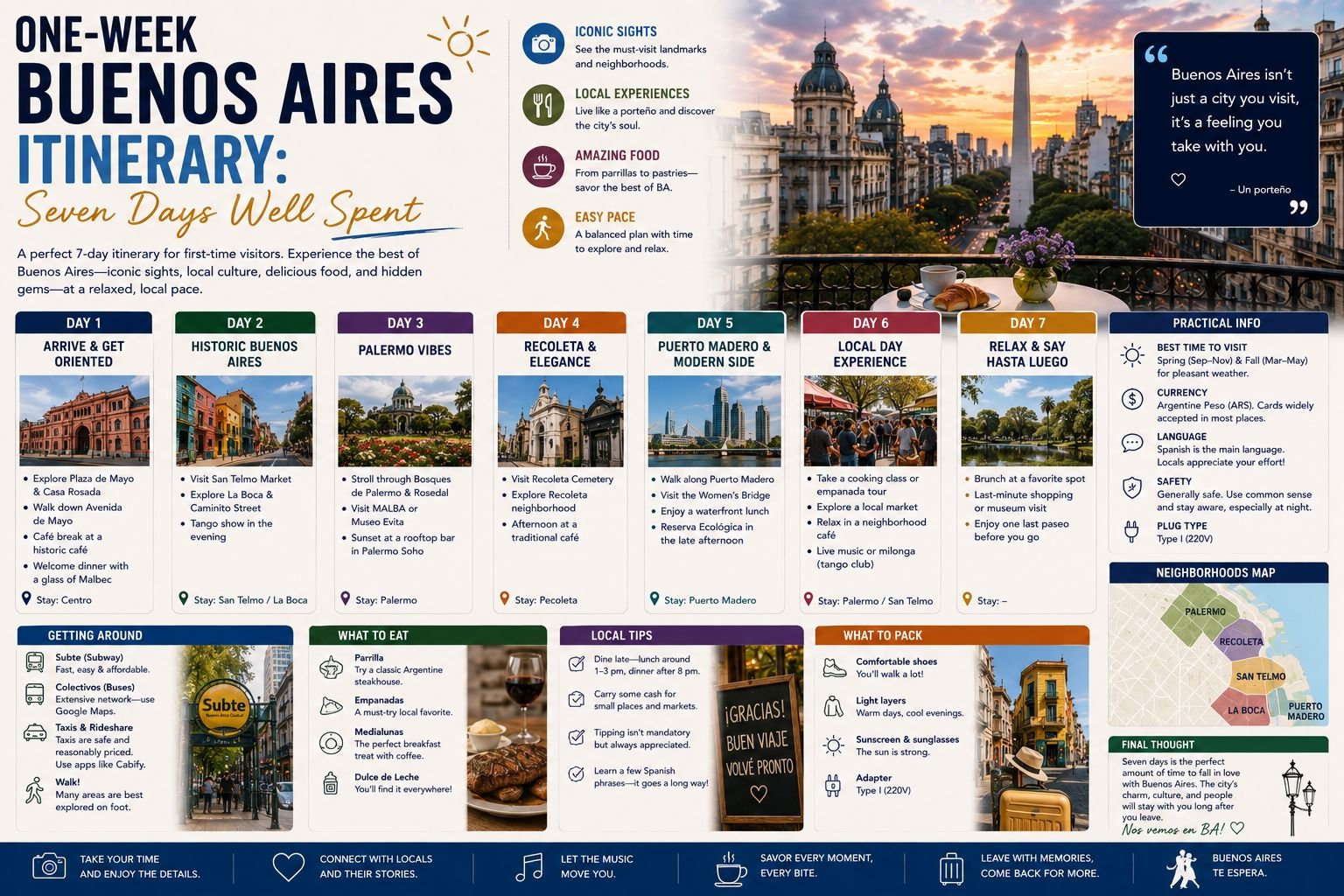
A week in Buenos Aires is the right amount for a first visit. You have time to see the main attractions without rushing, to develop a genuine sense of several neighbourhoods, to take two different day trips, and to have the unstructured days that let the city become familiar rather than just photographed.
Day 1: Arrival and San Telmo
Arrive, settle in, and orient yourself. Walk to San Telmo in the late afternoon or evening. Dinner at a neighbourhood parrilla; El Desnivel or La Brigada for an introduction to Argentine beef culture. Walk back along Calle Defensa in the evening.
Day 2: Historic Centre and Recoleta
Morning at Plaza de Mayo and the Microcentro, including the Casa Rosada, the Cathedral, and Avenida Florida. Afternoon in Recoleta: the Cemetery, MALBA, and the neighbourhood boulevards. Evening dinner in Recoleta at one of the neighbourhood’s traditional restaurants.
Day 3: La Boca and Puerto Madero
Early morning at La Boca before the crowds, then Puerto Madero waterfront and the Reserva Ecológica. Afternoon free; return to a neighbourhood you enjoyed from the first two days, or explore Villa Crespo (one stop north of Palermo on the Subte, undervisited and excellent for independent food and coffee). Evening in Palermo.
Day 4: Palermo Day
A full day in Palermo. Morning in the Palermo Parks: the rose garden, the Japanese Garden, the lakes and paths. Afternoon in Palermo Soho: boutiques, design, coffee, and the neighbourhood’s particular energy. Visit the Museo Evita if Argentine history interests you (excellent museum on the life and legacy of Eva Perón, in the house she used to host women in need). Evening dinner in Palermo; take your time choosing, there is no shortage of excellent options.
Day 5: Day Trip to Colonia del Sacramento
The Colonia ferry from the Dársena Norte terminal. Day in the colonial old town: the fortifications, the lighthouse, the cobblestone streets, the cafés on the main square, and the remarkably preserved Portuguese colonial architecture. Return ferry in the afternoon or early evening. Late dinner in Buenos Aires.
Day 6: Sunday Market and a Milonga (schedule a Sunday here if possible)
If Day 6 or 7 falls on a Sunday, build the San Telmo Sunday market into the morning. This is the best single morning activity in Buenos Aires: Plaza Dorrego and the surrounding streets fill with antique dealers, artisan vendors, street performers, and tango dancers. It runs from around 10am until late afternoon.
Non-Sunday morning: the Feria de Mataderos (a gaucho-themed craft and cultural fair in the western neighbourhood of Mataderos, running Sundays only), or a longer morning at MALBA or at the Museo Nacional de Bellas Artes (free, strong collection of Argentine and European art).
Afternoon: A second day trip to Tigre. The Tigre Delta, just 35 minutes north of Buenos Aires by suburban train (Ramal Tigre from Retiro station, under 1 USD), is a river delta of islands and waterways where the old delta lifestyle of houseboats and rowing clubs persists. Take the train, walk around the Puerto de Frutos market, and take a boat tour of the delta channels. Return by early evening.
Evening: Dinner and a milonga. The milonga is the essential Buenos Aires cultural experience that a longer visit finally allows time for. Plan to arrive around 11pm; stay until 1 or 2am. You will not regret it.
Day 7: Belgrano, Villa Crespo, or the Mataderos Fair
Use the final day for a neighbourhood that did not make it into the first six. Belgrano is the most distinctly Chinese-influenced neighbourhood in the city, with a Chinatown (Barrio Chino) along Calle Arribeños that is small but excellent for cheap food and imported goods. The Museo Nacional del Hombre in Belgrano covers pre-Columbian Argentine history and is excellent.
Villa Crespo, adjacent to Palermo, is the neighbourhood that the food writers have been paying attention to for the past five years: a cluster of excellent restaurants, independent wine bars, and coffee shops in a neighbourhood that retains its working-class residential character while absorbing the best of the adjacent Palermo food scene. It is the answer to “where do Porteños eat when they are tired of Palermo.”
Chacarita, north of Villa Crespo, is home to the Chacarita Cemetery (the largest in the city, where Carlos Gardel, the most celebrated tango singer in history, is buried) and a growing independent food and wine scene.
Leave the last evening open for whatever the city offers.
One-Week Logistics
Accommodation: Palermo or San Telmo are the best bases for a one-week first visit. Palermo for access to the restaurant and social scene; San Telmo for the most atmospheric historic character.
Transport: Use Uber and Cabify for most inter-neighbourhood journeys. The Subte Line D (which runs from Congreso de Tucumán in the north through Palermo, Recoleta, and the Microcentro) is the most useful metro line for a visitor staying in the northern barrios. For the Tigre day trip, the suburban train from Retiro is the correct option (cheap, frequent, and takes you through the suburbs to the delta).
Eating timing: For the full experience, eat on the Porteño schedule: lunch between 1pm and 3pm, dinner after 9pm. Restaurants serving at 7pm are serving tourists; the same restaurant at 10pm is serving Porteños.
Booking: Reserve the tango show and the Colonia ferry in advance, ideally before arrival. Everything else can be arranged on the day.
Related: 3-Day Itinerary | 5-Day Itinerary | Plan Your Trip | Day Trips
The One-Week Buenos Aires Experience: What It Actually Produces
At the end of a well-executed week in Buenos Aires, most visitors have had three distinct categories of experience that together produce something close to a genuine sense of the city:
The iconic experiences: The cemetery, the tango show, the Sunday market, the great asado. These are the experiences that make it onto the social media posts and the dinner party stories. They are on the itinerary because they are genuinely good, not because they are merely famous.
The neighbourhood experience: By day five or six, you stop being a tourist navigating a foreign city and start being a temporary resident of a specific neighbourhood. You know which café has the best cortado, you have a preferred route through the Palermo parks, you recognise the man who sells medialunas at the corner. This is the phase of the visit that most people describe when asked what Buenos Aires is really like.
The unexpected experience: The thing that was not on the itinerary and ended up being the best day. A conversation in a café that turned into a dinner invitation. The milonga that ran until 4am. The neighbourhood you wandered into by mistake that turned out to have the most interesting street art in the city. Buenos Aires is particularly good at producing these; they require a schedule with room to follow them.
The one-week framework provides enough structure to ensure the iconic experiences happen while leaving enough slack for the unexpected to emerge. That balance is the correct approach to a Buenos Aires week.
A week in Buenos Aires is the amount of time that moves the experience from tourism to something approaching genuine encounter. By the end of a well-spent week, you have developed opinions, preferences, and a relationship with specific parts of the city that are your own rather than borrowed from a guide. This is the threshold worth reaching; it is what Buenos Aires trips that people describe as life-changing have in common.
A Final Note
Buenos Aires rewards visitors who arrive prepared and remain open. The practical preparation covered in this guide removes the friction that prevents engagement; the openness is yours to bring. The city that reveals itself to a visitor who knows what they are looking for, who has sorted the practical foundations, and who has the curiosity to follow what the city offers is one of the genuinely great urban experiences available anywhere in the world.
For questions, corrections, or feedback on this guide, the contact page is the right place. This site is updated regularly; if you visit Buenos Aires and find that conditions have changed from what this guide describes, telling us makes the guide better for the next reader.
Related guides are linked throughout. The [Start Here](/start-here/) page provides an overview of the entire site for visitors approaching Buenos Aires for the first time.
The one-week Buenos Aires itinerary, followed with appropriate flexibility and the willingness to let the city suggest its own additions, produces a trip that most visitors describe as one of their best travel experiences. The combination of extraordinary food, genuine cultural depth, warm and interesting social encounters, and the specific pleasures of a major South American city that takes itself seriously without taking itself solemnly is genuinely difficult to replicate elsewhere.
Buenos Aires rewards the traveller who arrives prepared and remains curious. Every guide in this site is designed to remove the friction between arrival and genuine engagement with the city; the engagement itself is yours to pursue. The city is inexhaustible, genuinely warm, and consistently surprising even to those who have been here many times. Whatever brings you to Buenos Aires, whether a first visit, an extended stay, or the beginning of a longer Argentine chapter, the preparation this guide provides is the starting point. What comes next is the city’s contribution.

Hi, I’m Natalia, an Argentine writer born and raised in Buenos Aires, and I’ve been writing about this city for 9 years.
I cover Buenos Aires the way only a local can: the neighbourhoods that don’t make the highlight reels, the ferias worth getting up early for, the parrillas where the menu isn’t in English, and the safety picture by barrio — honest, not sanitized. I’ve taken 40+ solo trips across Argentina, Uruguay, Chile, Bolivia and Peru, and I write in both Spanish and English, which means the local forums, neighbourhood Facebook groups and municipal notices that never get translated are all fair game for me.
My writing covers two things I know from the inside: Buenos Aires as a destination — what to do, where to stay, how to navigate the city as a visitor — and Buenos Aires as a place to live. The expat life content comes from real experience: the paperwork that defeats everyone, the healthcare system that surprises you, the cost of living that changes faster than any guidebook can track, and the parts of porteño life that make it worth all of it.
If you’re visiting for a week or moving here for a year, I aim to be the honest friend who actually lives here — not the one who visited once and wrote a listicle.