
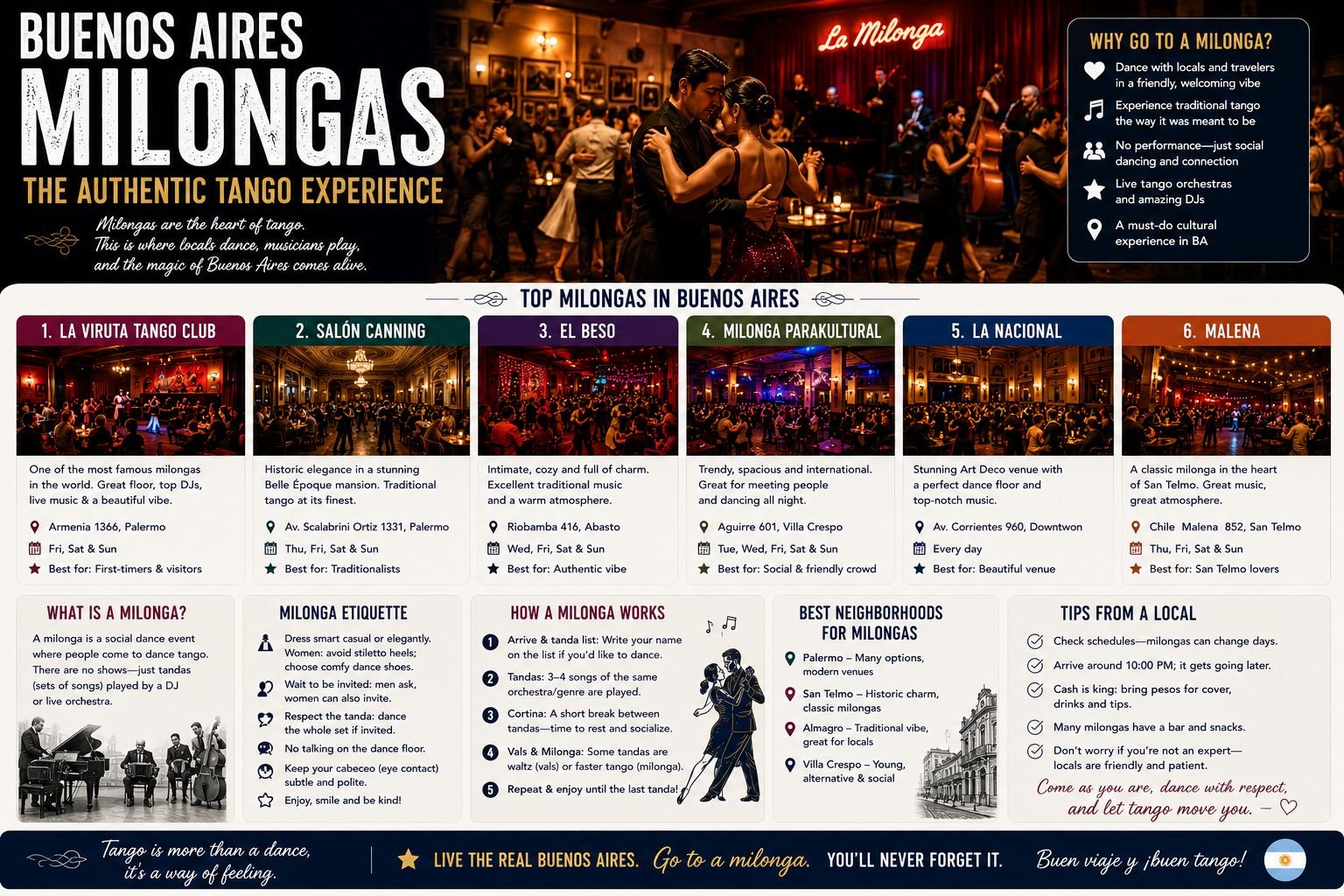
The milonga is where Buenos Aires tango actually lives. Not the theatrical version staged in shows for tourist audiences, magnificent as those can be, but the living social practice of a community that has been dancing tango together for generations. A milonga is a social dance event; most run several evenings per week in venues ranging from grand old ballrooms to converted warehouses to neighbourhood clubs. Visitors are welcome at most milongas; experiencing one is among the most authentic and memorable things you can do in Buenos Aires.
What Is a Milonga?
The word milonga means two related things: the social dance event itself, and a style of music that preceded tango and remains part of the tango repertoire. At a milonga event, you arrive to find a room with a dance floor surrounded by tables; an orchestra (orquesta típica) or DJ plays sets of three to four songs (tandas) of the same style (tango, milonga, or vals), separated by brief pauses (cortinas) during which dancers change partners.
The social codes of a milonga are specific and worth knowing before attending:
The cabeceo: Asking someone to dance is done through eye contact and a subtle nod (the cabeceo), not by walking over and verbally asking. This allows both parties to decline gracefully if the invitation is not taken up. Walking across the room to ask someone directly is considered poor form in traditional milongas.
Table seating: At traditional milongas, men and women sit on opposite sides of the room. This allows the cabeceo to work across the space. At less formal venues, this arrangement is relaxed or absent.
Dancing on the line of dance: The dance floor has an outer lane moving anti-clockwise; more experienced couples occupy the outer lane, couples with less floor experience stay in the inner circle. Following the line of dance and not cutting across others is basic milonga floor etiquette.
Dress code: Most milongas have a smart casual dress code. Some of the more traditional venues expect somewhat more formal dress, particularly for later evenings; jeans and trainers are generally not appropriate. This applies to both men and women.
The Best Milongas for First-Timers
Not all milongas are equally welcoming to visitors and beginners. The following are known for being accessible to those new to the milonga environment.
La Catedral: On Sarmiento 4006 in the Almagro neighbourhood, La Catedral is the most casual and visitor-friendly milonga in Buenos Aires. The venue, a rambling space in a converted old building with different rooms and an improvisational atmosphere, has a deliberately inclusive policy. Group lessons run in the hour before the main session on most evenings. It attracts a mixed community of regulars, visitors, and beginners. Less formal than traditional milongas; more forgiving of unfamiliarity with the codes.
El Beso: On Riobamba 416, one of the most beloved traditional milongas in the city, with consistently good dancing and a warm atmosphere that welcomes serious visitors. The standard of dancing is high; attending without dancing (simply watching from a table) is entirely acceptable and very enjoyable.
Salon Canning: Avenida Scalabrini Ortiz 1331 in Palermo, one of the most famous milonga venues in the city. Several different milonga organisations hold events here on different nights; check which is running on the night you want to attend. Practilonga, held most Saturdays, is particularly known for being welcoming to visitors.
Confitería Ideal: A historic Buenos Aires café on Suipacha in the Microcentro, the Ideal has been hosting milongas in its second-floor ballroom (with extraordinary period decoration) for decades. One of the most atmospheric settings in the city; check the current schedule as events vary.
El Arranque: On Bartolomé Mitre 1759, a traditional milonga with consistently excellent orchestras and a more formal atmosphere. Best for visitors who have some familiarity with tango and the milonga codes.
Group Lessons Before the Milonga
Most visitor-friendly milongas offer a group lesson (clase de práctica or practica) in the hour before the main milonga session begins. These typically cost a small additional fee and give a basic introduction to tango steps and the milonga environment. Attending the lesson is the single most useful preparation for a first milonga visit: you learn some steps, the teacher usually introduces the milonga codes, and you arrive at the main session already knowing some of the people in the room.
The Buenos Aires Tango Festival
The Buenos Aires Tango Festival and World Cup, held in August each year, transforms the milonga scene for two weeks. International dancers arrive from across the world; the city’s regular milongas feature extraordinary guest performers; the cultural programming around tango intensifies throughout the city. If tango is a significant part of your reason for visiting Buenos Aires, planning your visit around August produces a dramatically richer tango experience.
Timing and Practical Notes
When do milongas start?: Milongas typically open around 10pm and reach their social peak between midnight and 2am. The early part of the evening is often used for lessons and a warm-up period; the best dancing happens after midnight. If your body clock is set to European or North American rhythms, milongas require a significant schedule adjustment; it is worth making.
Entry cost: Most milongas charge entry of USD 5 to 20. This typically includes the lesson if one is offered. Drinks are purchased at the bar and are reasonably priced.
What to wear: Smart casual is safe for most milongas. Tango shoes, designed for dancing with flexible soles and a heel, are ideal but not required for first-timers; any clean shoes with a reasonably smooth sole work. Dedicated tango shoe shops in San Telmo and Palermo sell or rent appropriate shoes.
Language: Spanish is the language of the milonga environment. In the more visitor-friendly venues (La Catedral, Salon Canning), English is understood. In the more traditional settings, a few words of Spanish help with the social navigation.
Milongas vs Tango Shows: Which to Choose?
This is not an either/or question. Tango shows and milongas are genuinely different experiences offering different things:
A tango show is theatrical: spectacular professional dancing, often with elaborate staging, live orchestra, and dinner included. It is optimised for watching and being impressed. It is the ideal introduction to tango as a performance art.
A milonga is social: you are in the room with the dancers, potentially dancing yourself, experiencing the social codes and community that tango belongs to. It is the genuine cultural experience that the shows perform.
For a visit of three days or more, attending both is strongly recommended. The show provides the spectacle; the milonga provides the understanding.
Related: Tango Shows | Things to Do Hub | San Telmo
Learning Tango Before the Milonga
Buenos Aires has an extraordinary density of tango teachers, and taking even one or two lessons before attending a milonga significantly improves the experience. You do not need to be able to dance tango to attend a milonga (watching is entirely acceptable and often the right choice for a first visit), but having a basic understanding of the embrace, the basic step, and the social codes of the dance makes the experience of being in the room richer.
Private lessons in Buenos Aires cost approximately USD 30 to 70 per hour per couple. Group lessons cost USD 10 to 25 per class per person. Most milongas offer group lessons in the hour before the main session begins.
The recommended starting approach for first-timers: one or two group lessons at the venue (which familiarise you with that venue’s specific culture as well as the dance), followed by attending the milonga as a watcher initially and joining the floor if and when it feels right.
Respecting the Codes
The milonga codes can seem intimidating to newcomers but are straightforward once understood and are part of what makes the milonga experience distinctive:
The cabeceo: Do not walk across the floor to ask someone to dance verbally. Make eye contact, and if there is mutual interest, give a subtle nod. If someone declines (by looking away), accept this graciously; trying again immediately is bad form.
Sitting at a table, not on the dance floor edge: The tables around the floor are where you sit between dances; standing at the floor edge is not the done thing in traditional milongas.
Completing the tanda: If you accept a dance invitation at the beginning of a tanda (a set of three or four songs), the convention is to dance the full tanda with that partner. The cortina (a brief pause between tandas) is the appropriate moment for partners to thank each other and either continue or separate.
Floor etiquette: Move anti-clockwise with the line of dance; do not cut across the floor or stop in the middle of the dancing area; and be aware of other couples in your space.
These codes are not intimidating in practice; the experienced milonga community in Buenos Aires is generally welcoming to newcomers who approach with respect and genuine interest.