
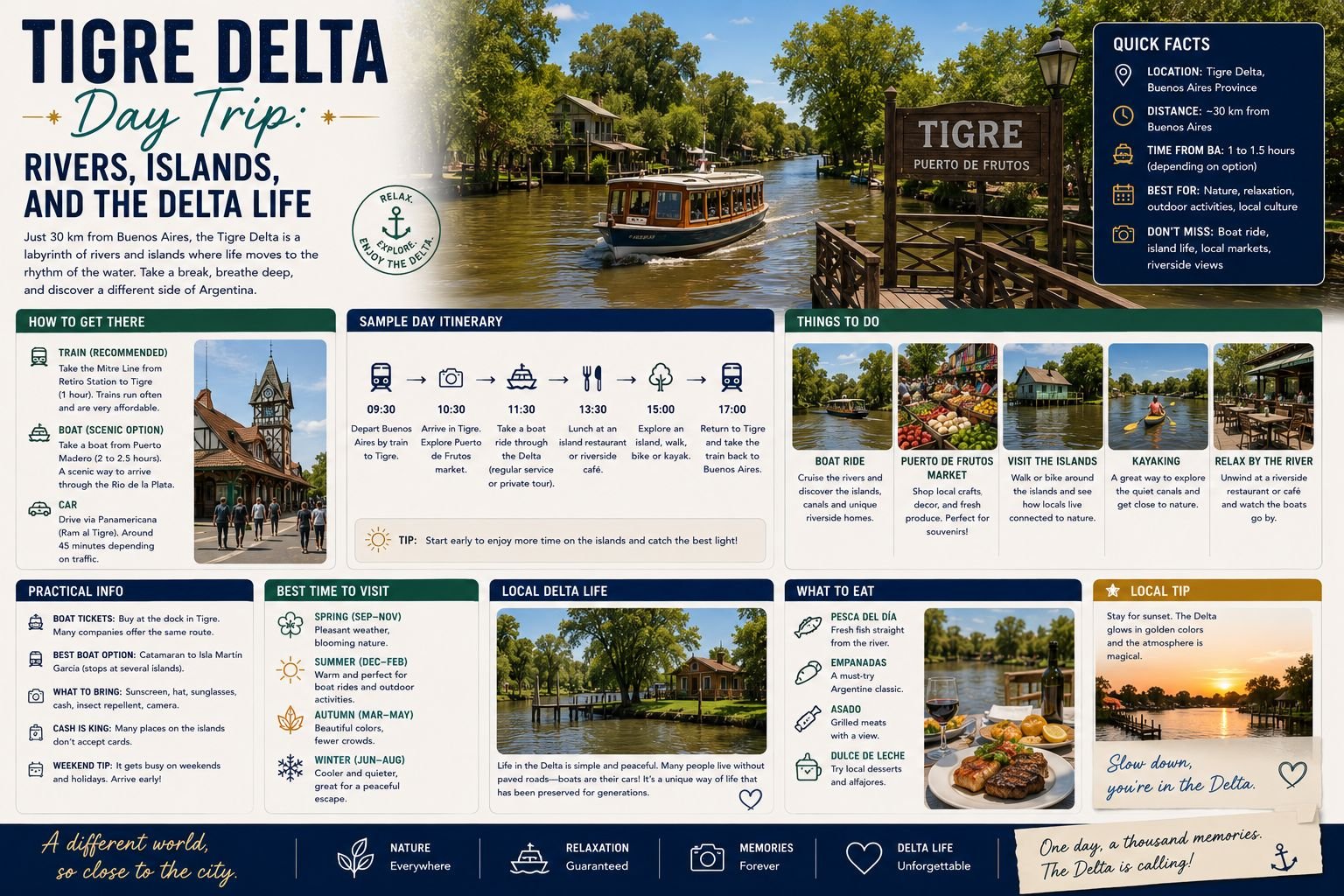
Thirty-five minutes north of Buenos Aires by suburban train, the world changes completely. The city gives way to a river delta of over 14,000 square kilometres, a network of channels and islands where the Paraná and Uruguay rivers meet the Río de la Plata and fragment into hundreds of waterways. The Tigre Delta has been the Buenos Aires escape since the 19th century; the rowing clubs, the summer houses on stilts, and the older gentry of the delta culture have been here for over a hundred years. For visitors, it offers a half-day of genuinely different Argentina.
Getting There
The easiest and most pleasant way to get to Tigre is by the suburban Mitre rail line from Retiro station (the main rail terminal adjacent to the Retiro bus station). Trains run frequently throughout the day (every 15 to 30 minutes on weekdays, slightly less frequent on weekends). The journey takes approximately 30 to 35 minutes and costs a small amount (payable with a SUBE transport card, which can be purchased and loaded at Retiro).
Arrive at Retiro Station (ground level, the suburban rail section) and buy a SUBE card at one of the vending machines if you do not already have one. Trains to Tigre are clearly marked.
Alternative: Bus services also run to Tigre but take considerably longer due to traffic. The train is the correct option.
Arriving in Tigre
Tigre station is a few blocks from the main activity area. Walk towards the river; the Puerto de Frutos is a 5-minute walk from the station. The Tigre river port and the main boat tour departure points are nearby.
The town of Tigre itself (on the mainland side of the delta) is a pleasant Argentine town with a central square, restaurants, and the Museo de Arte Tigre (housed in a former rowing club, with a good collection of 19th and early 20th-century Argentine art).
The Puerto de Frutos
The Puerto de Frutos is a riverside market that has been operating in its current form since the days when the delta islands produced fruit and flowers for Buenos Aires. Today it is primarily a handicraft and furniture market selling wicker goods, wood furniture, and delta crafts, alongside some fresh produce. It is bustling on weekends and quieter on weekdays; the weekend version is more atmospheric.
Boat Tours of the Delta
The essential experience in Tigre is getting onto the water and seeing the delta from a boat. Several options:
Lanchas colectivas (water taxis): The network of water taxis that service the delta communities, running from the Estación Fluvial (the river terminal, just upstream from the Puerto de Frutos). You can take these to explore the lower delta channels, travelling alongside the locals who use them for daily transport. This is the most authentic and cheapest way to experience the delta.
Tourist catamaran tours: Various companies run 60 to 90-minute tours of the lower delta channels, departing from the docks near the Puerto de Frutos. These give a comfortable overview of the landscape and some of the more interesting island architecture. Prices are reasonable (USD 15 to 25 per person); tours run throughout the day and do not usually need advance booking.
Longer kayak and canoe trips: For those who want more active exploration, kayak rentals and guided kayak tours are available. These are best suited for those with some paddling experience; the delta currents can be unpredictable.
The Delta Landscape
The Tigre Delta is a living landscape in continuous change: the rivers deposit and erode, islands form and disappear, and the vegetation is dense and tropical in character despite Buenos Aires’ temperate climate. The vegetation is a mix of subtropical plants brought down by the Paraná from further north, including large stands of cortadera grass, ceibo flowers (the Argentine national flower), and dense willow trees overhanging the channels.
The houses on the islands, accessible only by water, are a study in the variety of delta life: some are modest weekend homes going back generations; others are large and beautiful modern houses; some are essentially palaces built by wealthy Buenos Aires families at the turn of the 20th century. The rowing clubs along the lower delta (some of the oldest in South America) maintain beautiful waterfront facilities and host races on weekends.
Eating and Drinking in Tigre
The restaurants in Tigre town and along the riverside cater well to day visitors. The speciality is freshwater fish from the delta, particularly dorado and surubí (catfish varieties), prepared in the simply grilled style common to the river culture.
El Puerto de Frutos area: Several good lunch restaurants with river views, ranging from casual empanada and sandwich options to full river-fish menus.
The islands: Some of the island restaurants accessible by lancha colectiva are excellent; this requires more time and planning than a standard half-day trip but produces a more immersive delta experience.
How Long to Spend
Half-day: Train from Buenos Aires by 10am, Puerto de Frutos, a 90-minute boat tour, lunch, return train to Buenos Aires by 3pm. This covers the essentials in a comfortable half-day.
Full day: As above, plus a longer water taxi exploration of the delta channels, a visit to the Museo de Arte Tigre, and an afternoon on the island restaurant circuit.
Related: Colonia del Sacramento | Day Trips Hub
The Rowing Club Culture
One of the most specifically Argentine aspects of the Tigre Delta is the rowing club (club de remo) culture that developed here in the late 19th century. English and Italian immigrants brought rowing to Argentina; the first clubs were founded in the Tigre Delta in the 1870s and 1880s, and the club buildings that survive from this period, grand Victorian and Italianate structures facing the river, are extraordinary architectural artifacts of a specific moment in Argentine social history.
The Club de Regatas La Marina, the Tigre Boat Club, and several others still operate as sporting and social clubs for Buenos Aires families; the combination of Victorian architectural heritage and Argentine social life in these clubs is something found nowhere else. Some clubs are visible from the river during a boat tour; a few admit visitors for lunch or café access.
The Upper Delta: What Lies Beyond
The Tigre Delta extends far beyond the accessible lower channels near the Puerto de Frutos. The upper delta, hours by boat from the main Tigre town, is genuinely remote: communities accessible only by water, schools with their own small boats that serve as school buses, a way of life that has been sustained by the river for generations.
Accessing the upper delta requires a guided tour or considerable independent planning; it is not feasible as part of a standard day trip. But knowing that it exists, and that the accessible lower delta is just the beginning of a much larger and more complex landscape, changes the context of the accessible experience.
For visitors with a strong interest in the delta ecosystem or the traditional river culture, overnight stays in the delta on a tour package that includes the upper channels are available; these are typically arranged through Buenos Aires tour operators and require advance booking.
Practical Gear for the Tigre Trip
Insect repellent: The delta wetlands produce mosquitoes, particularly in summer and after rain. Carrying insect repellent is worthwhile.
Comfortable shoes: The boardwalks and paths around the Puerto de Frutos and the boat landings are wooden and can be slippery; flat-soled shoes with grip are more practical than anything smooth-soled.
A waterproof bag or cover: If the weather turns during a boat tour, having a waterproof bag cover protects cameras and electronics.
Cash in Argentine pesos: The food vendors and small restaurants in Tigre and the islands largely operate on cash; card acceptance is more limited than in central Buenos Aires.
The Tigre day trip is the Buenos Aires experience that most consistently surprises visitors who were not sure what to expect from it. The discovery that 35 minutes from South America’s third-largest city lies a genuine river delta with rowing club culture, subtropical vegetation, and a way of life sustained by water rather than road is one of the specific pleasures of Buenos Aires geography. It is easy, cheap, and entirely different from anything in the city itself.
A Final Note
Buenos Aires rewards visitors who arrive prepared and remain open. The practical preparation covered in this guide removes the friction that prevents engagement; the openness is yours to bring. The city that reveals itself to a visitor who knows what they are looking for, who has sorted the practical foundations, and who has the curiosity to follow what the city offers is one of the genuinely great urban experiences available anywhere in the world.
For questions, corrections, or feedback on this guide, the contact page is the right place. This site is updated regularly; if you visit Buenos Aires and find that conditions have changed from what this guide describes, telling us makes the guide better for the next reader.