
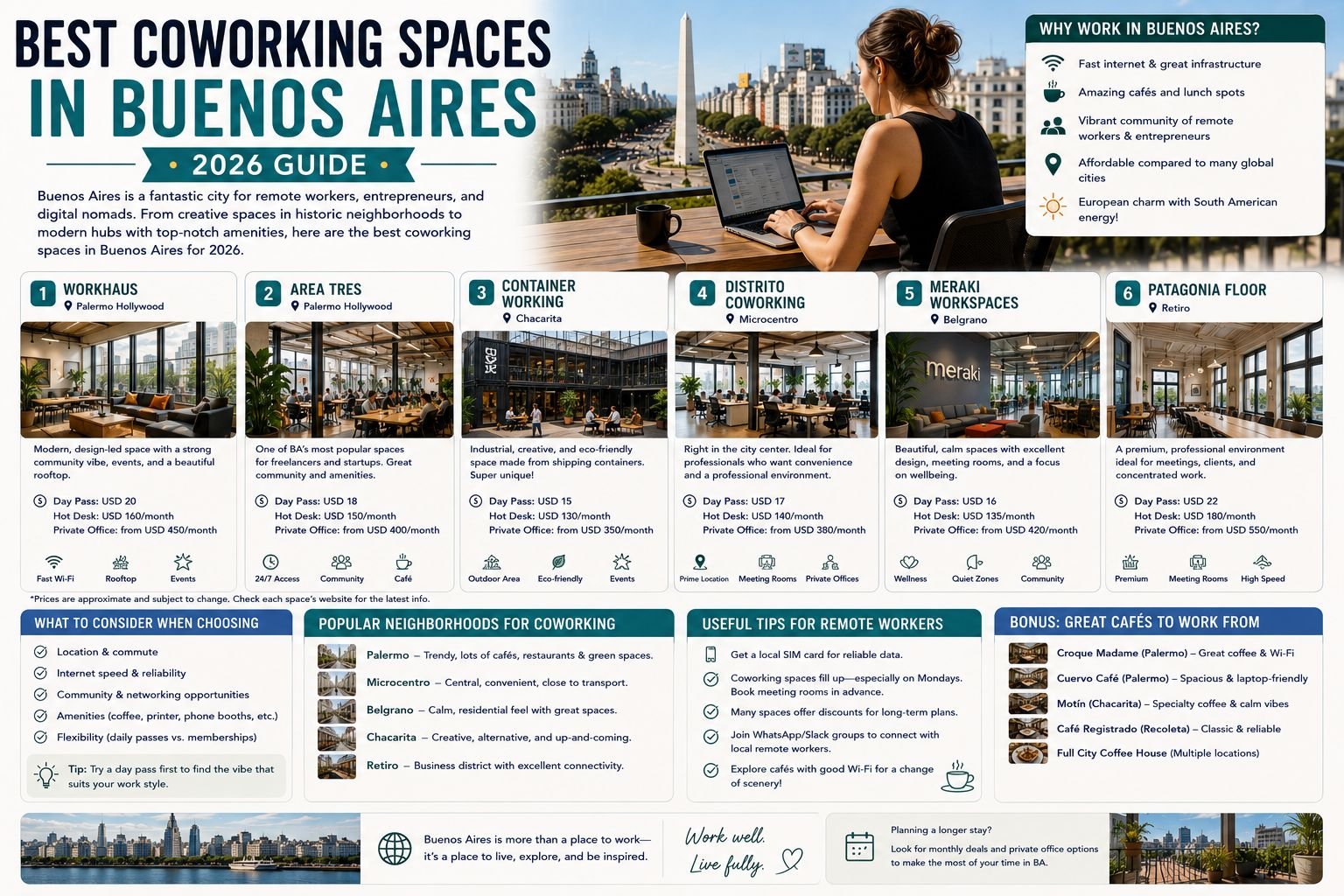
Buenos Aires has a mature, well-developed coworking scene that serves everyone from solo digital nomads passing through for a few weeks to established teams looking for flexible office space. The concentration is highest in Palermo, which has become the de facto hub for the city’s tech and creative community, but good spaces exist across multiple neighbourhoods. This guide covers the best options across different use cases and price points.
What to Look For in a Buenos Aires Coworking Space
Before the specific recommendations, a checklist of what matters:
Internet reliability: The most critical factor for remote work. A good coworking space in Buenos Aires will have multiple ISP connections (fibre, backup cable or wireless) to ensure redundancy when one connection has issues. Ask specifically about backup connectivity, not just headline speeds.
Power infrastructure: Buenos Aires has occasional power outages, particularly during summer peak consumption periods. Quality coworking spaces have UPS backup power for critical infrastructure and, in some cases, generators.
Air conditioning: Buenos Aires summers reach 32 to 35°C with significant humidity. A coworking space without effective air conditioning is not functional in January and February.
Community and events: The best coworking spaces are not just office rentals; they are communities that run events, introduce members to each other, and create a social infrastructure that is particularly valuable for nomads arriving without local networks.
Location and neighbourhood: The neighbourhood matters for daily quality of life. A coworking space in a building with good nearby lunch options, transport access, and safe surroundings produces a different daily experience than one in an inconvenient location.
The Best Coworking Spaces in Buenos Aires
Areatres (Multiple locations, Palermo and others)
Areatres is the most established coworking brand in Buenos Aires, with several locations across the city. The Palermo locations are the most popular with nomads and international visitors. The spaces are well-designed, have reliable internet (multiple ISP connections), and have a genuine community of regular members across the tech, design, and creative sectors.
Best for: Nomads wanting a professional environment with community, and those who want the option of multiple locations on one membership.
Price range: Daily passes available; monthly hot desk and dedicated desk options at competitive prices for the Buenos Aires market.
Urban Station (Multiple locations)
Urban Station operates a network of coworking locations across Buenos Aires and multiple Latin American cities. The Buenos Aires locations are in business-friendly areas and cater to a mix of established freelancers, small teams, and nomads. The multi-city membership is particularly useful for nomads who travel through multiple Latin American cities.
Best for: Nomads doing multi-city South American itineraries; small teams wanting professional meeting rooms.
La Maquinista (Palermo)
A well-regarded independent coworking space in Palermo with a design-forward aesthetic and a community of creative professionals. Smaller and more intimate than the large chains, with programming that reflects the creative community it serves.
Best for: Designers, creative professionals, and anyone who finds a smaller community more productive than a large anonymous space.
Industrious-style Premium Spaces
Several Buenos Aires coworking spaces operate at the premium end of the market, with private offices, high-quality meeting rooms, and enterprise-level connectivity. These are typically located in Puerto Madero or the financial district and serve corporate clients alongside individual members.
Best for: Those needing private offices, regular client meetings in a professional setting, or enterprise-level infrastructure.
Café Working: The Complementary Option
Most Buenos Aires nomads combine coworking with café working: using a coworking space for focused work or calls requiring reliable infrastructure, and working from cafés for more flexible work. The [cafés to work from guide](/expat/cafes-to-work-from/) covers the best café working options neighbourhood by neighbourhood.
The café working culture in Buenos Aires is comfortable; unlike some cities, there is no strong social norm against extended laptop sessions. The standard etiquette is to order regularly (at minimum a coffee every hour or two), to use headphones for any audio, and to avoid taking up multiple tables during busy periods.
Day Passes vs Monthly Memberships: Which to Choose
Day passes: The most flexible option, suitable for testing different spaces, for occasional use, or for short-stay nomads. Priced per day, typically available without advance booking.
Weekly or monthly hot desk: A fixed monthly payment for access to any available desk in the space. The right choice for nomads staying more than two weeks who want the reliability and community of a regular space without committing to a specific desk.
Dedicated desk: A permanent desk that is always yours, including personal storage. More expensive than a hot desk but provides a genuine home-base quality that is valuable for stays of a month or more.
Private office: For teams of two or more who need private space for calls, confidential work, or simply a guaranteed quiet environment.
Coworking Price Benchmarks
Buenos Aires coworking is very affordable by international standards. As a rough guide at the time of writing (exchange rates vary; confirm current prices):
Daily hot desk: USD 8 to 20 depending on the space and location.
Monthly hot desk: USD 100 to 200.
Monthly dedicated desk: USD 150 to 300.
Small private office (2 to 4 people): USD 400 to 800 per month.
These prices represent outstanding value compared to equivalent spaces in European or North American cities.
Working in Coffee Shops: Free Options
For nomads on tighter budgets or those who want maximum flexibility, Buenos Aires café working is a genuinely productive option. The [cafés to work from guide](/expat/cafes-to-work-from/) identifies the specific cafés with the best combination of internet, power sockets, comfortable seating, and duration-friendly policies.
Related: Digital Nomad Guide | Cafés to Work From | Cost of Living | Neighborhoods
The Coworking Community Events Circuit
Buenos Aires coworking spaces run a regular programme of community events that serve as professional networking and social opportunities for members. These events, which typically range from startup pitches and design talks to social evenings and asados, are worth attending actively rather than treating coworking as purely transactional desk rental.
The Buenos Aires tech and creative community that concentrates in the Palermo coworking spaces is active and internationally connected. Attending the talks and social events at Areatres, La Maquinista, and similar spaces produces professional connections that are useful both during and after a Buenos Aires stay; the community of people who have spent time working from Buenos Aires is global and maintains connections.
Remote Work Infrastructure: Beyond Coworking
For nomads who want to maintain a productive work environment without coworking spaces, Buenos Aires offers several additional options:
University libraries: The Universidad de Buenos Aires (UBA) has multiple faculties throughout the city with reading rooms that are technically open to all; the atmosphere is studious and WiFi is available.
Banco de Trabajo: Several neighbourhood cultural centres (centros culturales) have workspaces and WiFi accessible to the public; these are less well-known than formal coworking spaces but are often excellent.
Hotel business centres: Most mid-range and above hotels in Buenos Aires have business centres with computers and printing; some sell day passes that allow non-guests to use meeting rooms and workspace.
Managing Time Zone Differences
For digital nomads working primarily with clients or employers in North America or Europe, Buenos Aires time zone (GMT-3, with no daylight saving in recent years as Argentina has discontinued it) creates specific scheduling implications:
For North American clients: Buenos Aires is 2 hours ahead of US Eastern time in summer and 1 hour ahead in winter. Morning meetings at Buenos Aires time align with early North American mornings; afternoon Buenos Aires time aligns with North American morning prime time.
For European clients: Buenos Aires is 4 to 5 hours behind European time (depending on daylight saving in Europe). European morning meetings require very early Buenos Aires starts; European afternoon meetings fall in Buenos Aires midday, which is the most manageable alignment.
Most Buenos Aires-based nomads working with European clients adapt by pushing their working day slightly earlier (starting at 7am rather than 9am) to maintain overlap with European afternoons.
Buenos Aires coworking spaces are the backbone of the city’s digital nomad infrastructure and a genuine social asset. The community that forms around the best spaces, the events and connections that emerge from regular membership, and the professional and social networks that develop through shared working environments are often the most lasting outcomes of a Buenos Aires nomad stay. The spaces in this guide are well-regarded starting points; your specific preferences around atmosphere, community type, and infrastructure will guide you toward the right long-term space for your working style.
A Final Note
Buenos Aires rewards visitors who arrive prepared and remain open. The practical preparation covered in this guide removes the friction that prevents engagement; the openness is yours to bring. The city that reveals itself to a visitor who knows what they are looking for, who has sorted the practical foundations, and who has the curiosity to follow what the city offers is one of the genuinely great urban experiences available anywhere in the world.
For questions, corrections, or feedback on this guide, the contact page is the right place. This site is updated regularly; if you visit Buenos Aires and find that conditions have changed from what this guide describes, telling us makes the guide better for the next reader.