
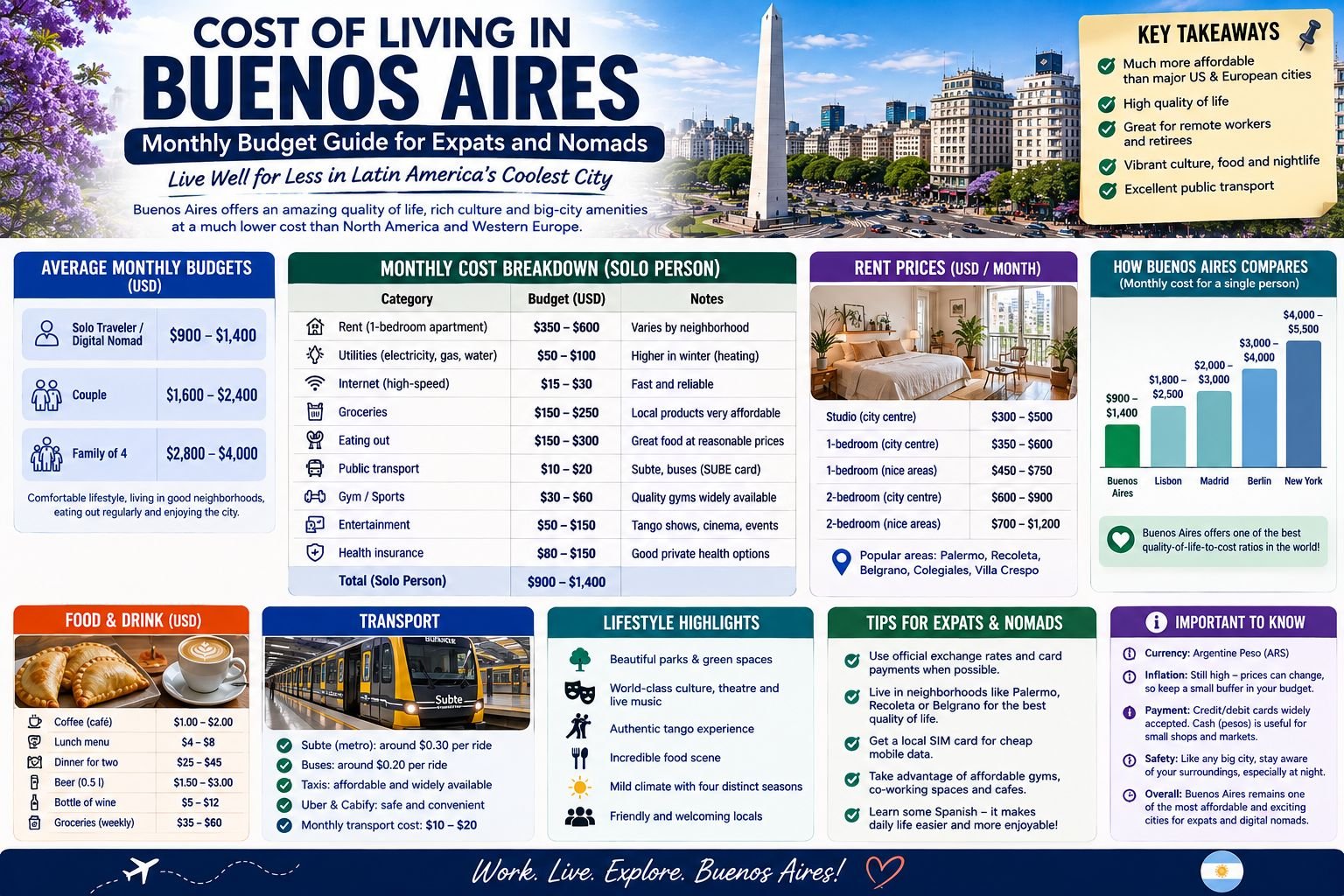
Buenos Aires is one of the most affordable major cities in the world for those earning in foreign currencies. The combination of the exchange rate advantage (for those receiving income in USD, EUR, or GBP), the low nominal cost of Argentine goods and services, and the genuine quality of what that money buys makes Buenos Aires a cost of living outlier compared to any Western or East Asian city of comparable cultural and urban sophistication.
This guide provides honest monthly budget benchmarks for different living standards, broken down by spending category, with the specific assumptions and caveats that make these numbers accurate rather than misleadingly optimistic.
The Essential Caveat: Exchange Rate Dependency
These figures assume you are accessing the tourist or MEP exchange rate rather than the official bank rate. If you exchange money at the official rate, your costs in USD terms are significantly higher. The [money guide](/practical-info/money/) explains the practical mechanics of accessing the better legal rate. For long-term residents, managing the exchange rate actively is one of the most important financial practices.
All figures below are in USD at the tourist/MEP rate as of mid-2025. Given Argentine inflation, the peso prices change continuously; the USD-denominated figures are more stable but still subject to exchange rate movements. Verify current conditions when planning.
Accommodation Costs
Accommodation is typically the largest single monthly expense and varies the most by type and neighbourhood.
Furnished apartment, one-bedroom, Palermo or San Telmo: USD 600 to 1,100 per month, depending on quality, building age, and amenities. A well-equipped modern apartment in a good Palermo location sits in the upper part of this range; a comfortable but older apartment with character in San Telmo at the lower end.
Furnished apartment, two-bedroom, Palermo or Recoleta: USD 900 to 1,600 per month. Two-bedrooms provide significantly more living space and a dedicated work area, which matters for long-term comfort.
Unfurnished apartment (longer-term local rental market): USD 400 to 800 per month for good one-bedrooms in desirable neighbourhoods. Cheaper than furnished, but requires furniture, longer lease commitments, and navigating the Argentine rental market. The [finding accommodation guide](/expat/finding-accommodation/) covers this in detail.
Coliving or furnished room in a shared apartment: USD 400 to 700 per month for a private room, typically with shared kitchen and living areas.
Budget hostel private room (short-stay): USD 30 to 60 per night; not practical for monthly living but included for comparison.
Food and Groceries
Groceries: A well-stocked week of grocery shopping for one person at a local supermarket (Coto, Disco, Jumbo) costs USD 40 to 70 per week. Buenos Aires produce markets (ferias) are cheaper for fresh vegetables and fruit; the organic and specialty food shops in Palermo are at European-equivalent prices.
Restaurant meals: This is where Buenos Aires most dramatically outperforms comparable cities. Eating well every meal at neighbourhood restaurants is feasible at a total weekly food budget that would not buy two restaurant meals in London or New York.
- Coffee and medialuna at a café: USD 2 to 5
- Lunch menú at a neighbourhood restaurant (two to three courses): USD 6 to 14
- Dinner at a good neighbourhood restaurant per person: USD 14 to 30
- Dinner at a quality parrilla with wine per person: USD 20 to 45
- Dinner at a top restaurant (Don Julio, Mishiguene level): USD 50 to 100+ per person
Monthly food budget, eating out most meals: USD 350 to 700 depending on meal quality and frequency of nicer restaurants.
Monthly food budget, cooking most meals with occasional dining out: USD 200 to 400.
Transport
Subte and bus (SUBE card): A month of daily public transport use costs approximately USD 15 to 30. The SUBE fare discount for transfers makes combined journeys very cheap.
Uber/Cabify for occasional use: A typical short in-city journey costs USD 3 to 8. Using ride-hailing for most journeys adds USD 60 to 150 per month depending on frequency.
Not owning a car: Most Buenos Aires expats and nomads do not own a car; the city is well-served by public transport and apps, parking is challenging, and car ownership involves Argentine bureaucracy. This is correctly treated as a zero-cost item in the budget.
Utilities and Internet
Utilities (electricity, gas, water) in an apartment: Usually included in furnished apartment rent, or approximately USD 30 to 70 per month separately. Buenos Aires summers (air conditioning heavy use) produce higher electricity bills; the costs are low by international standards.
Internet: Fixed home internet (fibre or cable) costs USD 15 to 30 per month. This is typically included in furnished apartment rental but worth confirming.
Mobile phone plan: A local Argentine SIM with generous data costs USD 8 to 20 per month.
Healthcare
Private health insurance (prepaga): For expats wanting access to the private healthcare system, a private health plan with a major operator (OSDE, Medicus, Swiss Medical) costs USD 80 to 300 per month depending on age, coverage level, and the specific plan. This is one of the significant recurring expenses for long-term expats. The [healthcare guide](/expat/healthcare/) covers the options.
Public healthcare: Free for all in Argentina, including foreigners, for emergency and most standard care. Quality varies by facility; the public system is functional for basic needs.
Culture, Entertainment, and Activities
Buenos Aires has an extraordinary amount of excellent free and very cheap culture: free museums, outdoor festivals, the street tango and Sunday markets. Paid culture is also very affordable:
- Theatre on Corrientes: USD 5 to 20 per show
- Cinema: USD 4 to 10
- Museum entry (where charged): USD 2 to 15
- Tango show (for occasional special experiences): USD 40 to 100
- Milonga entry: USD 5 to 15
- A bottle of good Argentine wine at a restaurant: USD 10 to 25
Monthly budget for culture and entertainment: USD 100 to 300 covers a very active cultural life.
Monthly Budget Totals
Minimum comfortable (solo, nomad, conscious budget): USD 1,200 to 1,600
- Modest Palermo apartment: USD 700
- Eating well but consciously: USD 350
- Transport: USD 30
- Entertainment: USD 100
- Miscellaneous: USD 120
Standard comfortable (solo, living well): USD 1,800 to 2,600
- Good Palermo apartment: USD 900
- Excellent restaurant dining: USD 600
- Transport (mix public and apps): USD 80
- Culture, activities, occasional weekend trip: USD 300
- Miscellaneous: USD 200
Generous and comfortable: USD 2,800 to 4,000
- Very good apartment in prime neighbourhood: USD 1,200
- Excellent dining including top restaurants: USD 900
- Private health insurance: USD 200
- Regular activities, travel, and a fully comfortable life: USD 700
These figures make Buenos Aires one of the best value major cities in the world for those earning in Western currencies. The equivalent comfortable life in Western Europe costs three to five times as much.
Related: Digital Nomad Guide | Banking | Finding Accommodation | Healthcare
The Hidden Costs: What Budgets Often Miss
Several cost categories are consistently underestimated in Buenos Aires living budgets:
Argentine administration fees: Residency applications, document notarisation, gestor fees, and other administrative costs accumulate over a longer stay. Budget USD 200 to 500 per year for a nomad with modest administrative needs; significantly more if pursuing formal residency.
Annual travel: Most Buenos Aires-based nomads leave the country at least once per 90 days for border run visa renewal. The most popular destination is Uruguay (Colonia ferry is USD 80 to 120 return); even at this modest cost, four border runs per year add USD 320 to 480.
Replacement electronics: Buenos Aires has import duties on electronics that make replacements expensive if you need to buy here. Bringing additional charging cables, a backup external battery, and any specialist equipment you rely on prevents the surprise of discovering that a replacement costs three times its home price.
VPN and software subscriptions: Some streaming services and software platforms have geographic restrictions or different pricing by region; a VPN subscription (USD 5 to 15 per month) is a useful tool that should be in the budget.
The Quality of Life Dividend
Beyond the financial calculation, Buenos Aires offers a quality of life premium for expats that does not appear in any budget spreadsheet. The city’s extraordinary food culture, the warmth of the social environment, the intellectual richness of a city that takes culture seriously, and the access to one of the world’s most beautiful and varied countries as a base for South American exploration: these are real advantages that make Buenos Aires competitive with destinations that might appear cheaper or more straightforward on paper.
The number of people who arrive in Buenos Aires for one month and stay for a year, or who return repeatedly, is the most reliable evidence that the quality of life here delivers on its promise.
A Final Note
Buenos Aires rewards visitors who arrive prepared and remain open. The practical preparation covered in this guide removes the friction that prevents engagement; the openness is yours to bring. The city that reveals itself to a visitor who knows what they are looking for, who has sorted the practical foundations, and who has the curiosity to follow what the city offers is one of the genuinely great urban experiences available anywhere in the world.
For questions, corrections, or feedback on this guide, the contact page is the right place. This site is updated regularly; if you visit Buenos Aires and find that conditions have changed from what this guide describes, telling us makes the guide better for the next reader.