
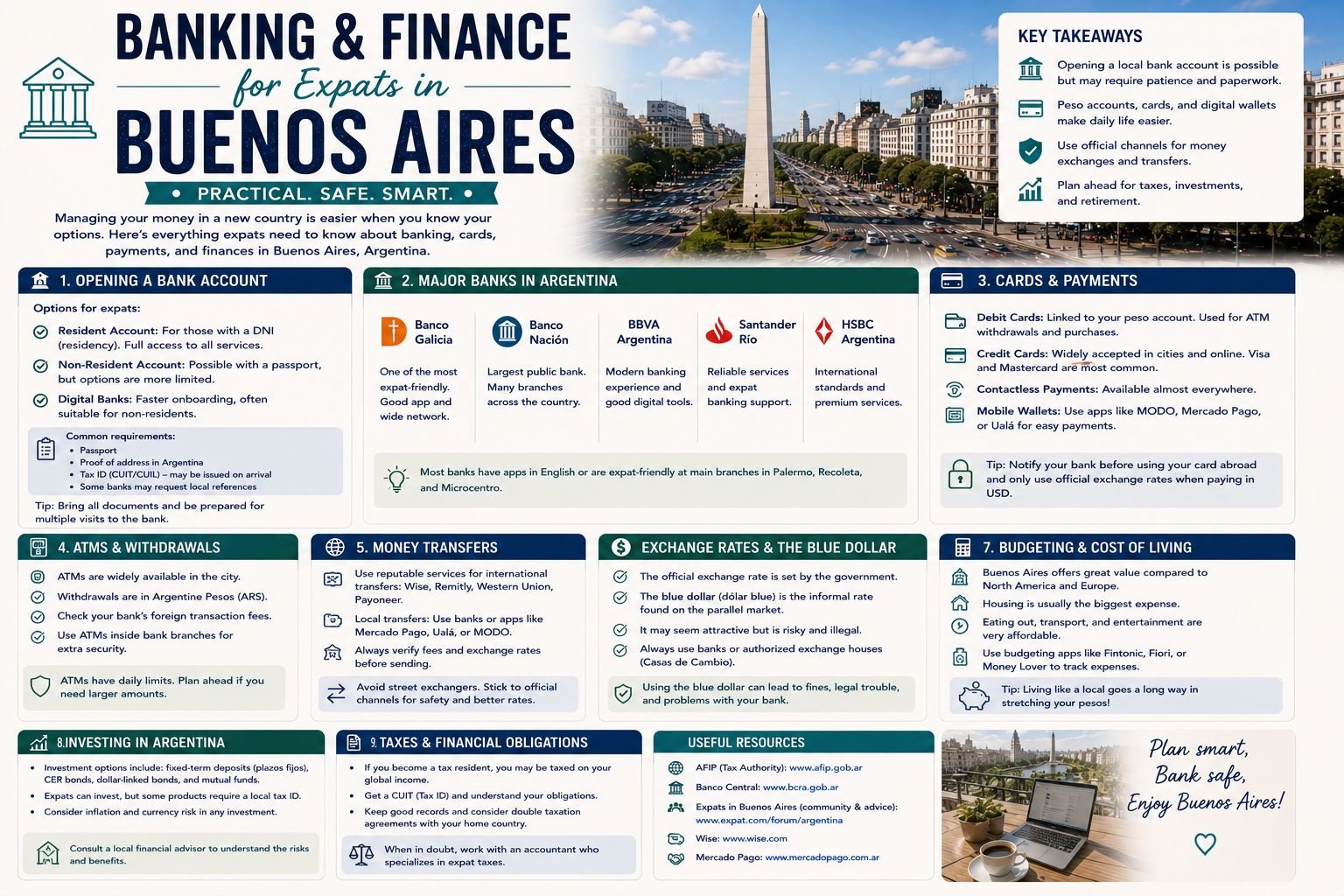
Managing money as an expat or long-term visitor in Buenos Aires is more complex than in most countries, but the rewards for managing it well are significant. The gap between the official exchange rate and the rates available through legitimate channels means that active financial management produces real, meaningful savings on day-to-day living costs. This guide covers the practical options for expats at different stages of their Buenos Aires stay.
The Starting Point: Your Foreign Accounts Remain Primary
For most expats and digital nomads in Buenos Aires, the correct financial foundation is to maintain your existing foreign bank accounts as your primary financial infrastructure and to actively manage how you convert that income to Argentine pesos. An Argentine bank account is useful for specific purposes but is not a necessity for shorter stays and is genuinely difficult to open.
Why this matters: The Argentine banking system, while functional, has specific constraints that make it less efficient than keeping income in a stable foreign currency and converting as needed. Argentine pesos lose value relative to USD through inflation; holding large peso balances is not recommended for those with foreign income sources.
Cards That Work Well in Argentina
Wise (formerly TransferWise): A Wise account with a Wise debit card is one of the most consistently useful tools for Buenos Aires expats. Wise holds multiple currency balances, converts between them at near-interbank rates, and the debit card can be used at ATMs and for card payments. Wise’s exchange rate for USD to ARS is typically close to the MEP or tourist rate, making it significantly better than standard bank cards for Argentine transactions.
Revolut: Similar to Wise in function; the exchange rates applied depend on the plan and the specific transaction. The Metal or Premium tier typically provides better rates. Revolut is widely used in the expat community.
Charles Schwab (US bank accounts): The Charles Schwab High Yield Investor Checking account reimburses all ATM fees globally, which is particularly valuable in Argentina where ATM fees per transaction can be high. For US-based expats, this is one of the most commonly recommended cards.
Standard credit cards: Mastercard and Visa are widely accepted in Buenos Aires’ tourist-facing businesses. The exchange rate applied to foreign credit card transactions varies by card issuer; some cards apply the official rate (poor), others apply rates closer to the tourist rate (much better). Check with your specific card issuer before relying on it.
Opening an Argentine Bank Account
Argentine bank accounts are possible for foreigners but require significant documentation and patience. The process varies by bank; the general requirements are:
A valid passport and Argentine entry documentation; a DNI (the Argentine national identity document, which requires being a resident or having started a residency process) or in some cases a foreign passport; proof of address in Argentina (a rental contract or utility bill in your name); and in some cases proof of income or purpose of the account.
Banco Nación (the state bank) and some private banks (Brubank is one that has been more accessible to foreigners) have been more accommodating than others. The process typically takes multiple visits and several weeks.
Is it worth the effort for a short stay?: For stays under three months, probably not; using foreign cards and cash management is more efficient. For stays of six months or more, an Argentine bank account provides access to specific local services (Mercado Pago, some local direct debits) that are useful for daily life.
Mercado Pago: The Essential Argentine App
Mercado Pago is Argentina’s dominant digital payment platform, used for everything from paying utilities to splitting bills at restaurants to paying at market stalls that do not accept cards. Foreigners can register with Mercado Pago using a foreign phone number and passport, which makes it accessible without an Argentine bank account.
Having Mercado Pago is genuinely useful for longer stays: some restaurants and cafés operate QR-code payment systems through Mercado Pago, some markets prefer it to cash, and various daily services are accessible through the app.
Cash Management
For day-to-day spending, cash remains important in Buenos Aires: local restaurants, market stalls, small shops, transport top-ups, and many non-tourist-facing businesses operate primarily or exclusively in cash.
How to have cash in hand: The most efficient options are withdrawing from ATMs at the tourist rate (Banco Nación ATMs generally provide the best rates; see the money guide for current advice), or exchanging at legal cambios that provide the MEP or tourist rate.
How much to carry: Carry enough for your immediate needs plus a buffer (typically 2 to 3 days’ expected spending). Carrying large amounts of cash increases the value of a theft; carrying too little means frequent inconvenient ATM visits.
Note condition: Argentine ATMs dispense old notes alongside new ones; the informal exchange market specifically requests notes in good condition (no tears, no heavy wear, no marks). If you are accumulating USD cash to exchange, keep notes clean and flat.
Transferring Money from Abroad
For nomads and expats receiving salary or client payments from abroad, the choice of how to receive and convert that money is one of the most important financial decisions of the Buenos Aires stay.
Receiving into a Wise or Revolut multi-currency account: Income received in USD or EUR can then be accessed in Argentina at rates close to the MEP rate through the card mechanisms described above.
Wire transfer to an Argentine bank account: For those with Argentine accounts, some exchange mechanisms allow wire transfers that convert at better-than-official rates. This is more complex and requires specific local knowledge; working with a local financial advisor or an established expat community member is advisable before doing this.
Related: Digital Nomad Guide | Cost of Living | Visa and Residency | Practical Info
Cryptocurrency in Argentina: The Nomad Perspective
Argentina’s currency instability has made cryptocurrency more relevant here than in most countries. A significant minority of Buenos Aires residents and expats use stablecoins (USDT, USDC) and other cryptocurrencies as a hedge against peso volatility and as a transactional currency for specific exchanges.
For digital nomads, cryptocurrency provides an additional mechanism for accessing pesos at better-than-official exchange rates: several peer-to-peer exchange platforms operate in Argentina that allow crypto-to-peso conversion at rates close to the MEP rate. This is legal under current Argentine regulations and is actively used by both Argentines and foreigners.
This is not a recommendation to convert large amounts of assets to cryptocurrency; it is an observation that cryptocurrency is more practically integrated into the Buenos Aires economy than in most places, and for those already comfortable with crypto, it represents an additional legitimate exchange mechanism worth knowing about.
Building a Financial Safety Net in Buenos Aires
The general principle for long-term Buenos Aires financial management: maintain more liquidity than you think you need, because unexpected expenses (medical, administrative, equipment replacement) can arise in a context where the mechanisms for accessing funds quickly are more limited than at home.
Specific recommendations:
Keep at least one month’s living expenses accessible in liquid form (accessible digital accounts, some cash).
Maintain access to a credit card with reasonable credit limit as emergency backup.
Know the specific contact number for your home bank’s international customer service before you need it; lost or frozen cards are a serious inconvenience when your primary financial infrastructure is abroad.
Have a plan for receiving emergency funds from family or friends if needed; Western Union and similar services are widely available in Buenos Aires for receiving international money transfers.
The financial management of a Buenos Aires expat or nomad life is one of the areas that benefits most from peer learning. The Argentine financial landscape changes quickly enough that advice that was correct six months ago may need adjustment; the Buenos Aires expat community in forums and Facebook groups carries the most current collective knowledge. Engaging with this community before and after arrival produces better financial outcomes than relying on any single guide, including this one.
A Final Note
Buenos Aires rewards visitors who arrive prepared and remain open. The practical preparation covered in this guide removes the friction that prevents engagement; the openness is yours to bring. The city that reveals itself to a visitor who knows what they are looking for, who has sorted the practical foundations, and who has the curiosity to follow what the city offers is one of the genuinely great urban experiences available anywhere in the world.
For questions, corrections, or feedback on this guide, the contact page is the right place. This site is updated regularly; if you visit Buenos Aires and find that conditions have changed from what this guide describes, telling us makes the guide better for the next reader.
Financial management as a Buenos Aires expat is an ongoing project rather than a one-time setup. The Argentine economic environment changes fast enough that the approach that worked well six months ago may need adjustment; staying current through the expat community and checking the rate situation regularly is the correct ongoing practice. The foundation, however, is stable: maintain foreign accounts as primary infrastructure, manage exchange actively, build Argentine mechanisms as supplements.
Deep dives: Banking in Argentina for Expats and Foreigners, Getting Paid and Moving Money as a Digital Nomad and Taxes in Argentina for Expats.