
A small but genuinely useful thing to sort out before you travel: Argentina’s electrical system is not the same as North America’s, and it is not quite the same as most of Europe’s either, which trips up visitors from both directions.
Voltage
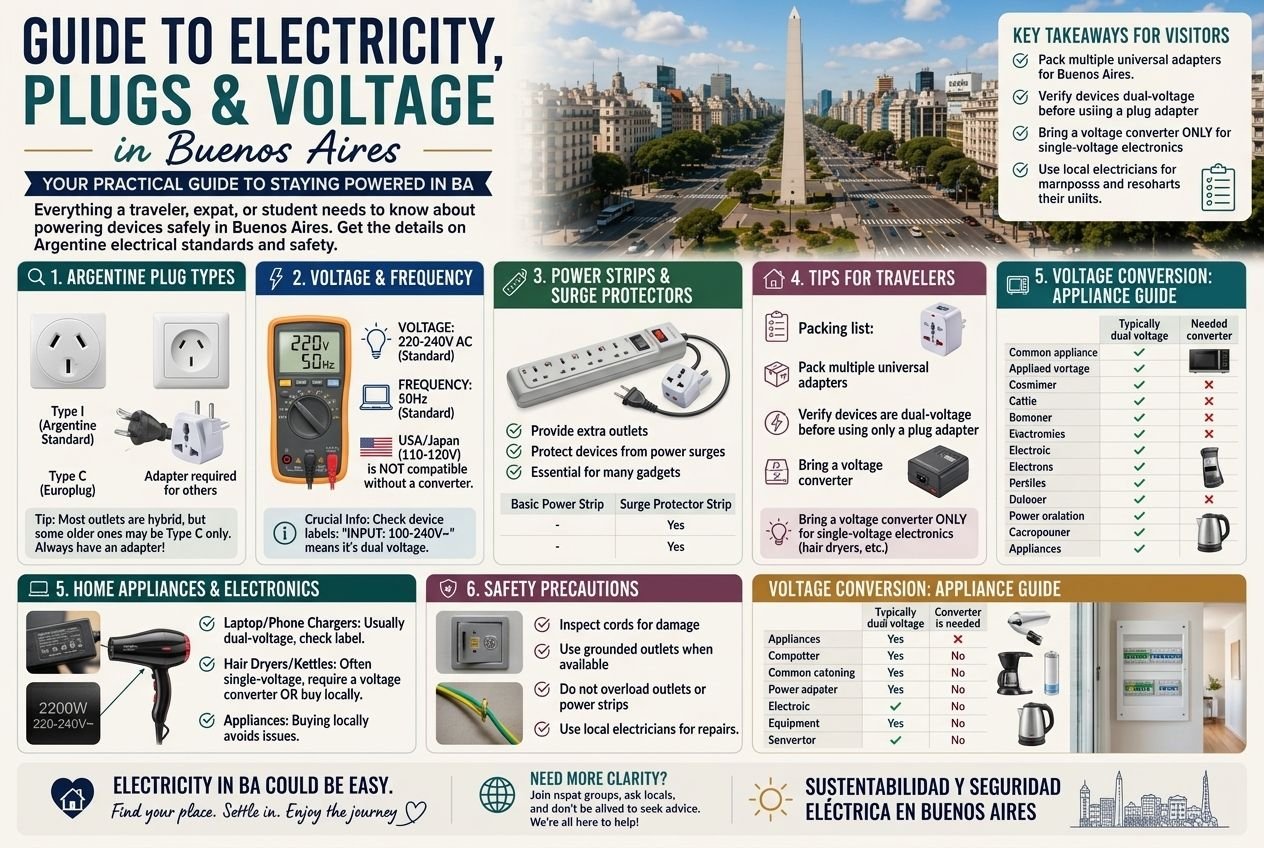
Argentina runs on 220 volts at 50 Hz. This matters most for visitors from North America, where the standard is 120 volts. Most modern electronics, chargers for phones, laptops, and cameras, are dual voltage (this is almost always printed on the plug or charger brick itself as a range such as “100-240V”) and will work in Argentina without any additional equipment beyond a plug adapter. Devices that are not dual voltage, most commonly hair styling tools like straighteners and some older or cheaper electronics, will need a proper voltage converter, not just a plug adapter, or they risk burning out.
Always check the voltage rating printed on the device itself before assuming a plug adapter alone is enough.
Plug Types
Argentina primarily uses two plug types:
Type I: A flat two-pin or three-pin plug with the pins angled in a V-shape, the same style used in Australia and New Zealand. This is the standard for modern Argentine buildings and most hotels.
Type C: The standard two-round-pin European plug is also widely compatible in Argentine sockets, particularly in older buildings.
Visitors from the UK, most of continental Europe, the US, and Canada will all need an adapter, as none of those countries use Argentina’s standard plug type natively. A universal travel adapter covering multiple plug standards is the simplest solution and is worth buying before you travel rather than searching for one on arrival, though electronics shops in central Buenos Aires and larger supermarkets do stock them if needed.
Power Reliability
Power in central Buenos Aires and the tourist and expat neighbourhoods (Palermo, Recoleta, San Telmo, Puerto Madero) is generally reliable. Outages do happen, particularly during the height of summer (January and February) when air conditioning demand spikes across the city and strains the grid, occasionally leading to localised blackouts in older buildings or during heatwaves. These are usually resolved within hours rather than becoming a serious disruption to a short visit, but it’s worth knowing about if you’re travelling in peak summer.
Practical Tips
Pack a universal adapter with surge protection if you’re bringing sensitive electronics. If you’re staying long-term or working remotely, a small backup power bank is a sensible addition given the occasional summer outages. Most hotels and quality apartment rentals in the main tourist neighbourhoods have adapters available at reception if you forget your own, though it’s not something to rely on.
Charging Multiple Devices
Visitors travelling with several devices, phones, laptops, cameras, e-readers, are often better served by a single multi-port USB charging hub plugged into one adapter than by carrying multiple individual chargers and adapters. This is a small packing decision that meaningfully reduces the fumbling-with-adapters friction of a longer trip, particularly in hotel rooms and apartment rentals where accessible outlets can be limited, an issue in some of Buenos Aires’ older converted buildings, particularly in San Telmo and parts of Recoleta, where a beautiful nineteenth-century apartment sometimes comes with a correspondingly limited number of modern outlets.
Older Buildings and Wiring
Argentina’s building stock, particularly in the older, architecturally significant neighbourhoods that make the city so appealing, sometimes has wiring and outlet standards that reflect their age rather than modern expectations. This is rarely a practical problem for a standard hotel stay, since hotels have generally upgraded their electrical infrastructure, but longer-term renters and anyone staying in a characterful older apartment rental should not be surprised by a more limited outlet count, occasional flickering under heavy simultaneous device load, or a fuse box that looks considerably older than the renovated interior around it. None of this is dangerous in a well-maintained building; it is simply a feature of a city with a great deal of beautiful, old housing stock.
What Visitors Get Wrong
The most common mistake is assuming a plug adapter alone will handle a non-dual-voltage device, most often a hair straightener or curling iron brought from a 120V country, and plugging it directly into a 220V Argentine outlet through nothing more than a shape adapter. This is the single most common cause of a fried hair tool on a Buenos Aires trip, and it is entirely avoidable by checking the voltage rating on the device before you pack it. If in doubt, it is simpler and cheaper to buy an inexpensive dual-voltage travel version of the device, or to buy one locally in Buenos Aires, than to risk a good one you brought from home.
Related: SIM Cards | Getting to Buenos Aires | Practical Info