
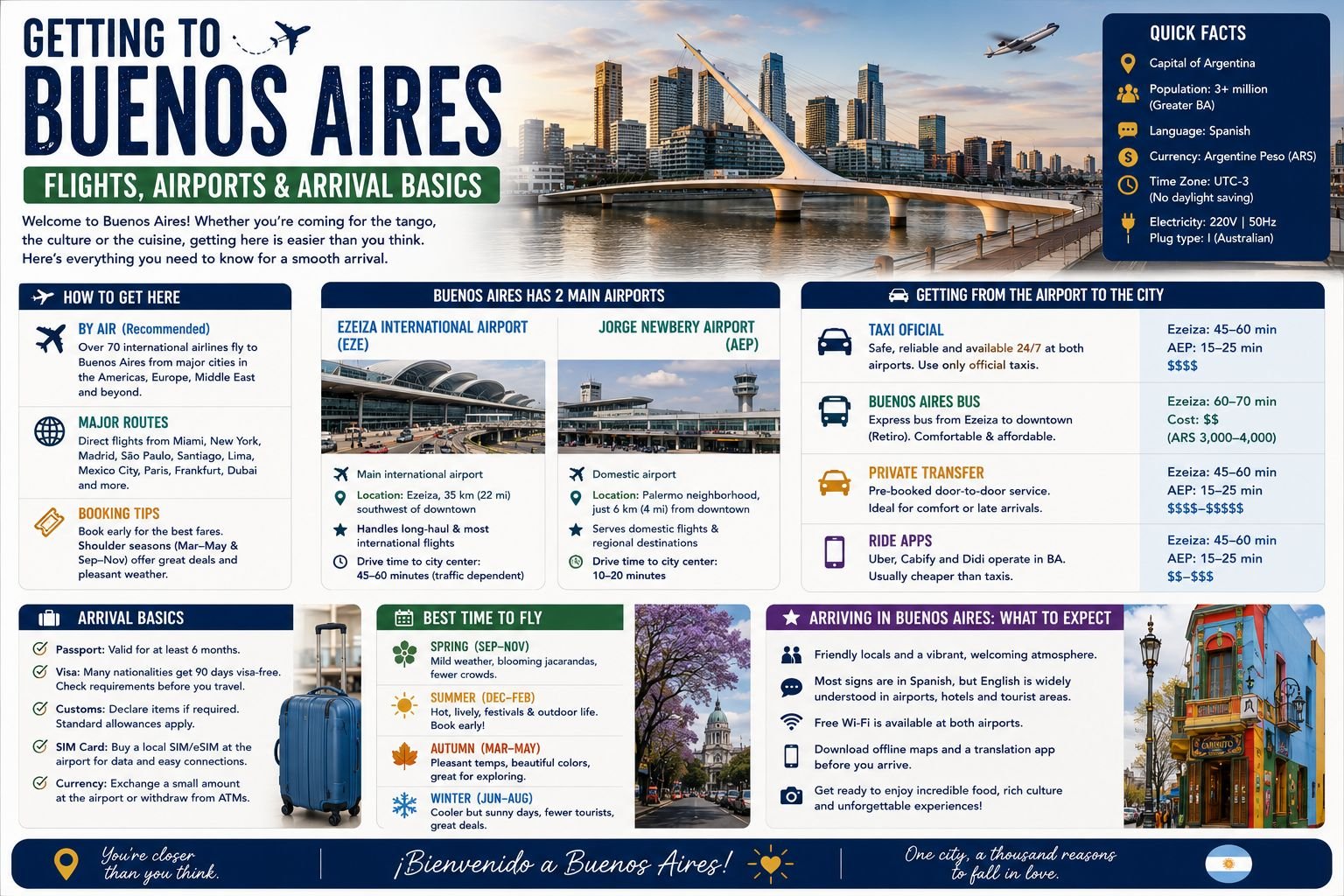
Before anything else, before neighbourhoods and parrillas and tango, there is the practical question of how you actually get to Buenos Aires and what happens once you land. This page is the starting point for that: an overview of the flights, the two airports, and the first decisions you need to make before you board. For the detailed walk-through of navigating Ezeiza specifically and getting into the city, see our dedicated Ezeiza-to-city guide; for the fuller comparison of the two airports, see our Ezeiza vs Aeroparque page.
The Two Airports
Buenos Aires is served by two airports, and which one you land at matters more than most first-time visitors expect.
Ezeiza International Airport (EZE) is where almost all international long-haul flights arrive, roughly 35 kilometres southwest of the city centre. If you are flying in from North America, Europe, Asia, or most of the rest of South America on anything other than a regional hop, this is your airport.
Aeroparque Jorge Newbery (AEP) is a smaller airport much closer to the city, on the riverfront near Palermo, used almost exclusively for domestic flights and a handful of regional international routes (mainly to neighbouring countries like Uruguay, Chile, and Brazil). If your trip includes domestic travel within Argentina, such as a side trip to Iguazú Falls, Patagonia, or Mendoza, you will very likely fly out of Aeroparque rather than Ezeiza.
The two airports are about 40 minutes to an hour apart by road depending on traffic, which matters if your itinerary has you landing at one and departing for a domestic leg from the other with a tight connection.
Flying In: Airlines and Routes
Buenos Aires has direct long-haul connections from major hubs in North America (New York, Miami, Atlanta, Dallas, Toronto), Europe (Madrid, London, Paris, Frankfurt, Rome, Amsterdam), and the Middle East (Doha, via Qatar Airways), alongside strong regional connectivity from across South America. Aerolíneas Argentinas is the national carrier and covers the widest network of domestic routes if your trip extends beyond the capital. Fares to Buenos Aires fluctuate significantly with the Argentine high season (roughly December through February, which is southern hemisphere summer) and around Argentine public holidays; booking several months ahead for December and January travel is worth doing.
What Happens When You Land
Immigration at Ezeiza has improved significantly in recent years with expanded facilities, though queues can still run long on flights that land in clusters (which happens often, given how many international arrivals concentrate in the early morning). Most nationalities do not require an advance visa for tourism, though requirements vary and change, so check the current requirements for your passport before you travel; see our dedicated visas page for the detail.
After immigration, baggage claim, and customs (a straightforward green-channel/red-channel system for most travellers with nothing to declare), you will find yourself in the arrivals hall with the full range of onward transport options: official airport taxis, remises (pre-booked car services, generally the safest and most predictable option for a first-time arrival), rideshare apps, and airport bus services into the centre. Do not accept offers from unofficial taxi touts in the arrivals hall; use one of the official counters or a rideshare app instead.
Currency on Arrival
Argentina’s currency situation is genuinely unusual and worth understanding before you land rather than after. The country has historically operated multiple effective exchange rates, and getting this wrong at the airport can mean losing a meaningful percentage of your money on your first transaction. Avoid exchanging large sums at airport currency counters, which typically offer the worst available rate. See our money guide and blue dollar guide for the detail on how to handle currency properly; the short version is that using the right combination of cards and apps, rather than cash exchanged at the airport, is now the most efficient approach for most visitors.
SIM Cards and Connectivity on Arrival
Getting connected as soon as you land makes everything else easier, from booking a rideshare to translating a menu. Ezeiza has SIM card kiosks in the arrivals area, though prices are generally better in the city. See our SIM cards guide for the full comparison of options.
Planning the Rest of Your Trip
Once you have landed and made it into the city, the practical groundwork is mostly done. From here, the planning questions shift to how long to stay, which neighbourhood to base yourself in, and what to prioritise; our trip planning hub covers all of that in depth.
Domestic Connections Beyond Buenos Aires
Argentina is a large country, and many first-time visitors underestimate how much of it lies well beyond the capital, from Iguazú Falls in the far northeast to Patagonia’s glaciers and mountains in the far south. If your itinerary includes any of these, understand that domestic flights almost always depart from Aeroparque rather than Ezeiza, and that Argentina’s internal distances are large enough that flying, rather than overland travel, is the realistic option for most multi-region itineraries within a typical trip length. Book domestic legs with enough of a buffer between an international arrival at Ezeiza and a domestic departure from Aeroparque, given the transfer time and the general wisdom of not cutting international connections too close.
Seasonal Considerations for Arrival
Argentina’s seasons are reversed from the northern hemisphere, which affects both pricing and crowding at arrival. Southern hemisphere summer, roughly December through February, is Argentina’s peak domestic holiday season as well as a popular time for international visitors, meaning fuller flights, busier immigration halls, and higher accommodation prices in the weeks around Christmas and New Year specifically, when many Argentines themselves are travelling. The shoulder seasons, spring (September to November) and autumn (March to May), offer a genuinely pleasant balance of good weather and lower crowds, and are worth considering if your travel dates have flexibility.
First Impressions and Adjusting to the City
Buenos Aires can feel overwhelming in the first hours after a long-haul flight: a new currency system to understand, a new language even if you speak some Spanish (the local accent and vocabulary take adjustment), and a city that operates on a noticeably later daily rhythm than most visitors are used to, with dinner reservations at 9 or 10pm being entirely normal. Give yourself an easy first day rather than an ambitious one; a walk through your neighbourhood, an early exploration of a nearby café, and an early night to recover from jet lag will set up the rest of the trip better than trying to hit major sights on day one.
Related: Ezeiza vs Aeroparque | Ezeiza to the City | Visas | Money | Blue Dollar | SIM Cards