
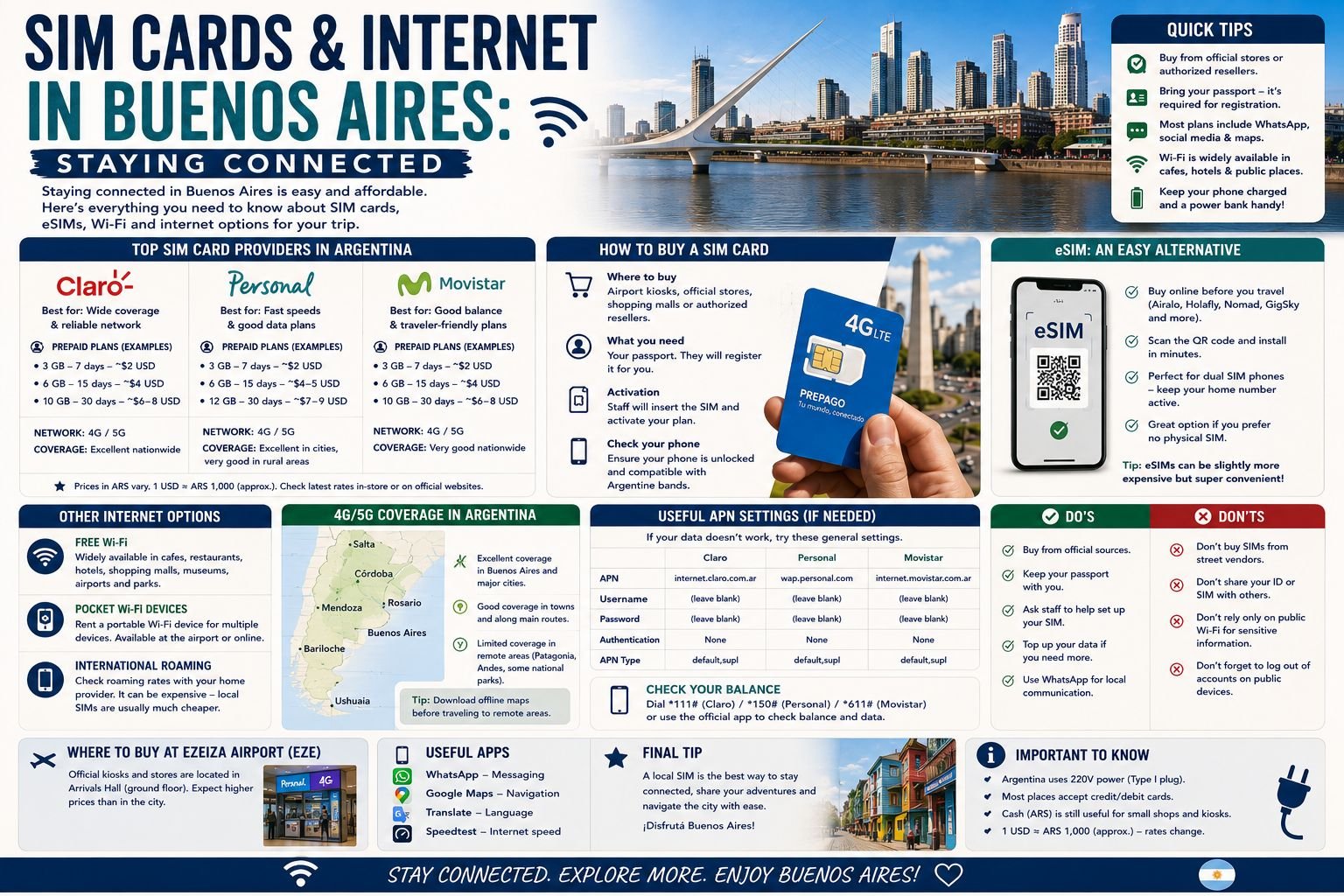
Staying connected in Buenos Aires is straightforward. The city has widespread Wi-Fi, good mobile coverage throughout the main tourist areas, and an accessible local SIM card market. For most visitors, the question is simply which connectivity solution best matches their needs and duration of stay.
Wi-Fi in Buenos Aires
Buenos Aires cafés, restaurants, and hotels almost universally provide Wi-Fi. The quality ranges from fast and reliable (most Palermo cafés) to slow and intermittent (older establishments in the historic centre). Connection is typically free for customers and available without lengthy procedures.
For working from cafés (important for digital nomads; see the [digital nomad guide](/expat/digital-nomad-guide/)), knowing which cafés have reliable connectivity is more useful than knowing that Wi-Fi exists everywhere; the [best cafés to work from](/expat/cafes-to-work-from/) guide covers specific recommendations.
Argentine SIM Cards
Buying a local Argentine SIM card is the best option for visitors planning to spend more than a few days in the city, particularly those who want reliable data for navigation apps, transport apps, and communication without relying on café Wi-Fi.
The three main operators:
Claro: Good coverage throughout Buenos Aires and the country. Tourist SIM packages with data included are available. Generally considered to have the most consistent coverage in central Buenos Aires.
Personal (Telecom Argentina): Wide coverage, competitive tourist packages. Strong coverage in the main cities.
Movistar (Telefónica): The third major operator; similar coverage and competitive packages.
Where to buy:
The most convenient purchase points for new arrivals are the operator kiosks in the arrivals area of Ezeiza airport and at Aeroparque. Tourist SIM packages (data-only or data plus some calls) are sold here with straightforward setup. Outside the airports, operator stores are found in all major shopping areas and the Microcentro.
Registration: Argentine law requires SIM registration with a passport. The shop will register the SIM for you; have your passport ready.
Cost: Tourist data packages typically cost the equivalent of USD 5 to 20 depending on the data included and the duration. The cost is low by international standards.
International Roaming
If your home mobile plan includes international roaming in Latin America, using it in Buenos Aires is technically possible but often expensive (per-minute, per-MB charges can accumulate quickly) and slower than a local SIM for data. Check your plan’s specific costs for Argentina before relying on roaming.
Some European and North American plans (T-Mobile Magenta Max in the US, various European unlimited plans) include data roaming in Latin America at no extra charge; if your plan is one of these, roaming can be competitive with a local SIM for shorter visits.
Portable Wi-Fi (Pocket Wi-Fi) Rental
Portable Wi-Fi device rental is available at Ezeiza airport and through various Buenos Aires rental services. This option is useful for groups travelling together who want to share a single data connection. The cost (USD 5 to 15 per day) is higher than a local SIM for individuals but can be cost-effective for two or more people sharing.
What You Need Data For in Buenos Aires
The most important apps for navigating Buenos Aires:
Google Maps or Waze: Navigation and traffic conditions. Download offline maps of Buenos Aires before arrival to use when data is unavailable.
Uber or Cabify: Essential for the recommended transport options. These require data to function.
Moovit: Buenos Aires public transport navigation, including bus routes and real-time arrival information.
MercadoPago: The dominant Argentine mobile payment app; useful for some specific situations (some restaurant and market payments are MercadoPago-based).
WhatsApp: The primary messaging platform in Argentina; most Porteños you interact with will prefer WhatsApp contact.
Related: Practical Info Hub | Getting Around | Digital Nomad Guide | Money Guide
The WhatsApp Imperative
A specific note on communication in Buenos Aires: WhatsApp is the dominant messaging platform in Argentina, used by virtually everyone for everything from personal communication to business coordination to group social planning. Without WhatsApp (or a phone number that WhatsApp can register on), you will be partially outside the communication network that Buenos Aires runs on.
If you are visiting for more than a few days and expect to communicate with anyone you meet locally, having WhatsApp on your phone with an accessible phone number is close to essential. An Argentine SIM card registered on WhatsApp gives you a local number that makes contacts straightforward; using your home number on WhatsApp works if the number can receive verification codes through roaming.
For emergency contact exchange: When exchanging contact details with new acquaintances in Buenos Aires, the exchange is almost invariably: “What’s your WhatsApp?” rather than “What’s your phone number?” or “What’s your email?” Having a working WhatsApp is the social infrastructure of Buenos Aires life.
Practical WiFi Security in Buenos Aires
Buenos Aires café and restaurant WiFi is broadly trustworthy but public networks always carry some security risk. For accessing banking or financial services on a public network, using a VPN (virtual private network) on your device provides a meaningful additional layer of protection. Several reliable VPN services (ExpressVPN, NordVPN, Mullvad) have apps for all major mobile platforms and add minimal friction to daily device use while substantially improving security on public networks.
For those managing significant financial transactions (the exchange rate management that long-stay visitors need to do involves accessing financial accounts regularly), a VPN on public networks is a worthwhile precaution rather than an extravagance.
A working Argentine SIM card is one of the most practically valuable things to acquire on arrival. The transport apps, the navigation, the communication with local contacts, and the exchange rate management that all depend on data access become straightforward with a local SIM and complicated without one. The airport kiosk is the right moment to solve this; starting your Buenos Aires experience connected rather than reliant on café WiFi is the correct preparation.
A Final Note
Buenos Aires rewards visitors who arrive prepared and remain open. The practical preparation covered in this guide removes the friction that prevents engagement; the openness is yours to bring. The city that reveals itself to a visitor who knows what they are looking for, who has sorted the practical foundations, and who has the curiosity to follow what the city offers is one of the genuinely great urban experiences available anywhere in the world.
For questions, corrections, or feedback on this guide, the contact page is the right place. This site is updated regularly; if you visit Buenos Aires and find that conditions have changed from what this guide describes, telling us makes the guide better for the next reader.
For digital nomads staying longer than a week, the SIM card investment (typically USD 8 to 20 for a good tourist data package) is one of the highest-return practical investments of the trip. Transport apps, navigation, WhatsApp communication with new contacts, and the exchange rate management tools that depend on internet access all become immediately usable once a working data connection is established. The five minutes spent at the airport kiosk pays for itself within the first hour of being in the city.
Buenos Aires rewards the traveller who arrives prepared and remains curious. Every guide in this site is designed to remove the friction between arrival and genuine engagement with the city; the engagement itself is yours to pursue. The city is inexhaustible, genuinely warm, and consistently surprising even to those who have been here many times. Whatever brings you to Buenos Aires, whether a first visit, an extended stay, or the beginning of a longer Argentine chapter, the preparation this guide provides is the starting point. What comes next is the city’s contribution.
For current information, corrections, and feedback: [contact@allaboutbuenosaires.com]
Buenos Aires is one of the great cities of South America and one of the most rewarding for visitors who approach it with good preparation and genuine curiosity. The specific combination of European-influenced culture, Argentine character, extraordinary food and wine, and a social warmth that is entirely its own makes it unlike any other city in the world. Whatever aspect of the city this guide covers, it is one part of a whole that is considerably greater than its components.
SIM cards and internet connectivity are the foundational infrastructure that makes every other aspect of Buenos Aires navigation work properly. Transport apps, exchange rate tools, communication with new contacts, navigation in unfamiliar streets: all depend on a working data connection. The 10 to 20 minutes spent sorting a local SIM card at the airport kiosk is one of the best investments of time in the first hour of a Buenos Aires visit. Do it on arrival, and the rest of the practical setup is significantly smoother.