
A short, practical reference page worth bookmarking before you travel rather than searching for in the moment. Save these numbers in your phone on arrival.
Core Emergency Numbers
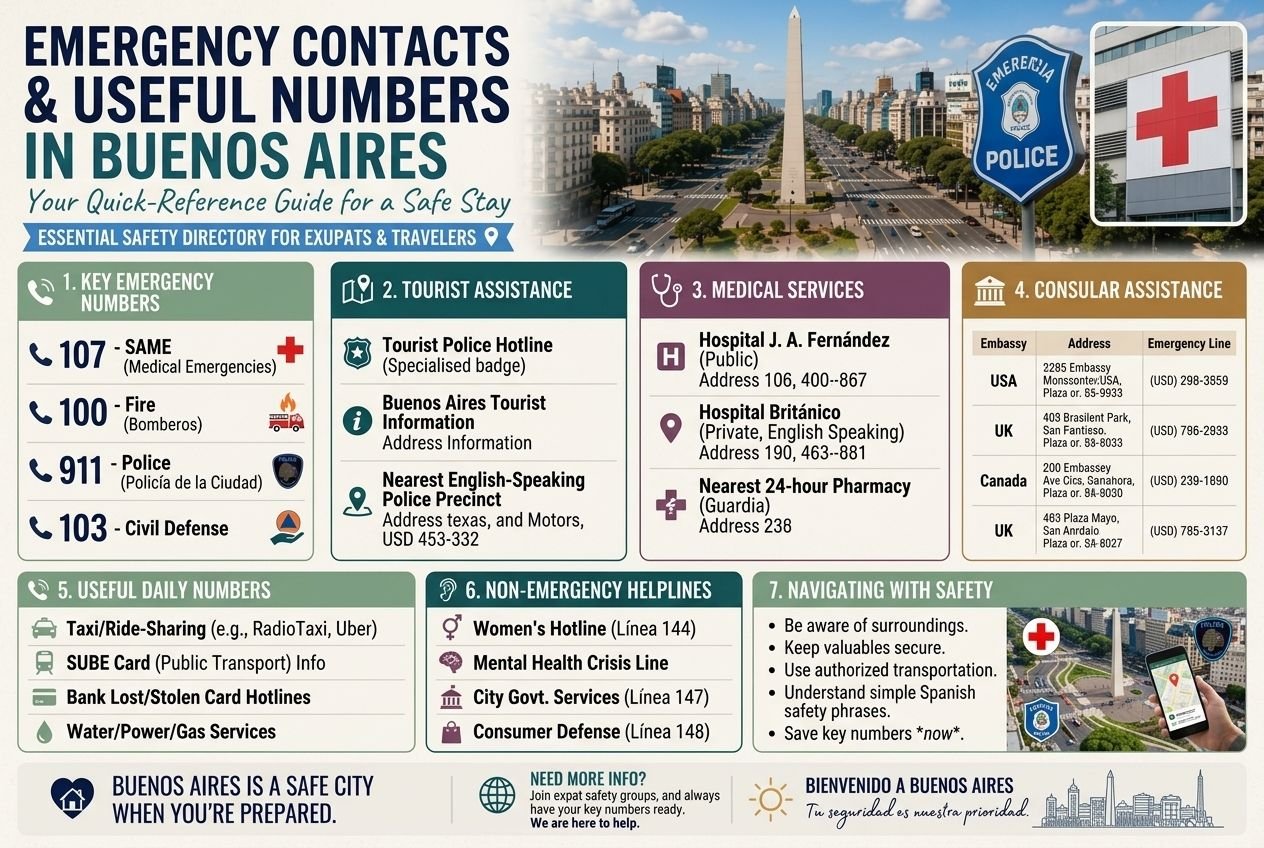
911: The general emergency number for Buenos Aires city (CABA), covering police, medical, and fire dispatch through a single unified line, similar in concept to 911 in the US or 999 in the UK. This is the number to call for any serious emergency.
107: SAME, the city’s dedicated emergency medical and ambulance service, for medical emergencies specifically.
100: Fire brigade (bomberos), for fire emergencies specifically, though 911 will also route you correctly if you’re unsure which specific number applies.
101: Federal Police direct line, an alternative to 911 for police-specific matters.
Tourist-Specific Support
Tourist Police (Policía Turística / Comisaría del Turista): Buenos Aires operates a dedicated tourist police unit with English-speaking officers, specifically set up to help visitors report theft, scams, or other issues, and generally a more efficient and visitor-friendly experience than a standard local police station. The main office is in the Recoleta/Retiro area near the main tourist zones; ask your accommodation for the current nearest location, as this is the recommended first stop for any visitor dealing with theft or a scam rather than a standard police station.
Embassies
If you lose your passport, are the victim of a serious crime, or need consular assistance for any other reason, your country’s embassy or nearest consulate is your first call after the police. Most major nations maintain embassies in Buenos Aires, concentrated mainly in Palermo and Recoleta. Save your specific embassy’s contact details before you travel; most embassy websites list a 24-hour emergency contact number separate from general office hours.
Healthcare
For non-emergency medical needs, private hospitals and clinics in the main tourist and expat neighbourhoods (Palermo, Recoleta, Belgrano) offer high-quality care and, in many cases, English-speaking staff. See our healthcare guide for a fuller rundown of the system, including guidance on travel insurance and how billing works for visitors versus residents. For genuine emergencies, call 911 or 107 and go to the nearest hospital with an emergency department (guardia) rather than waiting to research the “best” option.
Practical Tips for Saving These Numbers
Argentine phone numbers dial normally from a local SIM without any special prefix for these emergency lines. If you’re relying on an international phone plan or roaming, confirm with your provider that emergency numbers work as expected, and consider having your accommodation’s address and the Tourist Police number written down in Spanish in case you need to communicate with someone who doesn’t speak English during a stressful moment.
Keep a note of your accommodation’s exact address in Spanish (not just the name of the building), since this is often the first thing needed when calling for help or directing a taxi driver in an emergency.
Reporting Theft for Insurance Purposes
If you need to file a police report for travel insurance purposes after a theft, the Tourist Police is generally the most efficient route, since English-speaking staff and a visitor-focused process typically produce the necessary denuncia (police report) faster than a standard local comisaría. Keep a photo of your passport, travel insurance documents, and a list of your valuables’ serial numbers or identifying details somewhere accessible (cloud storage, not just your phone, in case the phone itself is what was taken) before you need any of this, since reconstructing this information after a theft is considerably harder than having it ready in advance.
A Practical Pre-Trip Checklist
Before you travel, it is worth spending ten minutes doing the following: save the 911, 107, and Tourist Police numbers in your phone; note your embassy’s emergency contact number and address; photograph your passport photo page and travel insurance documents and store them in cloud storage; and write down your accommodation’s exact address in Spanish somewhere you can access it even without your phone. None of this takes long, and all of it turns a stressful emergency into a manageable one rather than a scramble to find information under pressure.
Related: Safety Guide | Healthcare for Expats | Practical Info | Common Scams