
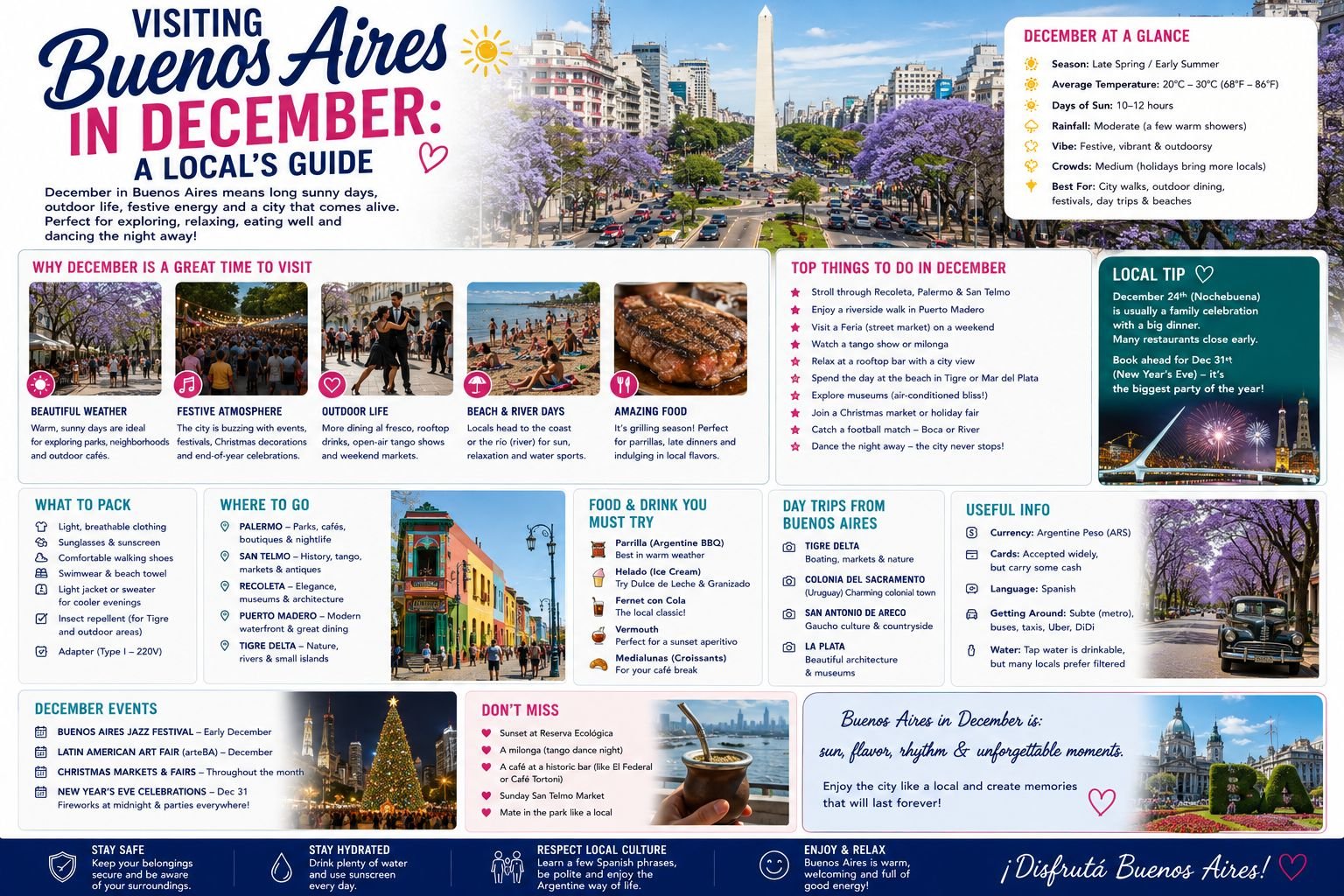
December is the start of summer in Buenos Aires, and it brings one of the more disorienting but delightful experiences available to visitors from the northern hemisphere: Christmas and New Year celebrated in genuine summer heat, with fireworks, rooftop asados, and beach-holiday energy replacing the cold-weather imagery most visitors associate with the season.
By Natalia Romero · Plan Your Trip → Best Time to Visit → December
Weather in December
December brings the start of summer’s heat, with highs typically reaching 28-30°C (82-86°F) and rising humidity as the month progresses. Afternoon thunderstorms become more frequent toward the end of the month. Pack light, warm-weather clothing, similar to what you’d bring for a January visit.
Christmas and New Year, Argentine Style
Argentine Christmas is a genuinely distinctive experience for visitors used to a cold-weather version of the holiday: family gatherings typically happen late on Christmas Eve (Nochebuena) rather than Christmas Day itself, often stretching into the small hours with an asado or other festive meal, followed by fireworks at midnight, a private, neighbourhood-level tradition rather than a single centralised display, meaning the whole city lights up simultaneously in a way that’s genuinely striking to witness from a rooftop or high vantage point. New Year’s Eve follows a similar pattern: family and friend gatherings, a midnight meal, and another round of citywide fireworks, with many locals then heading out to parties or the coast once the family celebration winds down.
The School Year Ends and the City Begins to Empty
Argentina’s school year runs on a calendar aligned with the southern hemisphere seasons, meaning it ends in December, and as the month progresses, particularly after Christmas, a growing share of the city’s population begins its summer exodus to the coast, similar to the pattern described for January but building toward its peak rather than already in full swing. Early December still feels like a fully active city; by the final week, especially after Christmas, the shift toward summer-holiday mode becomes noticeable.
What to Do in December
Early December, before the holiday exodus begins in earnest, offers a strong window for standard sightseeing with the parks, museums, and neighbourhood walks all comfortably before the deepest heat of January sets in. As the month progresses, the heat-management approach that suits January and February becomes increasingly relevant: cooler parts of the day for outdoor activity, air-conditioned museums during peak heat, and evening rooftop bars and pools for relief.
If your trip includes the Christmas or New Year period specifically, treat it less as sightseeing time and more as an opportunity to experience something genuinely local: the city’s rooftops and open spaces come alive at midnight on both occasions, and simply being out to witness the citywide fireworks is itself a distinctive Buenos Aires experience.
Crowds and Pricing
December sees rising visitor numbers and pricing as the peak summer season begins, particularly around the Christmas and New Year period itself, when both international visitors and the domestic holiday rhythm overlap. Book well ahead for accommodation and restaurants specifically over the December 24-January 1 window, as this is one of the busiest and most booked-up stretches of the year.
Practical Tips for a December Visit
Pack for genuine summer heat, similar preparation to a January trip. If your dates include Christmas Eve or New Year’s Eve, confirm your accommodation or a rooftop bar location in advance for the midnight fireworks, since securing a good vantage point is worth planning rather than leaving to chance on the night itself.
Choosing Between Early and Late December
If your travel dates have flexibility within December, the timing genuinely matters: the first half of the month offers comfortably warm weather with the city still in its normal, fully active rhythm, restaurants, offices, and the local population all present as usual, essentially an extension of November’s appeal with slightly higher heat. The back half of the month, particularly after Christmas, shifts into the holiday and pre-exodus mode described above, better suited to a visitor who specifically wants to experience the Argentine Christmas and New Year traditions rather than one prioritising a typical, fully “switched on” sightseeing itinerary.
Restaurant and Business Closures Around the Holidays
Similar to January, some smaller neighbourhood businesses and family-run restaurants close for a period around Christmas and New Year specifically, sometimes extending into the following weeks as owners take their own summer holiday. This rarely affects major tourist-facing restaurants, hotels, or attractions, but it’s worth checking opening hours specifically for smaller, less internationally known establishments if your visit falls in the final week of December.
Sample December Days
Early December suits a fairly standard sightseeing itinerary, adjusted only slightly for rising heat. If your trip includes Christmas Eve or New Year’s Eve specifically, treat that day differently: rather than a full sightseeing schedule, plan a lighter day building toward the evening, securing a good rooftop or open-air vantage point in advance for the midnight fireworks, and simply being present for what is a genuinely distinctive, once-a-year civic spectacle.
Frequently Asked Questions About Visiting in December
Is December too hot and crowded for a good visit? Early December avoids both issues reasonably well; it’s specifically the final week, and the Christmas-New Year window itself, where heat and crowds both peak.
Do I need to book restaurants in advance over the holidays? Yes, particularly for Christmas Eve and New Year’s Eve dinners specifically, well ahead, as the best-known parrillas and restaurants book out for these dates.
Is December a good time to combine Buenos Aires with the Argentine coast? Yes, this is exactly the pattern many locals follow themselves; a city stay followed by a coastal extension works well logistically as the summer holiday season ramps up.
Related: Best Time to Visit | November in Buenos Aires | January in Buenos Aires | Buenos Aires Travel Costs

Hi, I’m Natalia, an Argentine writer born and raised in Buenos Aires, and I’ve been writing about this city for 9 years.
I cover Buenos Aires the way only a local can: the neighbourhoods that don’t make the highlight reels, the ferias worth getting up early for, the parrillas where the menu isn’t in English, and the safety picture by barrio — honest, not sanitized. I’ve taken 40+ solo trips across Argentina, Uruguay, Chile, Bolivia and Peru, and I write in both Spanish and English, which means the local forums, neighbourhood Facebook groups and municipal notices that never get translated are all fair game for me.
My writing covers two things I know from the inside: Buenos Aires as a destination — what to do, where to stay, how to navigate the city as a visitor — and Buenos Aires as a place to live. The expat life content comes from real experience: the paperwork that defeats everyone, the healthcare system that surprises you, the cost of living that changes faster than any guidebook can track, and the parts of porteño life that make it worth all of it.
If you’re visiting for a week or moving here for a year, I aim to be the honest friend who actually lives here — not the one who visited once and wrote a listicle.