
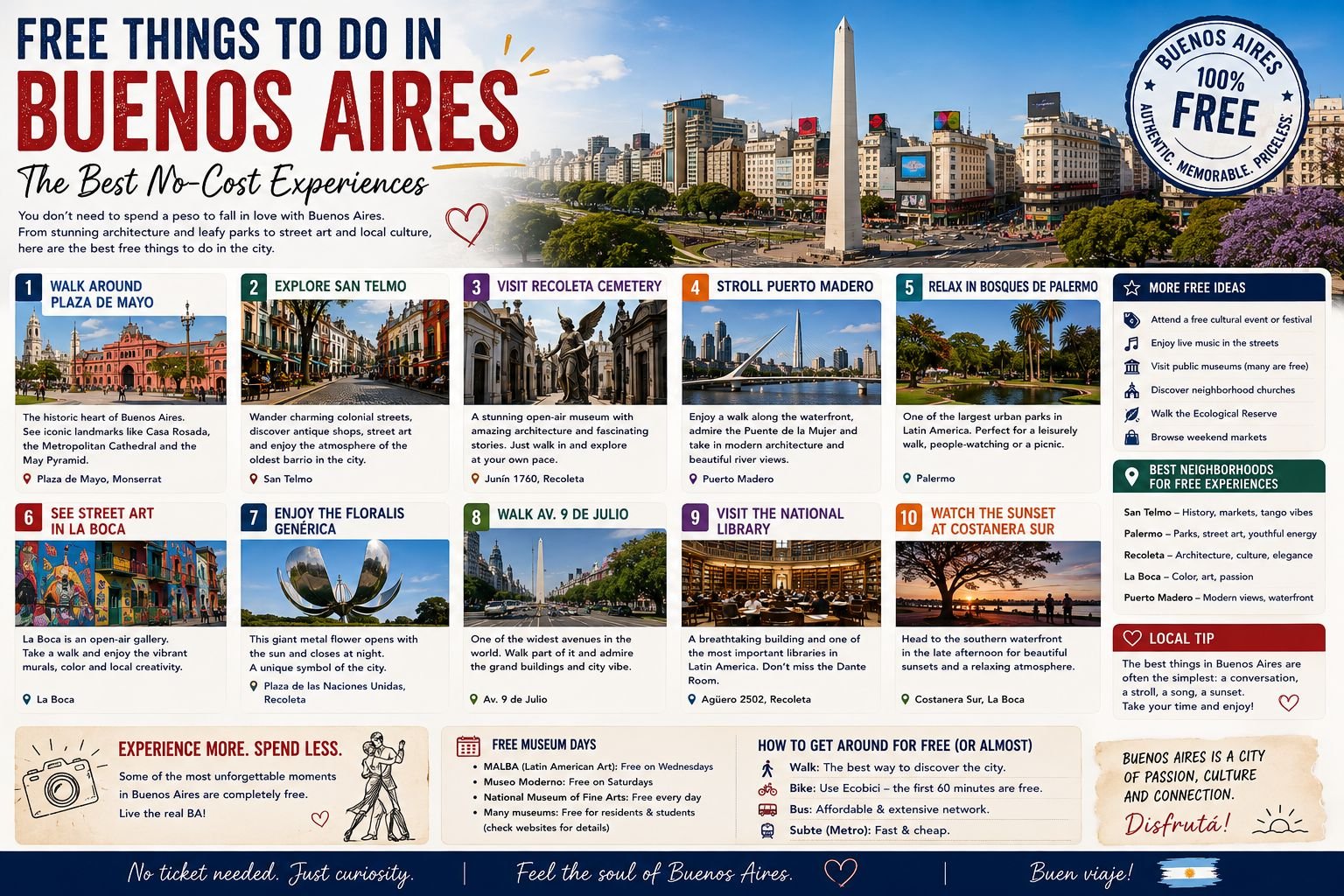
Buenos Aires is one of the most generously endowed cities in the world for free cultural and urban experiences. The combination of free museums, extraordinary public spaces, lively street markets, the city’s European-influenced architectural heritage, and the open character of the city’s social life means that a visitor on a very tight budget can have a genuinely rich experience in Buenos Aires without spending much beyond accommodation and food.
Free Museums
Museo Nacional de Bellas Artes: The national fine arts collection, located in a former pumping station in Recoleta, is free and excellent. The collection covers Argentine art from the colonial period to the 20th century, strong Latin American modernism, and a solid collection of European art. The building has beautiful high-ceilinged rooms that are pleasant to spend time in regardless of the art. Open Tuesday to Friday 11am to 8pm, weekends 10am to 8pm.
Museo de Arte Moderno de Buenos Aires (MAMBA): The city’s modern art museum, in the Av. San Juan in San Telmo, is free or very cheap (small admission for temporary exhibitions). The permanent collection covers Argentine modern and contemporary art; the building’s former tobacco factory space is excellent.
Museo del Cine Pablo Ducrós Hicken: A specialist museum covering Argentine cinema history, free of charge, in the Mataderos neighbourhood.
Museo Etnográfico Juan B. Ambrosetti: On the edge of the Microcentro, a free museum of anthropology and ethnography covering pre-Columbian South American and Pacific cultures. Small but interesting.
Fundación PROA (La Boca): Free entry on Tuesdays; small admission on other days. Consistently excellent contemporary art exhibitions in a beautiful building on the La Boca waterfront.
Free Parks and Green Spaces
Bosques de Palermo (Palermo Parks): The largest park complex in Buenos Aires encompasses the Rosedal (rose garden, spectacular in October and November), the Jardín Japonés (the Japanese garden, which has a small entry fee but is worth it), multiple lakes, cycling paths, the Planetarium, and the Botanical Garden. A morning or afternoon here costs nothing except transport.
Reserva Ecológica Costanera Sur: Free, accessible from Puerto Madero, and genuinely wild in character for an urban nature reserve. Over 350 bird species, capybara, and the contrast of Buenos Aires’ skyline visible across the wetlands. Open daily; busiest on weekends.
Parque Tres de Febrero: The central section of the Palermo Parks, with excellent weekend activity including outdoor fitness classes, cycling (Ecobici public bikes are available nearby), and the famous Buenos Aires roller skating culture.
Free Architecture and Public Spaces
Plaza de Mayo: The historical heart of Argentina is free to visit at any time. The Casa Rosada and the surrounding buildings, the mothers’ march every Thursday, and the weight of history in this square make it worth extended time.
Recoleta Cemetery: Free entry to one of the most extraordinary spaces in South America.
Avenida Alvear: A free walking tour of Buenos Aires’ finest street of 19th and early 20th century architecture.
San Telmo neighbourhood: The cobblestone streets, colonial and 19th-century architecture, and neighbourhood character of San Telmo are free to walk through. The Sunday market is free to attend.
Caminito, La Boca: Free to walk and photograph.
Palacio Barolo observation deck: The guided tours of Palacio Barolo cost a small fee, but the building’s exterior on Avenida de Mayo and the views from the street are free.
The San Telmo Sunday Market
Every Sunday from approximately 10am to 5pm, Plaza Dorrego and the surrounding streets of San Telmo become one of the best free experiences in South America. Street performers, tango dancers who perform in the square (putting some money in the hat is appropriate), antiques vendors, artisan craft sellers, and a Buenos Aires in its most relaxed and open weekend mode. There is no entry fee, no ticket, and no agenda required.
Street Tango
Tango appears on the streets of Buenos Aires, particularly in tourist areas on weekends. The best street tango performances are in the Caminito in La Boca (weekend afternoons) and in the San Telmo Sunday market square. These are professional performances by dancers who work for donations from their audience; stopping to watch and contributing a modest amount to the hat is appropriate.
Buenos Aires Walking Culture
Buenos Aires is one of the world’s great walking cities. The architecture, the street life, the neighbourhood differences, and the general density of interesting things to look at makes wandering without an agenda one of the most rewarding things you can do. Some specific walks:
The Microcentro architecture circuit: From Plaza de Mayo along Avenida de Mayo to the Congreso Nacional; the most impressive avenue in Buenos Aires and free to walk.
Palermo Soho streets: The neighbourhood between Thames, Honduras, Gorriti, and Nicaragua is dense with independent bookshops, design boutiques, galleries, and cafés worth looking at even if you do not plan to buy anything.
The San Telmo market streets: Walking the full length of Calle Defensa from the historic centre south to Parque Lezama, passing the covered market, antique shops, and colonial architecture.
Related: Things to Do Hub | Neighborhoods | Plan Your Trip
The Free Cultural Circuit: A Walking Route
For a free day in Buenos Aires, a specific walking route covers the best free experiences in the city’s cultural and historic centre:
Start at Plaza de Mayo (the historic heart, free, always open). Walk west along Avenida de Mayo to the Congreso Nacional, arguably the finest monumental building in the country, and the surrounding square. Return along Corrientes (theatre and bookshop street; entry to any bookshop is free) to the Microcentro. Walk north on Florida to the Galería Güemes (architectural marvel, free to enter and walk through). Continue north to Plaza San Martín in Retiro, with views of the finest concentration of early 20th-century architecture in the city. Take a taxi or bus to Recoleta Cemetery (free, one of the great free attractions in South America). Walk through Recoleta neighbourhood and the adjacent Palermo Parks (completely free, beautiful).
This route takes a full day at an unhurried pace, costs nothing except transport between the cemetery and Plaza de Mayo, and covers more of Buenos Aires’ most significant architecture and public space than many paid tours.
Neighbourhood Markets: Beyond San Telmo
The San Telmo Sunday market is the most famous Buenos Aires market, but several neighbourhood markets provide equally authentic and less tourist-concentrated experiences:
Feria de Mataderos (far west, Sundays): The most authentically Argentine of the city’s markets, with gaucho culture, folk music, craft demonstrations, and traditional food. Requires a 30 to 45 minute bus or taxi journey from the centre but rewards the effort with an experience that has no tourist theatrics.
Mercado de Pulgas (Colegiales, weekends): A Saturday and Sunday antiques and vintage market in the Colegiales neighbourhood, much less famous than San Telmo but excellent for genuine antique finds at lower prices than the tourist-driven San Telmo market.
Plaza Serrano (Palermo, weekends): An artisan craft market in the central Palermo Soho square with a younger, design-forward character; good for contemporary Argentine design products and independent jewellery.
Buenos Aires’ free cultural offer is among the most generous of any major city in the world. The combination of free museums, free parks, free public spaces with extraordinary architecture, free street markets, and the entirely free experience of walking a city of this quality produces days of genuine cultural richness at zero entry cost. Budget constraints need not limit the quality of the Buenos Aires experience.
A Final Note
Buenos Aires rewards visitors who arrive prepared and remain open. The practical preparation covered in this guide removes the friction that prevents engagement; the openness is yours to bring. The city that reveals itself to a visitor who knows what they are looking for, who has sorted the practical foundations, and who has the curiosity to follow what the city offers is one of the genuinely great urban experiences available anywhere in the world.
For questions, corrections, or feedback on this guide, the contact page is the right place. This site is updated regularly; if you visit Buenos Aires and find that conditions have changed from what this guide describes, telling us makes the guide better for the next reader.
Related guides are linked throughout. The [Start Here](/start-here/) page provides an overview of the entire site for visitors approaching Buenos Aires for the first time.
Buenos Aires’ free cultural offer represents one of the most generous public cultural investments of any major city. The combination of free museums, free public spaces with extraordinary architecture, free street markets, and the entirely free experience of wandering a city of this quality at no entry cost means that the Buenos Aires experience is not diminished by budget constraints in the way that visits to many other major cities are.
Buenos Aires rewards the traveller who arrives prepared and remains curious. Every guide in this site is designed to remove the friction between arrival and genuine engagement with the city; the engagement itself is yours to pursue. The city is inexhaustible, genuinely warm, and consistently surprising even to those who have been here many times. Whatever brings you to Buenos Aires, whether a first visit, an extended stay, or the beginning of a longer Argentine chapter, the preparation this guide provides is the starting point. What comes next is the city’s contribution.