
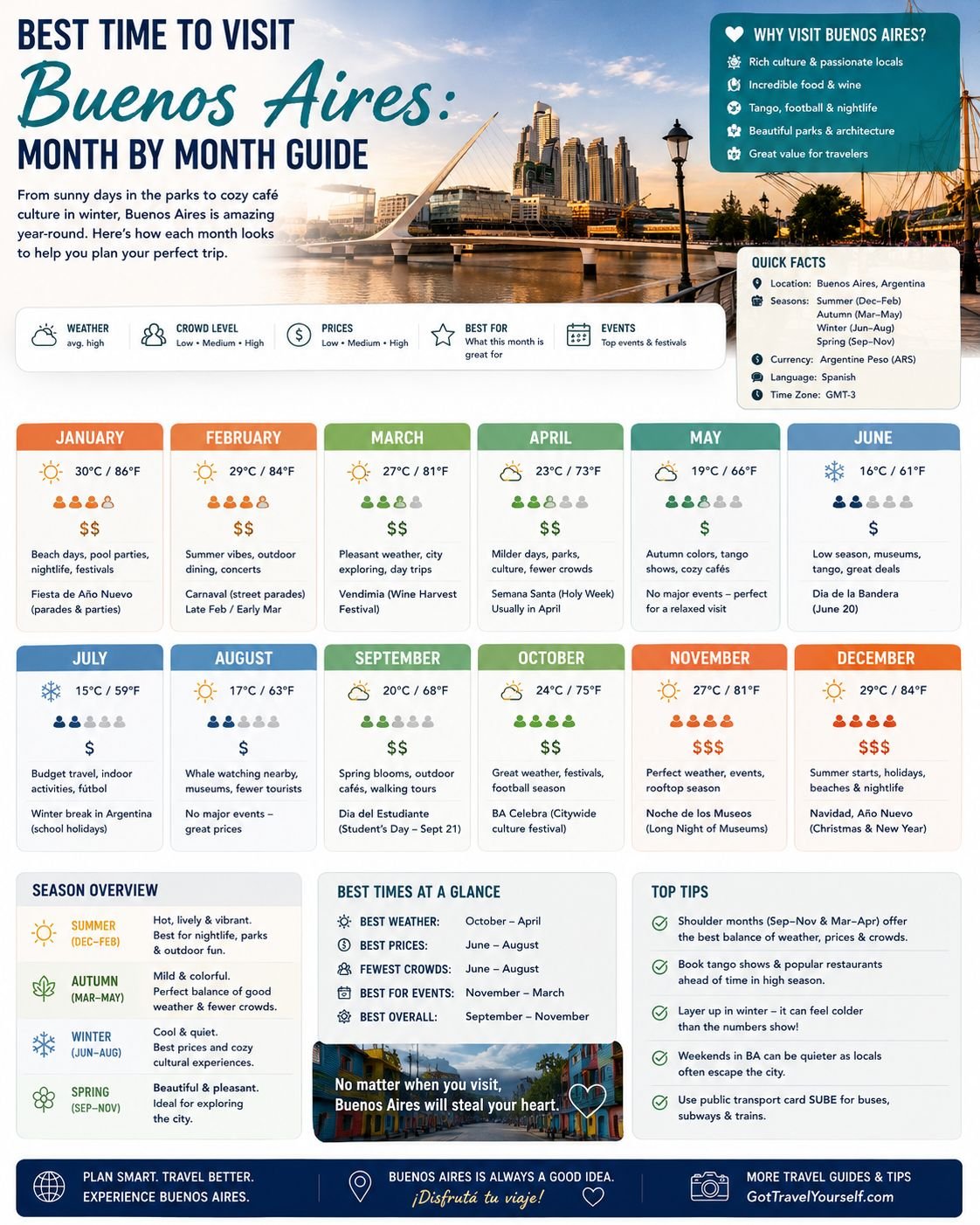
Buenos Aires has a genuine four-season temperate climate, which means the question of when to visit actually has a meaningful answer. The best time depends on what you want from the trip, how you handle heat and humidity, and whether specific events or festivals are part of your reason for coming. This guide covers every month and helps you match your travel dates to what the city is doing.
The Quick Answer
Spring (September to November) and autumn (March to May) are the best times for most visitors. Temperatures are comfortable for walking and exploring (typically 14 to 22°C), the city is at full energy, and you avoid the extremes of summer heat and the quieter winter period.
August is the best time for tango, because the Buenos Aires Tango Festival and World Cup brings the world’s best dancers to every milonga in the city.
January is the worst month for most visitors: peak summer heat, high humidity, and a significant proportion of the city’s residents away on holiday meaning some restaurants and businesses close.
Season by Season
Spring: September to November
Spring is Buenos Aires at its best. The jacaranda trees bloom purple across the city in October and November, creating one of the most beautiful urban streetscapes in South America. Temperatures rise gradually from 12°C in September to 22°C in November. Rain is moderate and generally brief. The city is fully operational, outdoor life expands back onto terraces and parks, and there is an energy of recovery from winter that makes the city feel particularly alive.
September is the first month of spring and the most unpredictable weather-wise; bring layers. The city gradually wakes up from its quieter winter pace. October is peak jacaranda season and one of the most beautiful months in the city. Temperatures are ideal for walking. November becomes warmer and is the last comfortable month before the heat builds. It is an excellent month to visit, with long days, outdoor dining, and the city in full swing before the summer school holiday period begins.
Summer: December to February
Buenos Aires summer is hot and humid. Temperatures regularly reach 32 to 35°C in January and February, with humidity making it feel higher. The city does not have the infrastructure of adaptation to heat that cities in similarly hot climates have developed; many older buildings lack air conditioning and the heat in street markets and covered spaces can be intense.
December is the most pleasant summer month: temperatures are building but not yet extreme, the city is festive with Christmas decorations and events, and there is a social energy in the lead-up to the holidays. Many Porteños are still in the city until the first week of January. January is the genuine low point for visitors who are heat-sensitive: extreme heat, humidity, the departure of a large fraction of the population to coastal resorts, and the closure of some businesses. Hotel prices are lower, which attracts budget travellers, but the experience of the city is genuinely diminished. February brings carnival, when neighbourhood murgas parade through the barrios; the heat continues but the city begins to come back to life after the January exodus.
Autumn: March to May
Autumn rivals spring as the best season for visitors. Temperatures drop from summer highs to comfortable mid-range levels (15 to 25°C in March, 10 to 18°C in May). The city feels fully inhabited and energetic after the summer holidays, the restaurants are busy, and cultural life is in full swing.
March still has summer warmth (and summer humidity) in the early part of the month, but it is significantly more comfortable than January and February. The city is back from summer holidays. April is arguably the single best month to visit: temperatures are ideal (around 17 to 22°C), the city is fully operational, and two major cultural events (FIBA film festival and various art events) add to the calendar. May is the last warm autumn month before winter sets in. Weather is variable but the mid-month period is typically comfortable. There are national holidays in May that affect some businesses.
Winter: June to August
Buenos Aires winter is mild by Northern Hemisphere standards but genuinely cold by the standards of what the city is prepared for. Temperatures range from 5 to 14°C, with the coldest period in July. The city has relatively little central heating in older buildings and the cold is damp and penetrating. Rain is more frequent. That said, winter in Buenos Aires is not an obstacle to visiting; it is a different version of the city, with its life moving indoors to the bookshops, cafés, and cultural centres.
June is the first winter month, with cooling temperatures and shorter days. July is the coldest month and the school holiday month, which means the city has a higher proportion of domestic tourists in parks and attractions while local families are out of the city on holiday. August is the standout winter month: the Buenos Aires Tango Festival and World Cup fills every milonga in the city with extraordinary dancers and transforms the cultural experience of August. If tango is your primary reason for visiting, plan around August.
Monthly Visitor Guides
For specific information about what to expect, what is on, and what to watch out for in each month:

January is peak summer in Buenos Aires and the month locals themselves leave town for the coast. Here's what that means for visitors, plus weather, events, and a sample itinerary.
View more
February shares January's heat but adds Carnival, Buenos Aires' own murga-centred take on the tradition. Weather, events, and a sample itinerary for the month.
View more
March is the turning point of the Buenos Aires year, summer giving way to autumn as the city fully reactivates. Weather, BAFICI, Día de la Memoria, and a sample itinerary.
View more
April is widely considered the single best month to visit Buenos Aires: mild weather, the Book Fair, Malbec World Day, and none of summer's heat.
View more
May brings cooler autumn weather, Revolution Day, and ArteBA, making it a strong month for a culture-and-museum-focused Buenos Aires visit.
View more
June starts Buenos Aires' low season: lower prices, thinner crowds, and an indoor-friendly month for museums, parrillas, and tango.
View more
July is Buenos Aires' coldest month, but Independence Day and winter school holidays give it real energy. Weather, events, and tips for combining with Patagonia.
View more
December brings the start of summer, Christmas and New Year celebrated in genuine heat, and the beginning of the city's summer exodus to the coast.
View more
November is late spring in Buenos Aires, warm and largely dry, and it carries one of the fullest events calendars of the year, from a major gaucho festival to the city’s Pride march to the start of the polo season’s biggest tournament. Weather in November November brings genuinely warm, pleasant...
View more
In this comprehensive guide, we will delve into all the reasons why you should consider visiting Buenos Aires in October, covering essential topics
View more
September is early spring in Buenos Aires, and it marks the genuine start of what many consider the city’s best stretch of weather: the transition out of winter into the mild, blooming months that carry through to November. Weather in September September brings noticeably warming temperatures, typically ranging from around...
View more
Most people think of Argentina for its tango and steak, but you're about to discover that April is a blissful time to experience all the culture and flavor Buenos Aires has to offer! As you wander the vibrant streets, be prepared for a sprinkle of unexpected rain and a whole...
View more
Buenos Aires in March offers an exciting blend of vibrant culture and pleasant weather, making it an ideal time for you to explore this captivating city. As summer winds down, you can enjoy milder temperatures and fewer crowds while indulging in local festivals and outdoor activities. However, stay vigilant in...
View more
August is the end of winter in Buenos Aires, still cool but with the first genuine hints of the warming to come, and it’s home to the single biggest event on the city’s tango calendar: the Buenos Aires Tango Festival and World Cup. Weather in August August remains cool, with...
View more
Key Events Calendar
February: Carnival murgas; summer festivals
April: FIBA International Film Festival; autumn cultural season opens
May: National holidays (May 25 and May 1); Buenos Aires Design Week
August: Buenos Aires Tango Festival and World Cup (two weeks, peak in mid-August)
November: Buenos Aires Marathon; start of outdoor festival season; jacaranda peak bloom
December: Christmas events; end-of-year cultural programming
Weather Data by Month (Buenos Aires City)
| Month | Avg High | Avg Low | Rain days | Notes |
| January | 30°C | 20°C | 8 | Hottest month; humid; many locals absent |
| February | 29°C | 20°C | 7 | Still hot; carnival season |
| March | 26°C | 17°C | 8 | Pleasant; city returns from holidays |
| April | 22°C | 13°C | 9 | Ideal; best single month |
| May | 18°C | 10°C | 8 | Good; cooling begins |
| June | 14°C | 8°C | 7 | Cool; damp; indoor season |
| July | 13°C | 7°C | 8 | Coldest month; school holidays |
| August | 15°C | 8°C | 7 | Tango festival; good for culture |
| September | 18°C | 11°C | 9 | Spring warming; variable |
| October | 22°C | 14°C | 9 | Jacaranda bloom; excellent |
| November | 25°C | 16°C | 8 | Late spring; last comfortable month |
| December | 28°C | 18°C | 9 | Festive; heat building |
Related: Plan Your Trip | How Many Days | Travel Costs | Neighborhoods
Special Events Worth Planning Around
Buenos Aires Tango Festival and World Cup (August): The defining event for tango enthusiasts. For two weeks in mid-August, the world's best tango dancers converge on Buenos Aires for a festival that transforms the milonga scene. Championship events are held at the Luna Park stadium; shows and performances proliferate across the city. For anyone who cares about tango, this is the best time to visit by a significant margin.
FIBA International Film Festival (Buenos Aires, April): One of Latin America's most important film festivals, with screenings across multiple venues in the city over approximately two weeks. The programme covers international and Argentine cinema with an emphasis on independent and art-house work.
Buenos Aires Pride (November): La Marcha del Orgullo, one of the largest Pride parades in Latin America, typically in November, attracting hundreds of thousands of participants and visitors.
Vinos y Bodegas (August/September): An annual wine exhibition held in the La Rural exhibition centre, featuring Argentine wineries from all regions. One of the best opportunities to taste the full breadth of Argentine wine production in a single venue.
The Buenos Aires International Book Fair (late April to May): One of the largest book fairs in the world, attracting major Argentine and international authors and publishers. The social and intellectual energy around the fair extends beyond its venue into the city's cultural life.
Avoiding the Wrong Weeks
Certain weeks in Buenos Aires are best avoided if possible:
Semana Santa (Holy Week before Easter): A long weekend that produces peak domestic tourism; accommodation prices rise and popular attractions are crowded.
The week of July 9 (Independence Day): A national holiday with associated events; mid-July coincides with the school winter holiday peak.
The first two weeks of January: The period when the highest proportion of Buenos Aires residents are away on summer holiday. Some businesses close for the period; the city is quieter but less fully operational.

Hi, I’m Natalia, an Argentine writer born and raised in Buenos Aires, and I’ve been writing about this city for 9 years.
I cover Buenos Aires the way only a local can: the neighbourhoods that don’t make the highlight reels, the ferias worth getting up early for, the parrillas where the menu isn’t in English, and the safety picture by barrio — honest, not sanitized. I’ve taken 40+ solo trips across Argentina, Uruguay, Chile, Bolivia and Peru, and I write in both Spanish and English, which means the local forums, neighbourhood Facebook groups and municipal notices that never get translated are all fair game for me.
My writing covers two things I know from the inside: Buenos Aires as a destination — what to do, where to stay, how to navigate the city as a visitor — and Buenos Aires as a place to live. The expat life content comes from real experience: the paperwork that defeats everyone, the healthcare system that surprises you, the cost of living that changes faster than any guidebook can track, and the parts of porteño life that make it worth all of it.
If you’re visiting for a week or moving here for a year, I aim to be the honest friend who actually lives here — not the one who visited once and wrote a listicle.