
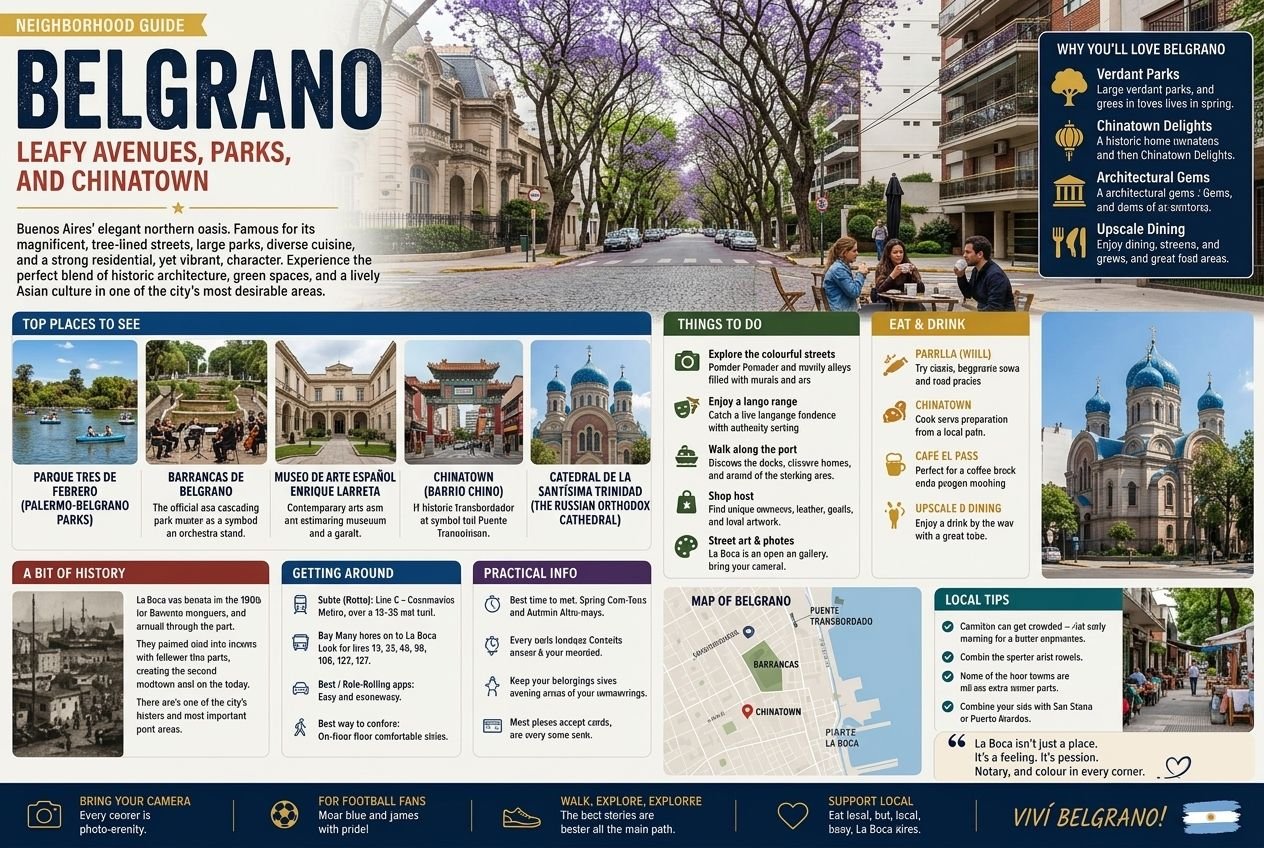
Belgrano sits at the northern edge of the city’s most desirable residential corridor, and it is one of the least touristed of Buenos Aires’ major neighbourhoods despite being, by most local measures of safety and quality of life, one of the best places in the city to actually live. For visitors willing to venture slightly further from the main tourist cluster, it offers a genuinely different, more residential picture of Buenos Aires.
Character and History
Belgrano was an independent town before being absorbed into the city of Buenos Aires in the late nineteenth century, and it briefly served as the country’s capital in 1880 during a period of political transition, a fact still marked by a few municipal buildings from that era. The neighbourhood retains a distinct small-town feel within the larger city, organised around Barrancas de Belgrano, a sloped park that was once a riverbank before the Río de la Plata receded, and the twin plazas around the Belgrano C and Belgrano R train stations, which give the neighbourhood two slightly different centres of gravity.
Belgrano is also home to Buenos Aires’ Chinatown (Barrio Chino), a compact but lively few blocks packed with Chinese and broader East Asian restaurants, supermarkets, and shops, a genuinely distinctive pocket within an otherwise very European-inflected city.
Things to Do in Belgrano
Barrancas de Belgrano: The neighbourhood’s signature park, a series of grassy slopes and mature trees that once formed the edge of the Río de la Plata before land reclamation pushed the water further away. A pleasant, quiet place to walk, and the site of a small antiques and crafts fair on weekends.
Barrio Chino: Buenos Aires’ Chinatown, centred on Calle Arribeños, is worth a visit for the restaurants alone, alongside supermarkets stocking ingredients hard to find elsewhere in the city, and it comes especially alive around Chinese New Year with street festivities.
Museo Casa de Yrurtia: A small, atmospheric museum in the former home and studio of sculptor Rogelio Yrurtia, one of Belgrano’s quieter cultural gems.
Iglesia de la Inmaculada Concepción: The neighbourhood’s main church, on the Barrancas, a solid example of the kind of substantial parish architecture found throughout Belgrano’s older streets.
Museo Histórico Sarmiento: Housed in the building where the country’s former capital briefly functioned, with exhibits on the period and on former president Domingo Sarmiento.
Where to Eat in Belgrano
Belgrano’s food scene is less internationally oriented than Palermo’s but strong on its own terms, particularly around Barrio Chino for genuinely good and often better-value Asian food than you’ll find in the more tourist-facing parts of the city. The neighbourhood also has a solid, unpretentious selection of traditional parrillas and cafés serving the local residential population rather than a tourist crowd, which for many visitors is exactly the appeal.
Where to Stay in Belgrano
Belgrano has a smaller hotel and short-term rental market than Palermo or Recoleta, reflecting its status as primarily a residential rather than tourist neighbourhood. What accommodation exists tends toward apartment rentals rather than hotels, appealing particularly to longer-stay visitors and those prioritising a quiet, local, genuinely residential base over proximity to nightlife and major attractions. Belgrano is consistently rated among the safest neighbourhoods in the city, which is part of why it has become popular with expat families in particular.
Getting To and Around Belgrano
Belgrano is well served by the Subte (Line D reaches the neighbourhood) and by two suburban train lines, plus extensive bus routes. It sits further from the city centre than Palermo or Recoleta, roughly 20 to 25 minutes by taxi from downtown in normal traffic, which is the main trade-off visitors weigh against its calmer, more local atmosphere.
Related: Palermo | Recoleta | Best Neighborhoods To Stay | Cost of Living