
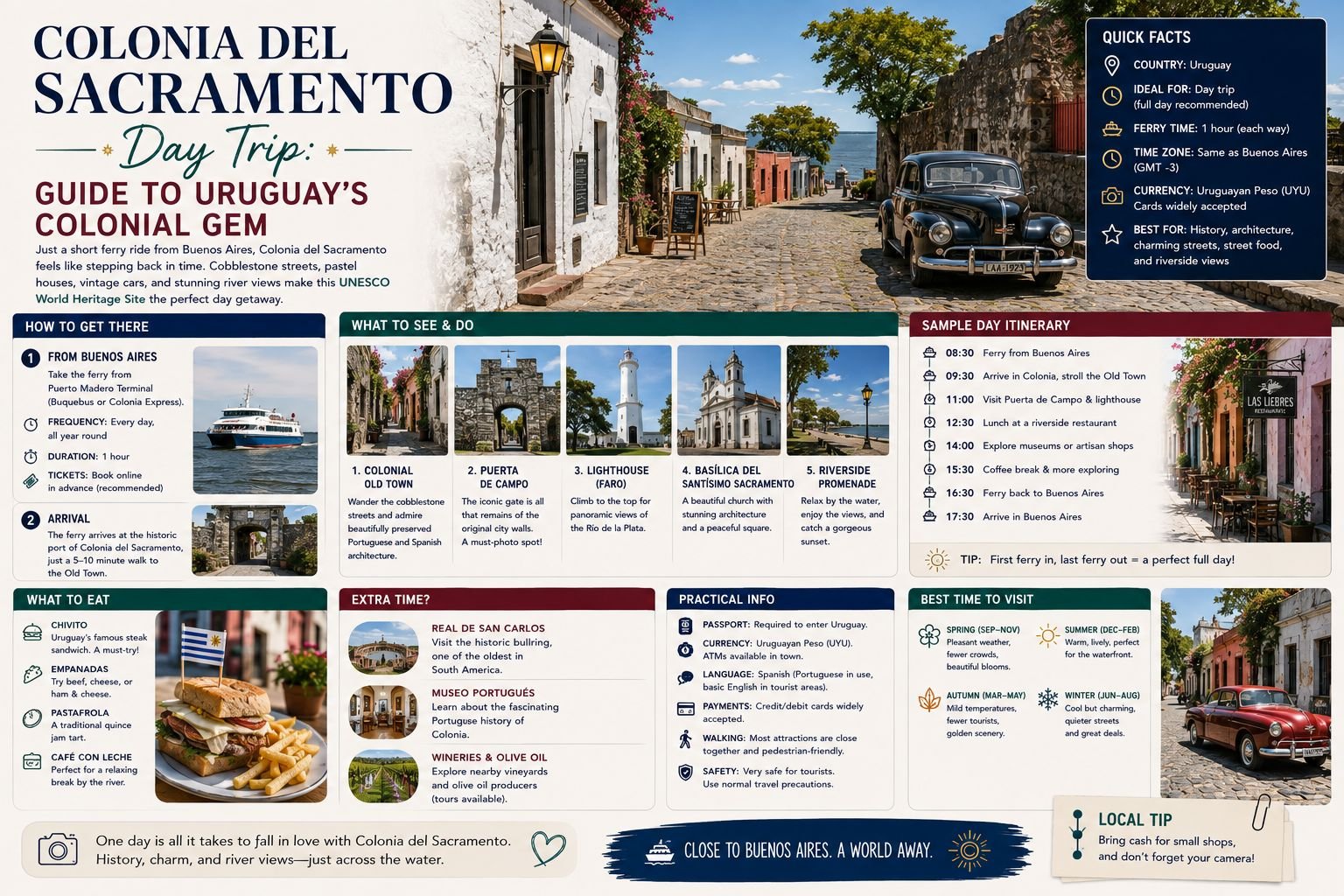
The day trip to Colonia del Sacramento is one of the most consistently recommended activities in Buenos Aires, and the enthusiasm is justified. A short ferry crossing of the Río de la Plata takes you to one of the best-preserved colonial towns in South America, a place that feels genuinely different from everything in Argentina and that rewards wandering without a specific agenda.
What Is Colonia del Sacramento?
Colonia is a small city of around 30,000 people on the Uruguayan bank of the Río de la Plata, approximately 50 kilometres west of Buenos Aires as the crow flies. Its old town, the Barrio Histórico, is a UNESCO World Heritage Site: an intact 17th and 18th century colonial settlement with cobblestone streets, Portuguese and Spanish colonial architecture, a lighthouse, fortifications, and a series of small museums that tell the town’s complicated history.
The town was founded by the Portuguese in 1680 as a strategic foothold on the south bank of the Plata; it was one of the main entry points for contraband into the Spanish colonial economy, which made it militarily valuable and led to repeated Portuguese-Spanish conflict over control of it. The town changed hands between the two empires several times before finally becoming part of Uruguay in the 1820s. The UNESCO designation reflects both the quality of the preservation and the historical significance of the town as evidence of the Portuguese-Spanish colonial struggle.
Getting There: The Ferries
Three ferry companies run services between Buenos Aires and Colonia:
Buquebus: The fastest and most comfortable service, with vessels taking approximately 1 hour (the fastest class). Departs from the Buquebus terminal at Avenida Antártida Argentina, near the Retiro bus station and Puerto Madero. The most expensive option, typically USD 40 to 80 each way depending on the class and booking lead time.
Seacat Colonia: A subsidiary of Buquebus running the same route at similar prices and times.
Colonia Express: The cheapest option, taking approximately 3 hours in a slower conventional ferry. The journey time makes it a better option for those who are not in a rush; the price saving can be significant. Departs from the Dársena Sur terminal in Puerto Madero.
Book in advance: All three companies can be fully booked on weekends, particularly in the summer months (December to February). Booking both legs when you make the initial reservation is strongly advisable. A return booking is necessary for Uruguayan immigration to see evidence of your intent to leave.
Logistics: Allow extra time at both terminals. Argentine departure includes passport control and security; Uruguayan arrival includes immigration. The total terminal-to-terminal process typically takes 30 to 45 minutes on each side beyond the ferry crossing time.
What to Do in Colonia
The Barrio Histórico: The old town is compact and entirely walkable; the main attractions are concentrated in an area you can cover on foot in 2 to 3 hours. Start at the Puerta de la Ciudadela (the only remaining colonial gate), walk along Calle de los Suspiros (Street of Sighs, one of the most photographed streets in Uruguay) to the waterfront, and explore the main square (Plaza Mayor) and its surrounding streets.
The Lighthouse and views: The Faro del Barrio Histórico, a 19th-century lighthouse, provides the best views over the old town and the Río de la Plata. There is typically a small entry fee.
Bastion del Carmen: The ruins of the Portuguese fortifications, visible at the edge of the old town along the river. Combined with the original city walls, these give a physical sense of the town’s military history.
The Museums: A single admission ticket covers most of the small museums in the Barrio Histórico, including the Museo Portugués (colonial period objects), the Museo Municipal (local history), and the Archivo Regional. None are large; together they add about 90 minutes to a thorough visit.
The Waterfront: Walking the riverside promenade outside the fortification walls offers views across the Plata to Argentina. At sunset, the light over the river from Colonia is extraordinary.
The Town Outside the Barrio: The new town around Colonia, which is the actual functioning city that most of the 30,000 residents inhabit, has good supermarkets, restaurants, and the kind of small-city Uruguay character that is a pleasant contrast to Buenos Aires. Walking a few blocks outside the tourist precinct shows you a place that is not performing for visitors.
Where to Eat in Colonia
Uruguayan food is broadly similar to Argentine food: grilled beef (asado), empanadas, and Italian-influenced cooking. The quality is generally good, the pace is even slower than Buenos Aires, and the prices are comparable to or slightly lower than Buenos Aires.
Parador La Rotonda: On the waterfront outside the old town, good for a long lunch with river views. The fish and seafood (less common in Buenos Aires) is worth ordering.
La Florida: A reliable option on the main square in the old town, with outdoor tables in good weather and a menu covering the Uruguayan standards well.
El Drugstore: A quirky, eclectic restaurant and bar in a former pharmacy on the main square, popular with both tourists and locals and reliably good.
Practical Notes
Currency: Uruguay uses the Uruguayan peso, a different currency from the Argentine peso. USD and Argentine pesos are often accepted in tourist-facing businesses in Colonia, but having some Uruguayan pesos is useful for markets, smaller cafés, and transport.
Entry: Argentine passport holders and citizens of most Western countries can enter Uruguay visa-free. Ensure your passport is valid.
Mobile data: Argentine SIM cards work in Uruguay (roaming charges may apply, depending on your plan); the ferry terminals and most restaurants in Colonia have WiFi.
How long to spend: A full day (arrive by 10am, leave on the last afternoon ferry back to Buenos Aires) allows time to explore the old town thoroughly, have a long lunch, and enjoy the slower pace. A half-day (arrive midday, leave on an early evening ferry) is possible but leaves less room to breathe.
Related: Day Trips from Buenos Aires | Tigre Day Trip | Plan Your Trip
Colonia vs Montevideo: Which Uruguay Day Trip?
Both Colonia del Sacramento and Montevideo are accessible by ferry from Buenos Aires, and a common question is which to choose for a single-day trip. The answer depends on what you are looking for:
Colonia is the right choice for: a complete contrast with Buenos Aires (small, slow, historic, colonial), beautiful old town architecture and cobblestone streets, a very relaxed pace, and a trip that delivers strongly on its own terms in a single day.
Montevideo (about 3 hours by fast ferry) is the right choice for: experiencing a capital city rather than a colonial town, a deeper experience of Uruguayan culture and everyday life, more time in the ferry itself as part of the experience, and visitors who want to understand Uruguay at a broader scale than its most famous historic town.
For most first-time visitors to the Buenos Aires area, Colonia is the stronger single-day recommendation because the contrast is more dramatic and the manageable size means you see it properly in one day. Montevideo benefits from a longer stay; a day trip feels rushed.
The Ferry Experience as Part of the Trip
The ferry crossing is not just a means to an end; it is part of the experience. The 1 to 3 hour crossing of the Río de la Plata, with its extraordinary width (the river is so wide that the opposite bank is invisible, producing the impression of crossing a small sea), is itself worth doing. The light on the water in the morning and late afternoon, the arrival view approaching the Uruguayan coast, and the sense of crossing the river that separates two countries and two very different colonial histories make the ferry a worthwhile experience beyond its functional purpose.
First-class seats on the Buquebus service are worth the premium for the crossing experience; the lounge-style seating, the better views, and the breakfast service on early morning departures make the 1-hour crossing feel appropriately event-like.
Colonia del Sacramento is consistently described by Buenos Aires visitors as the highlight of their trip, which is a remarkable achievement for a day trip to a small Uruguayan town. The quality of the experience, the perfect state of preservation, the ferry crossing, the lunch by the river, and the complete contrast with the city you left that morning produce a day that stands apart from the rest of the Buenos Aires visit. Go.
A Final Note
Buenos Aires rewards visitors who arrive prepared and remain open. The practical preparation covered in this guide removes the friction that prevents engagement; the openness is yours to bring. The city that reveals itself to a visitor who knows what they are looking for, who has sorted the practical foundations, and who has the curiosity to follow what the city offers is one of the genuinely great urban experiences available anywhere in the world.
For questions, corrections, or feedback on this guide, the contact page is the right place. This site is updated regularly; if you visit Buenos Aires and find that conditions have changed from what this guide describes, telling us makes the guide better for the next reader.