
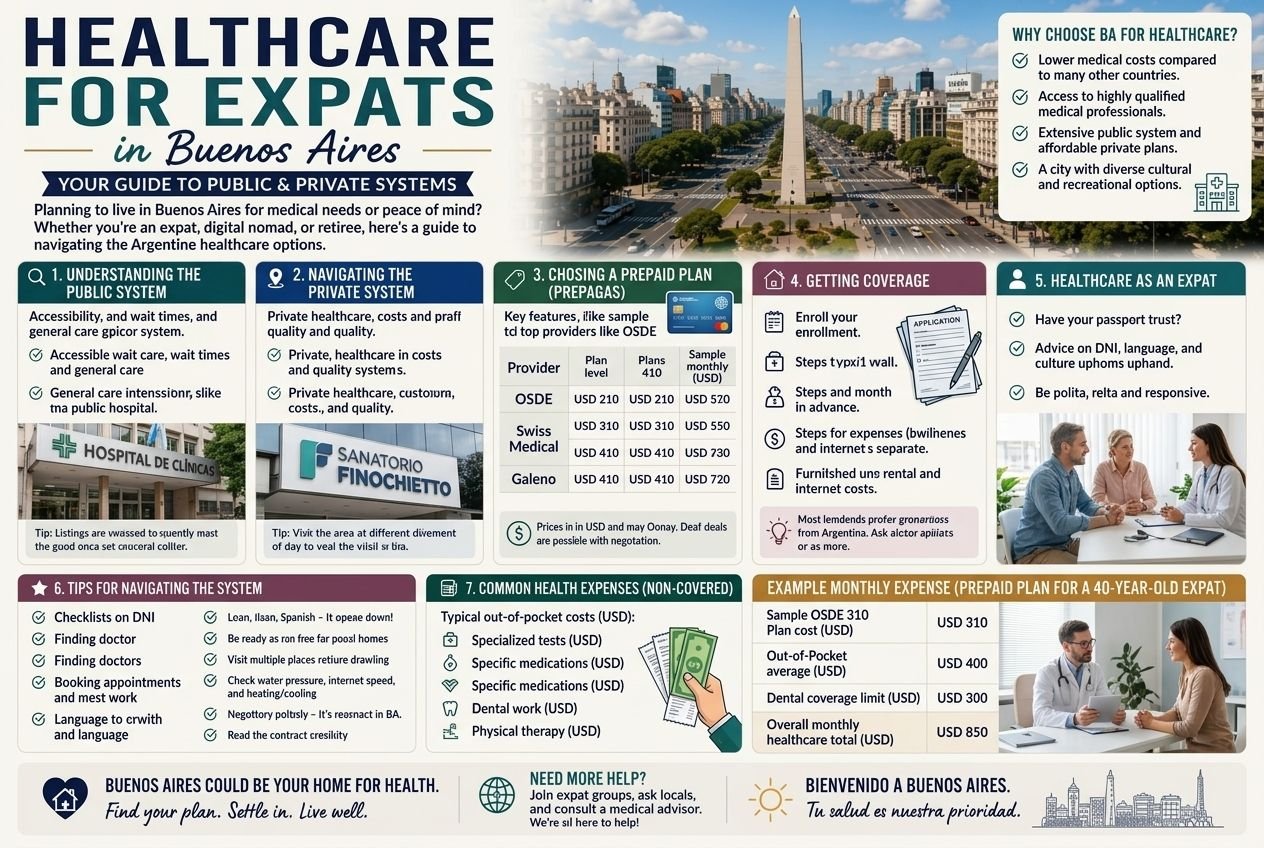
Argentina has a three-tier healthcare system: the public sector (the hospitals and clinics managed by the state, free to all residents and visitors); the obras sociales (union-affiliated health insurance funds, primarily for Argentine workers); and the private sector (the prepagas, private health insurance plans available to individuals). Understanding how this system works and which part of it is relevant to your situation is the essential healthcare preparation for an extended Buenos Aires stay.
The Public Health System
Argentina’s public healthcare system provides free treatment to everyone, including foreigners, at public hospitals and health centres throughout the country. The Buenos Aires public hospital system includes several major hospitals with genuine capacity: the Hospital de Clínicas, the Hospital Italiano (technically private but public-oriented), and the various municipally-managed hospitals across the city.
What the public system offers: Emergency care, medical consultations, surgical procedures, and most standard treatments, all at no cost to the patient. Medications require separate purchase at pharmacies, with prescription required.
The practical limitations: Public hospitals in Buenos Aires can have significant waiting times for non-emergency consultations and elective procedures. The facilities and equipment vary between hospitals; the best public hospitals are genuinely good, while others are more challenged. For non-emergency care, a private option produces a faster and more comfortable experience.
When to use it: The public emergency system (SAME, servicio de atención médica de emergencia, dial 107) provides ambulance response and emergency care that is genuinely functional. For genuine medical emergencies, the public emergency system works. For planned medical care, the private system is more efficient.
Private Health Insurance: The Prepagas
The Argentine private health insurance market is dominated by the prepagas: private health insurance companies that provide access to networks of private hospitals, clinics, and specialists.
The main operators: OSDE, Swiss Medical Group, Medicus, Galeno, and Omint are the major private health insurers, each with different plan structures, hospital networks, and price points.
Costs: Plans start at approximately USD 80 to 120 per month for a basic individual plan and go up to USD 200 to 350+ per month for comprehensive coverage with the most extensive hospital networks. Age is a significant factor in pricing; those over 50 or 60 pay substantially more.
Coverage: Standard plans cover hospitalisation, surgical procedures, specialist consultations, and emergency care. Prescription medication coverage varies by plan. Pre-existing conditions can be excluded or covered with a waiting period depending on the insurer and plan.
Accessing care: With a prepaga plan, you access care by visiting the plan’s affiliated clinics and hospitals or by requesting a consultation through the insurer’s digital platform (most major prepagas now have apps for appointment booking, teleconsultations, and prescription management).
International Travel Insurance vs Local Prepaga
For digital nomads and shorter-stay expats (under 6 months), international travel insurance may be the more practical choice than signing up for an Argentine prepaga:
International travel insurance provides global coverage, typically including Buenos Aires, for medical emergencies and evacuation. The major international travel insurers (World Nomads, SafetyWing, etc.) have plans specifically designed for longer-stay digital nomads. SafetyWing, for example, provides month-to-month global medical coverage at approximately USD 40 to 80 per month for those under 40.
Argentine prepaga provides more comprehensive local coverage and access to the full network of private Buenos Aires healthcare. For stays of six months or more, and particularly for those with ongoing health needs, a local prepaga is likely the better option.
For shorter stays or those primarily wanting emergency coverage, international travel insurance is more flexible and often cheaper.
Finding a Doctor
The easiest way to find an English-speaking doctor in Buenos Aires is through:
Your prepaga: Most prepagas have searchable directories of affiliated doctors; filtering for English-speaking doctors (médicos con inglés) is possible through their apps and websites.
The expat community: Buenos Aires expat Facebook groups and community forums maintain current lists of recommended English-speaking doctors, dentists, and specialists based on community member experience.
Hospital Alemán and Hospital Británico: These two hospitals have traditionally served the German and British communities in Buenos Aires respectively and have English-speaking staff across their various specialties.
Dentistry
Buenos Aires is a genuinely excellent destination for dental care from a cost perspective. The quality of dental care in the private sector is high; the cost is dramatically lower than in Western Europe or North America. Many expats specifically schedule dental work during their Buenos Aires stays. Finding a good English-speaking dentist through the prepaga directory or expat community recommendations is straightforward.
Mental Health Services
Buenos Aires has an unusually high density of psychologists and psychotherapists per capita; the city’s psychotherapy culture is legendary in Latin America. Access to mental health support, including English-speaking therapists, is significantly better here than in most cities of comparable size. Expat-community directories and platforms like Doctoralia list English-speaking mental health professionals with the ability to filter by specialty and language.
Related: Digital Nomad Guide | Cost of Living | Expat Hub | Practical Info
The Pharmacy Culture in Buenos Aires
Argentine pharmacies (farmacias) are an important part of the healthcare landscape because pharmacists in Argentina have significantly more latitude to advise on and dispense medications than in many Western countries. For common ailments (stomach issues, minor infections, skin conditions), visiting a Buenos Aires farmacia and describing your symptoms to the pharmacist is a first-line resource that is faster and cheaper than a medical consultation.
Most pharmacies in tourist and residential areas have at least one pharmacist who speaks enough English to handle a basic medical conversation; bringing a translation app provides backup when language is a barrier.
Pharmacies in Buenos Aires are open long hours; many larger pharmacies in Palermo and Recoleta operate 24 hours. The Farmacity chain has branches throughout the city with long opening hours.
Dental Tourism: An Increasingly Significant Opportunity
Buenos Aires has developed a reputation as a dental tourism destination for visitors from Western countries. The quality of private dental care in the city is high; the costs are dramatically lower than in Europe or North America.
Common dental procedures in Buenos Aires at quality private dental clinics cost approximately:
Dental check-up and clean: USD 40 to 80
Tooth filling: USD 50 to 100
Root canal: USD 150 to 300
Dental implant: USD 600 to 1,200
Dental crown: USD 200 to 400
Equivalent procedures in the UK, US, or Australia typically cost three to five times these amounts. For visitors with significant dental work needed, scheduling it during a Buenos Aires stay is financially compelling; many expat community members specifically mention dental work as one of the most tangible financial benefits of their time in the city.
Mental Health Resources
Buenos Aires has exceptional mental health infrastructure by global standards. The city’s therapist-per-capita ratio is among the highest in the world; the culture of engaging with therapy is normalised and not stigmatised. For expats dealing with the stresses of relocation, cultural adjustment, or simply wanting support during a life transition, Buenos Aires offers excellent mental health access.
English-speaking therapists are findable through the BA Expats community recommendations and through the Doctoralia platform, which allows filtering by language and specialty.
Healthcare in Buenos Aires, once the initial orientation is complete, is genuinely good for expats and nomads. The private system is high quality, affordable by Western standards, and accessible with a reasonable insurance plan. The cultural normalisation of both physical and mental health care makes Buenos Aires a genuinely supportive environment for wellness, which is not something that can be said of every expat destination. Building your healthcare network early, before you need it urgently, is the practical recommendation.
A Final Note
Buenos Aires rewards visitors who arrive prepared and remain open. The practical preparation covered in this guide removes the friction that prevents engagement; the openness is yours to bring. The city that reveals itself to a visitor who knows what they are looking for, who has sorted the practical foundations, and who has the curiosity to follow what the city offers is one of the genuinely great urban experiences available anywhere in the world.
For questions, corrections, or feedback on this guide, the contact page is the right place. This site is updated regularly; if you visit Buenos Aires and find that conditions have changed from what this guide describes, telling us makes the guide better for the next reader.
Healthcare in Buenos Aires for expats is genuinely good once the initial orientation is complete. Building the healthcare infrastructure, specifically a good prepaga plan and identified doctors for the specialties most relevant to your personal health situation, before you need it urgently is the right approach. Buenos Aires’ density of medical professionals, the quality of the private hospital system, and the cultural normalisation of health care as a regular part of life all make it an unusually supportive environment for maintaining wellbeing.