
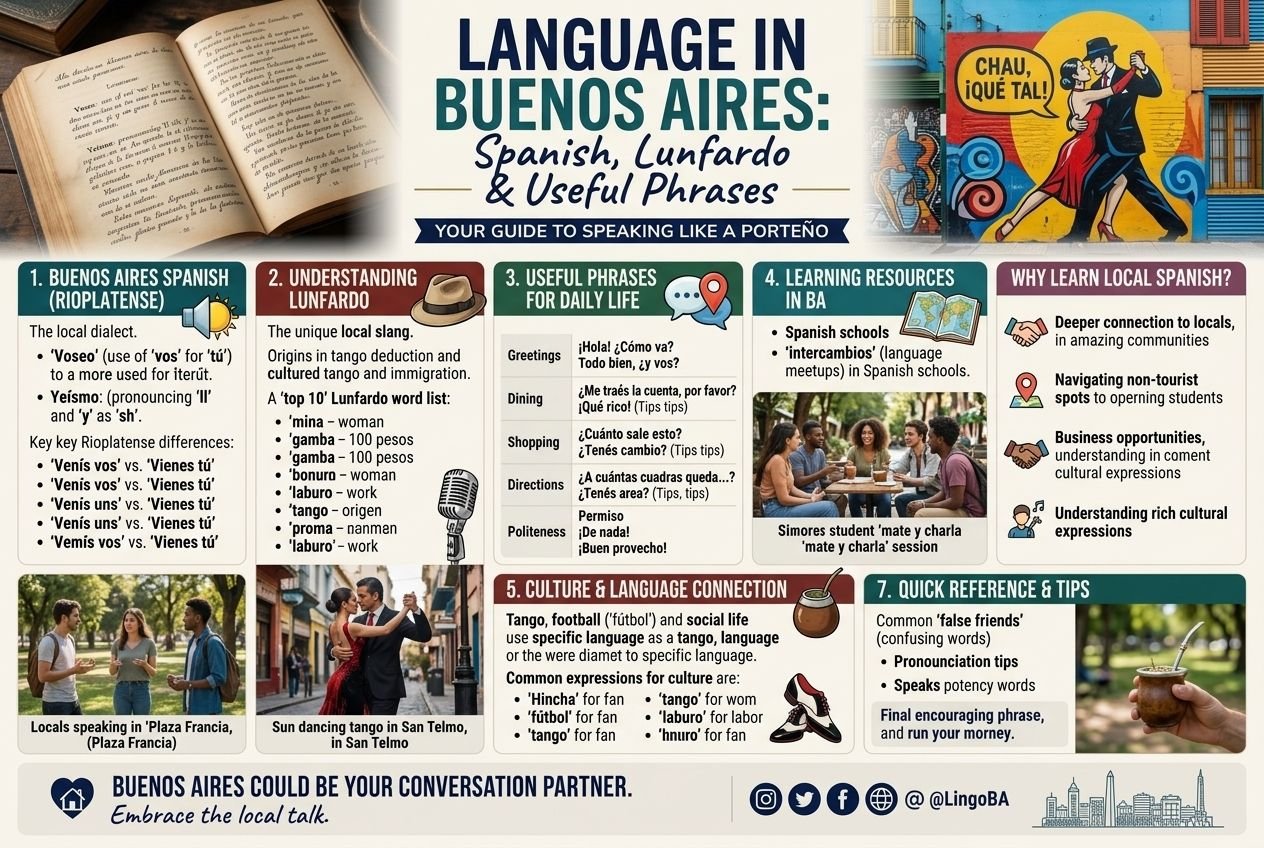
Spanish is the language of Buenos Aires, but it is a distinctive dialect, and understanding a little of what makes it distinctive will genuinely improve your visit, beyond the practical value of a few useful phrases.
Rioplatense Spanish: What Makes It Different
Argentine Spanish, more specifically the Rioplatense dialect spoken in Buenos Aires and along the Río de la Plata, differs from the Spanish taught in most language courses (which usually teaches a more neutral or Mexican/Iberian standard) in a few noticeable ways.
Voseo: Argentines use “vos” instead of “tú” for the informal second person, with its own distinct verb conjugation (vos tenés rather than tú tienes, vos sos rather than tú eres). This is the single biggest adjustment for visitors who learned Spanish elsewhere, though porteños are entirely used to hearing tú from foreigners and will understand you regardless.
The “sh” sound: The double-L (ll) and the y are both pronounced as a “sh” sound in Rioplatense Spanish, so “yo” (I) sounds like “sho” and “calle” (street) sounds like “cashe.” This is one of the more immediately noticeable features of the accent to anyone who has studied Spanish elsewhere.
Italian influence: Buenos Aires’ huge nineteenth and twentieth-century Italian immigration left a lasting mark on both the accent (a distinctive sing-song intonation often compared to Italian) and the vocabulary.
Lunfardo
Lunfardo is the local slang, originally a working-class and somewhat underworld argot from the late nineteenth century that has since worked its way thoroughly into everyday porteño speech and, notably, into tango lyrics, which draw heavily on it. You will hear lunfardo constantly even in casual conversation: che (a general-purpose “hey” or “mate,” Argentina’s most famous verbal tic), laburo (work, from the Italian lavoro), pibe/piba (kid, guy/girl), and quilombo (a mess or chaotic situation, used constantly and about almost anything) are among the most common words a visitor will pick up quickly just from daily exposure.
Useful Phrases for Visitors
Greetings and basics: Hola (hello), buen día / buenos días (good morning), buenas tardes (good afternoon), buenas noches (good evening/night), por favor (please), gracias (thank you), de nada (you’re welcome), disculpe / perdón (excuse me).
Getting around: ¿Dónde está…? (where is…?), ¿Cuánto cuesta? (how much does it cost?), la cuenta, por favor (the bill, please), ¿Hablás inglés? (do you speak English? using the local vos form).
Food and drink: Una mesa para dos, por favor (a table for two, please), ¿Qué me recomendás? (what do you recommend?, again using vos), sin carne (without meat, useful for vegetarians navigating a very meat-forward food culture).
Emergencies: Ayuda (help), necesito un médico (I need a doctor), ¿dónde está el hospital más cercano? (where is the nearest hospital?).
How Much English Is Spoken
English proficiency in Buenos Aires is reasonably good in tourist-facing businesses, hotels, and among younger, more educated porteños, but it is far from universal, and it drops off quickly outside the main tourist neighbourhoods and among older generations. Taxi drivers, smaller neighbourhood shops, and government offices are the places you are most likely to need at least basic Spanish or a translation app.
Practical Tips
Download an offline translation app before your trip, since data connectivity can be patchy in some areas, and it is worth having a backup that doesn’t depend on a signal. Even a small effort with basic Spanish phrases is warmly received; Argentines are generally patient with visitors making an effort, considerably more so than the stereotype of impatience with language learners in some other destinations. Language exchange meetups are common and easy to find in Palermo for visitors on longer stays who want structured practice.
Learning Spanish While in Buenos Aires
Buenos Aires is a genuinely good city to study Spanish in for visitors on a longer stay, with a large, well-established Spanish-language school industry catering specifically to foreign students, ranging from intensive full-time immersion courses to casual evening classes designed to fit around remote work schedules. Group classes are generally inexpensive by international standards, and many schools specifically build in cultural programming, tango lessons, cooking classes, city tours conducted in Spanish, alongside the language instruction itself, which suits visitors who want language learning integrated into a broader cultural experience rather than delivered as a standalone academic exercise.
Private tutors are widely available and easy to find through the same expat community channels covered in our communities guide, and tend to be considerably more affordable than equivalent private tutoring in North America or Western Europe, making one-on-one instruction a realistic option even for visitors on a moderate budget.
Reading the City Through Its Language
Part of the pleasure of picking up even a little porteño Spanish is how much it opens up about the city’s own self-understanding. Tango lyrics, saturated in lunfardo, become newly comprehensible once you know a handful of the key terms; graffiti and street art, common throughout Palermo and San Telmo, frequently plays with local slang and political references that are invisible without at least basic vocabulary; and the particular warmth and directness of porteño conversational style, quick to use diminutives, quick to switch to vos with new acquaintances, becomes something you can actually participate in rather than just observe from outside.
A Final Note on Confidence
Visitors often hold back from using the Spanish they do have out of fear of getting the voseo conjugations wrong or mispronouncing the distinctive “sh” sounds. This concern is generally unwarranted: porteños are accustomed to visitors, understand tú-form Spanish from other dialects perfectly well, and are, on the whole, more encouraging of an honest effort with imperfect grammar than dismissive of it. The confidence to try, more than grammatical precision, is what actually improves both your experience and your Spanish over the course of a stay.
Related: Getting to Buenos Aires | Practical Info | Social Life & Integration