
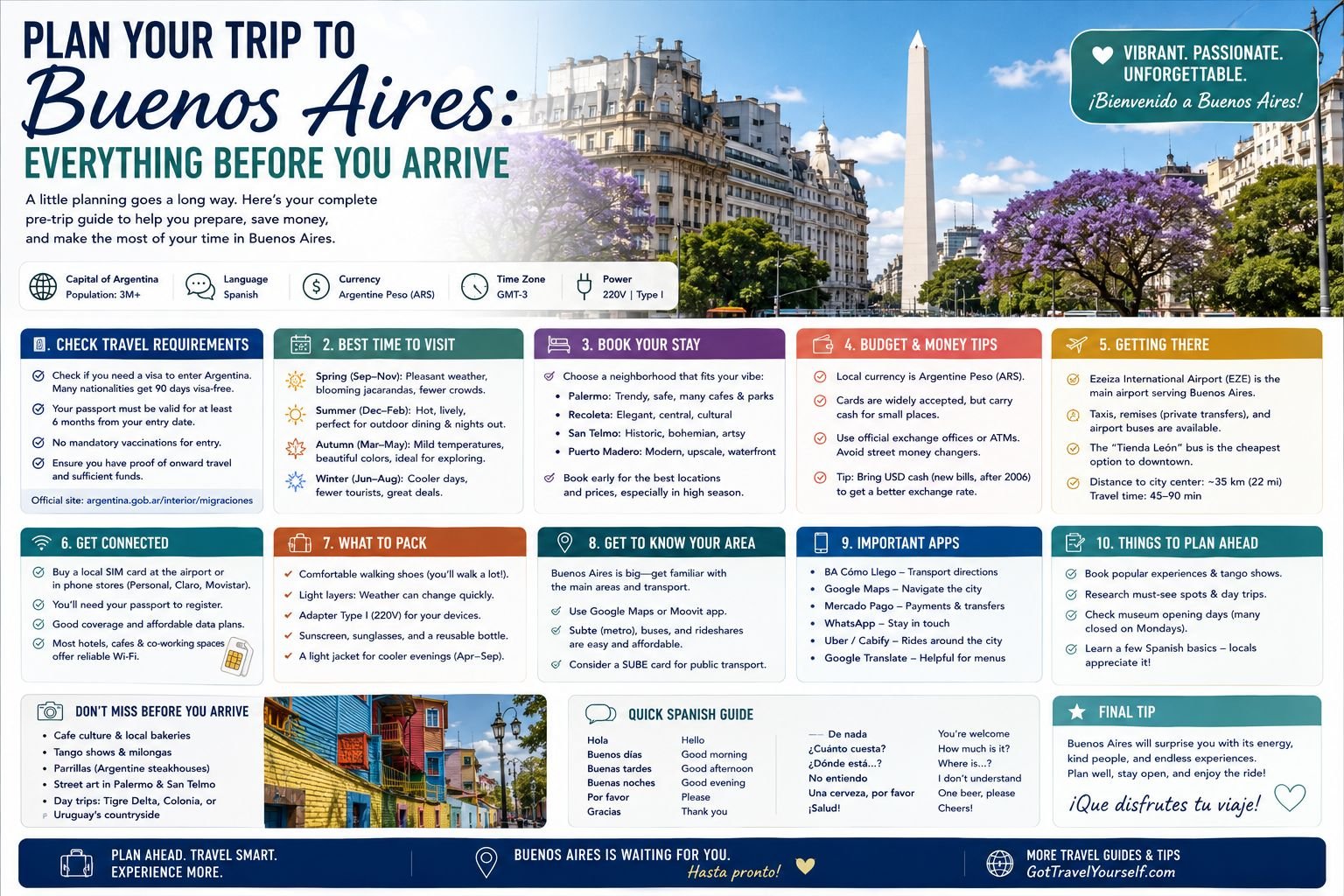
Planning a Buenos Aires trip well pays dividends throughout the visit. The city has a few genuine practical complexities, most notably the currency situation, that reward advance research and catch unprepared visitors off-guard in ways that cost them real money. Beyond the practical specifics, understanding what you are coming to, when to come, and how to structure your time produces a fundamentally better experience than arriving with enthusiasm and no framework.
This section covers everything you need to know and decide before you board the plane.
The Decisions to Make Before Anything Else
When to go. Buenos Aires has a real four-season climate, and the best time to visit depends on what you want from the trip. The short answer: spring (September to November) and autumn (March to May) offer the best balance of weather and city energy. Summer (December to February) is hot and humid; many Porteños leave the city in January for coastal resorts, which means some businesses close and the city has a different, slower character. Winter (June to August) is mild by European or North American standards (rarely below 5°C) and the city is fully operational.
The best time to visit guide covers every month in detail with specific weather data, what is happening culturally and socially, and who each month suits. If your dates are fixed, the relevant monthly guide will tell you exactly what to expect.
How long to stay. Buenos Aires is a city that improves with time. Three days gives you the highlights; a week gives you the beginning of genuine familiarity; two weeks or more lets you develop the kind of local knowledge (the best milanesa in your neighbourhood, the coffee shop where the owner learns your name) that makes any city really open up. The how many days guide provides specific itinerary frameworks for stays of different lengths.
Do you need a visa? Most Western passport holders enter Argentina visa-free for 90 days as tourists. Citizens of some countries need to apply in advance or pay a reciprocity fee. The visas guide covers all major nationalities and the current entry requirements.
The Money Situation: Read This Before Anything Else
Argentina’s currency situation is unusual and genuinely important to understand before you arrive. The Argentine peso has experienced significant inflation and devaluation over recent years, and this has produced a system with multiple exchange rates operating simultaneously.
The officially recommended tourist exchange rate, available through legal mechanisms including the tourist card program and certain exchange services, is significantly better than the official rate you would get at a bank. Understanding how to access this rate legally, and how to manage your spending to take advantage of it, can save you a very meaningful amount of money on a typical visit.
The travel costs and budget guide covers daily cost benchmarks, the exchange rate situation in practical terms, and how to budget realistically. This is the guide that requires the most attention before your visit.
Getting the Timing Right
Buenos Aires has a genuine cultural calendar that is worth aligning with if your dates are at all flexible. Key events and periods:
Buenos Aires Tango Festival (August): The world’s premier tango event, bringing international dancers and filling the city’s milongas with extraordinary performances. If tango is a reason you are coming, August is the best month.
BAFICI (Buenos Aires Festival Internacional de Cine Independiente, April): The largest film festival in Latin America, with screenings across the city.
Carnival (February): Argentine carnival is less spectacular than Brazil’s but has its own character; Buenos Aires neighbourhood murgas (neighbourhood carnival troupes) parade through the barrios.
National holidays: Argentina has a full calendar of national holidays when many businesses close and the city shifts character. The monthly visitor guides note the relevant holidays for each month.
Summer exodus (January): A significant proportion of middle-class Porteños leave the city in January for Mar del Plata and other coastal resorts. The city is quieter, some restaurants and businesses close for the month, and hotel prices are lower.
Building Your Itinerary
Buenos Aires rewards a different pace from most European city-break itineraries. The city is very large (the metropolitan area has 15 million people, though the inner city is manageable), the evenings start late and go very long, and the best experiences are often the ones that were not planned, the afternoon that turned into a neighbourhood wander, the lunch that became a three-hour meal.
A well-structured Buenos Aires itinerary allocates:
Dedicated neighbourhood time: Rather than trying to see every barrio briefly, spending two or three half-days getting genuinely familiar with one or two neighbourhoods produces better results. Palermo, San Telmo, and Recoleta each warrant at least a half-day of unhurried exploration. The neighborhood guides cover each barrio specifically.
Evening flexibility: Buenos Aires evening life operates on a schedule that most visitors initially find disorienting. Dinner before 9pm is unusual; restaurants fill up between 9pm and midnight. If you plan to experience the city’s food culture properly, build this into your schedule rather than fighting it.
At least one tango evening: Whether a show or a milonga, experiencing tango in some form is essential. The tango shows guide and the milongas guide cover the full range of options.
A day trip: Buenos Aires is within a day’s travel of some genuinely exceptional experiences: Colonia del Sacramento in Uruguay (a ferry ride away, UNESCO heritage town), the Tigre Delta (river islands just north of the city), and the gaucho heartland of the Pampas. The day trips guide covers all the main options.
The 3-day itinerary, 5-day itinerary, and one-week itinerary provide complete day-by-day frameworks that can be used as-is or adapted.
Packing
Buenos Aires has a temperate climate with four distinct seasons. Packing for it is straightforward compared to tropical destinations, but a few specific considerations:
Plug adapters: Argentina uses Type I plugs (the three flat angled pins, same as Australia and New Zealand), different from European and American standards. Bring an adapter.
Dress code: Porteños dress well for evenings out. If you plan to attend tango shows, nicer restaurants, or evening events, packing at least one smart outfit is worthwhile. Many show venues have a smart casual dress code.
Medications: Bring an adequate supply of any prescription medications, as finding exact equivalents can be complicated.
The packing guide covers the seasonal specifics and the specific items worth bringing for a Buenos Aires trip.
What Is in This Section
- Best time to visit with monthly guides for every month of the year
- How many days do you need? with itinerary frameworks for different trip lengths
- Visa and entry requirements for all major nationalities
- Travel costs and daily budget including the exchange rate situation
- 3-day itinerary
- 5-day itinerary
- One-week itinerary
- Packing guide
Related: Neighborhoods | Practical Info | Things to Do | Food and Drink
The Planning Mindset for Buenos Aires
Buenos Aires rewards a different planning approach from a tightly-scheduled European city break. The city functions at its own pace, which is slower than most visitors initially expect and more rewarding when accepted than when resisted. The most useful planning habit for Buenos Aires is to plan the things that genuinely benefit from advance planning (tango shows, the Colonia ferry, the best parrilla reservations) and to leave the rest open to the city’s own rhythms.
The specific things that benefit from advance planning:
Tango shows fill up, particularly in peak season (December to February, August). Booking before you arrive, not on arrival day, is the correct approach for the best venues.
Don Julio parrilla in Palermo is the most celebrated of the city’s steakhouses on international lists and requires reservation weeks in advance for weekend evenings. This is worth booking from home if a world-class parrilla experience is a priority.
Colonia del Sacramento ferry should be booked both ways when you make the initial reservation; weekend ferries fill up, and arriving in Colonia without a return booking is a unnecessary complication.
Accommodation in August: The tango festival in August creates demand spikes for accommodation in the main tourist barrios; booking well in advance for August travel is particularly important.
Everything else in Buenos Aires, the restaurants, the milongas, the day trips to Tigre, the museum visits, the Sunday market, works well on a same-day or walk-in basis. The city is large, well-supplied, and generally forgiving of spontaneity.
A Note on Buenos Aires Information Currency
Buenos Aires information goes stale faster than information about more economically stable cities. The exchange rate situation, restaurant openings and closings, accommodation prices, and entry requirements all change more frequently here than in most Western tourist destinations. This guide provides current information at the time of writing; for anything with a direct financial implication (exchange rates, prices, visa fees), verifying the current position from primary sources (government websites, current traveller forums, the monthly visitor guides in this section) before travel produces more reliable information than any guide written months before your departure.