
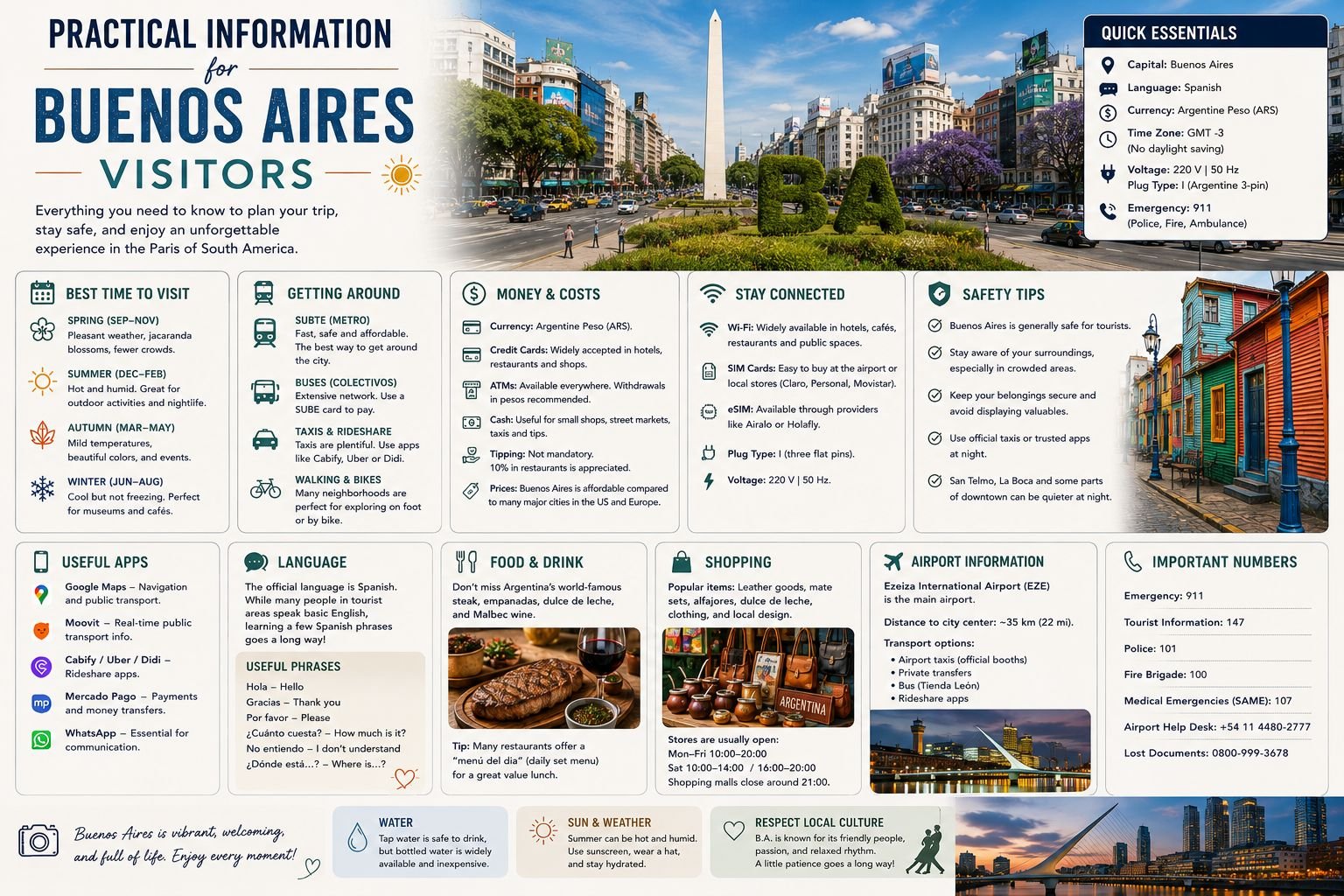
Buenos Aires has a handful of specific practical considerations that are more complex than in most Western destinations. The currency situation, in particular, is genuinely unusual and has a meaningful impact on how much your visit costs. Understanding the key practical points before you arrive makes everything significantly easier.
This section covers everything you need to navigate Buenos Aires successfully: getting there and around, managing money, staying safe, and the everyday logistics that catch unprepared visitors off-guard.
The Most Important Practical Information
Money and the exchange rate: The single most important practical thing to understand before arriving in Buenos Aires. Argentina has a dual exchange rate system; the rate available to tourists through legitimate channels is significantly better than the official bank rate. Knowing how to access this rate legally can save you 40 to 70 percent on your spending. The money guide and the blue dollar guide cover this in detail. Read these before you travel.
Airports: Buenos Aires is served by two airports. Ezeiza (EZE) is the international airport, 35km from the city centre. Aeroparque Jorge Newbery (AEP) is the domestic airport, 7km from Palermo. Understanding which airport you are arriving at and the best options for getting to the city is the first practical question to resolve. The airports guide covers both.
Safety: Buenos Aires is broadly safe for tourists by South American city standards, but requires basic urban awareness. Petty theft in tourist areas and around transport hubs is the primary risk; specific scams target visitors in predictable ways. The safety guide and the scams guide cover the specific situations to be aware of.
The Buenos Aires Transport System
Subte (metro): Buenos Aires has six metro lines (A, B, C, D, E, and H) running through the city. The Subte is fast, cheap, and generally reliable; it is the best way to cover longer distances within the city. Lines run from approximately 5am to around 11pm or midnight (later on Fridays and Saturdays). Fare payment is by SUBE card, a rechargeable transit card available at kiosks throughout the city.
Colectivos (buses): An extensive bus network covers the entire city and operates 24 hours. The colectivos are cheap (under USD 1 per journey) and cover areas the Subte does not. Navigation is easiest with the Moovit app or Google Maps, both of which show bus routes and real-time positions.
Taxis: Buenos Aires’ taxis (black with yellow roofs) are metered and generally honest. The fare starts when you enter the taxi and the meter runs; ensure the meter is started at the beginning of the journey. Radiotaxis (those called by phone or app) are slightly more reliable than flagged street taxis.
Uber and Cabify: Both operate in Buenos Aires. Uber operated in a legal grey area for several years but is now normalised and widely used. Payment by card or cash is possible. The app-based services offer the advantage of pre-set pricing and no need for cash.
Electricity and Connectivity
Plugs: Argentina uses Type I outlets (three flat angled pins, the same as Australia and New Zealand). EU, UK, and US plugs require adapters. Voltage is 220V; most modern electronics (phones, laptops, camera chargers) accept 100-240V and require only an adapter, not a converter.
Internet and SIM cards: Buenos Aires has widespread Wi-Fi in cafés, restaurants, and most accommodation. For mobile data, Argentine SIM cards from operators Claro, Personal, and Movistar are available at airports and shops throughout the city; registration requires a passport. Tourist SIM packages are available with data included. The SIM cards guide covers the options.
Language
Spanish is the official language, and the Buenos Aires variant (Rioplatense Spanish) has specific features worth knowing. The most distinctive is the use of vos instead of tú for the second person singular, with different verb conjugations. If you have learned Spanish elsewhere, you will be understood; the local version will take some adjustment.
English is widely understood in hotels, tourist-facing restaurants, and by younger Porteños in service roles. Away from these contexts, Spanish is required; having a translation app ready is advisable.
The language guide covers the most useful phrases for a Buenos Aires visit.
What Is in This Section
- Getting to Buenos Aires — flights, airports, and arrival
- Airports guide — Ezeiza vs Aeroparque, which to use
- Getting from Ezeiza to the city — all transfer options with current prices
- Getting around Buenos Aires — Subte, buses, taxis, and apps
- Money and exchange rates — the essential currency guide
- The blue dollar explained — what it is and why to avoid it
- Safety guide — honest assessment of risks and how to manage them
- Common scams — the tricks used on tourists and how to recognise them
- SIM cards and internet — staying connected
Related: Plan Your Trip | Neighborhoods | Expat and Nomad | Things to Do
Argentine Time and the Adjustment Required
One practical cultural note that does not fit neatly into any single category but affects daily navigation: Argentina operates on its own time logic. Meetings start 15 to 20 minutes after the stated time as a matter of course; restaurants fill up 90 minutes later than in most European countries; the social evening starts when most visitors are thinking about going to bed.
This is not disorganisation; it is a different relationship with time that is consistent and, once internalised, entirely navigable. The adjustment required is mental rather than logistical: accepting that dinner at “9pm” means arriving at 9pm and eating at 10pm, that a meeting at “3pm” means starting at 3:15 to 3:30, and that nothing social in Buenos Aires begins punctually by the standards of Northern European or North American time culture.
For the practical daily schedule, this means: do not book a tango show starting at 8pm and plan to be hungry for dinner after; do not schedule early morning meetings immediately after a night at a milonga; and do not interpret a Buenos Aires invitation to “come over any time in the afternoon” as permission to arrive at 2pm.
Emergency and Useful Numbers
Police: 911 (national emergency number covering police, fire, and ambulance)
Ambulance (SAME): 107 (Buenos Aires metropolitan medical emergency service)
Tourist Police (Comisaría del Turista): Located at Avenida Corrientes 436; handles tourist-related crime reports in English and other languages
Fire: 100
Gas emergencies: 104
Keep these numbers saved in your phone before you need them.
Practical preparation for Buenos Aires, properly done, requires a few hours of advance research and produces significant benefits throughout the visit. The currency situation, the transport system, the safety considerations, and the entry requirements are all manageable topics that reward advance attention. Arriving in Buenos Aires already oriented to these practical realities means your first hours in the city are spent engaging with it rather than figuring out the basics.
A Final Note
Buenos Aires rewards visitors who arrive prepared and remain open. The practical preparation covered in this guide removes the friction that prevents engagement; the openness is yours to bring. The city that reveals itself to a visitor who knows what they are looking for, who has sorted the practical foundations, and who has the curiosity to follow what the city offers is one of the genuinely great urban experiences available anywhere in the world.
For questions, corrections, or feedback on this guide, the contact page is the right place. This site is updated regularly; if you visit Buenos Aires and find that conditions have changed from what this guide describes, telling us makes the guide better for the next reader.
Buenos Aires practical preparation, done well, requires a few hours of research and produces consistent benefits throughout the visit. The exchange rate situation, the transport system, the entry requirements, the safety picture, and the connectivity situation are all manageable topics that reward advance attention. Arriving oriented to these practical realities means the energy that might otherwise go to logistics goes instead to experiencing the city.
Buenos Aires rewards the traveller who arrives prepared and remains curious. Every guide in this site is designed to remove the friction between arrival and genuine engagement with the city; the engagement itself is yours to pursue. The city is inexhaustible, genuinely warm, and consistently surprising even to those who have been here many times. Whatever brings you to Buenos Aires, whether a first visit, an extended stay, or the beginning of a longer Argentine chapter, the preparation this guide provides is the starting point. What comes next is the city’s contribution.
Buenos Aires is one of the great cities of South America and one of the most rewarding for visitors who approach it with good preparation and genuine curiosity. The specific combination of European-influenced culture, Argentine character, extraordinary food and wine, and a social warmth that is entirely its own makes it unlike any other city in the world. Whatever aspect of the city this guide covers, it is one part of a whole that is considerably greater than its components.